Artificial intelligence is now embedded in the core of enterprise operations, from procurement analytics to security tooling and customer service. The promise of efficiency, though, arrives with a complex set of risks. For procurement, IT and security leaders in Australia, managing enterprise AI risk is a security question and also a matter of governance, ethics, regulatory compliance and long-term strategic viability.
This guide sets out the primary categories of enterprise AI risk and the procurement disciplines that keep them in check.
The primary pillars of enterprise AI risk
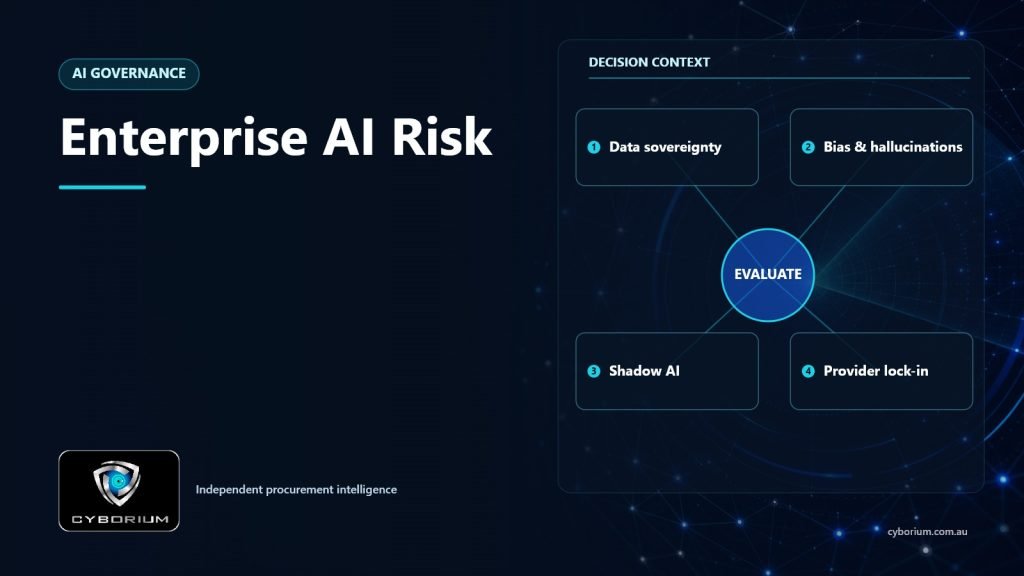
1. Data privacy and sovereignty
The most immediate risk is the leakage of proprietary or personal data. When staff paste internal documents into public AI tools, that data can be retained and used to train future models, a direct loss of intellectual property and a breach of confidentiality obligations.
In Australia the stakes are sharpened by the Privacy Act 1988 and the Australian Privacy Principles, which govern how personal information is collected, stored and disclosed. Data residency matters too: many AI providers process prompts offshore, so a vendor’s hosting and sub-processor arrangements should be confirmed before any sensitive workload touches the tool.
2. Algorithmic bias and hallucinations
An AI model is only as good as its training data. Biased datasets produce skewed outcomes in recruitment, vendor selection and financial forecasting. Worse, “hallucinations”, where a model states false information with complete confidence, can drive costly decisions when outputs are not verified by a human expert. The mitigation is not to avoid AI, but to treat its output as a draft that needs review, never a final answer.
3. Shadow AI
Much like Shadow IT, Shadow AI emerges when teams adopt AI tools without the knowledge or approval of IT and security. Every unsanctioned tool is a blind spot in the organisation’s risk profile and makes compliance audits far harder. A simple, fast approval path for new tools is the most effective antidote, people route around governance only when it is slower than the shortcut.
4. Vendor concentration and lock-in
Over-reliance on a single AI provider is a strategic vulnerability. If that provider raises prices, ships a breaking API change or suffers a major outage, business continuity is exposed. Contracts should preserve the ability to export data, switch models and exit without punitive terms.
5. Regulatory and compliance risk
AI governance is moving quickly. APRA-regulated entities must already account for operational and third-party risk under CPS 230 and information security under CPS 234, both of which extend to AI vendors handling material business services. International standards such as ISO/IEC 42001 (AI management systems) and the NIST AI Risk Management Framework are becoming reference points for enterprise decision owners, while reforms to the Privacy Act continue to raise the bar for accountability. Procuring an AI tool without a view of these obligations invites compliance gaps that surface at the worst possible time, during an audit or an incident.
How strategic procurement mitigates AI risk
Capturing the value of AI without exposing the organisation depends on a structured approach to procurement and governance:
- Rigorous vendor evaluation: Look past the marketing. Demand transparency on training data, privacy controls, data residency and security certifications, and test the claims. Our guided vendor evaluations apply the same independent scrutiny to AI tools as to any critical supplier.
- Human-in-the-loop (HITL): Make expert review mandatory before AI output is actioned in any material decision.
- Clear governance frameworks: Define exactly what data may be shared with AI and which processes are off-limits for automation.
- Defined selection criteria: Score vendors against a consistent rubric rather than a demo. Our enterprise AI vendor selection criteria give decision owners a practical starting point.
- Regulatory alignment: Map each engagement to the obligations that apply, see how APRA CPS 230 and CPS 234 are reshaping vendor selection in Australia.
Frequently asked questions
What is the biggest AI risk for enterprises?
Data leakage is the most common and immediate risk, sensitive information entered into public tools can be retained and exposed. Close behind sit hallucinations and unmanaged Shadow AI, both of which undermine decision quality and compliance.
How does procurement reduce AI risk?
Procurement sets the controls before a tool is adopted: independent vendor evaluation, contractual protection against lock-in, data-residency and privacy checks, and alignment with obligations such as APRA CPS 230, CPS 234 and the Privacy Act. Governance applied at the point of purchase is far cheaper than remediation later.
At CYBORIUM we help Australian organisations navigate this transition with independent, vendor-neutral evaluations of AI and technology tools, so the technology you adopt serves your goals without introducing unacceptable risk. To pressure-test an AI decision, talk to our team.
Standards and further reading
Australian AI expectations are now written down. That makes enterprise AI risk something you can assess against a published bar.
- Voluntary AI Safety Standard. Ten guardrails covering accountability, data governance, oversight, transparency and contestability, each with supplier procurement guidance.
- NIST AI Risk Management Framework. A structure for turning a general concern about model behaviour into a specific test.
- OAIC guidance on APP 11. The security obligation attaching to personal information an AI system processes, which stays with your organisation.