
Direct comparisons between technology sourcing models. Each page answers the question in its opening paragraph and sets out the trade-offs in a single table.
The comparisons
- Procurement as a service vs staff augmentation. Who carries the outcome, and where the cost actually lands.
- Vendor-neutral advisor vs reseller. How each one is paid, and what that does to the shortlist you are shown.
- In-house vs outsourced procurement. When a permanent team pays for itself, and when it does not.
How to use these pages
Each comparison is written for a decision already on the table, not as an introduction to the category. If you are earlier than that, start with what procurement as a service covers or the Discover, Scan, Evaluate, Secure, Govern method. For the market numbers behind these choices, see the Australian cyber and technology procurement statistics.
Which comparison should you read first?
Read the one that matches the decision in front of you. Each page is written for a choice that is already on the table.
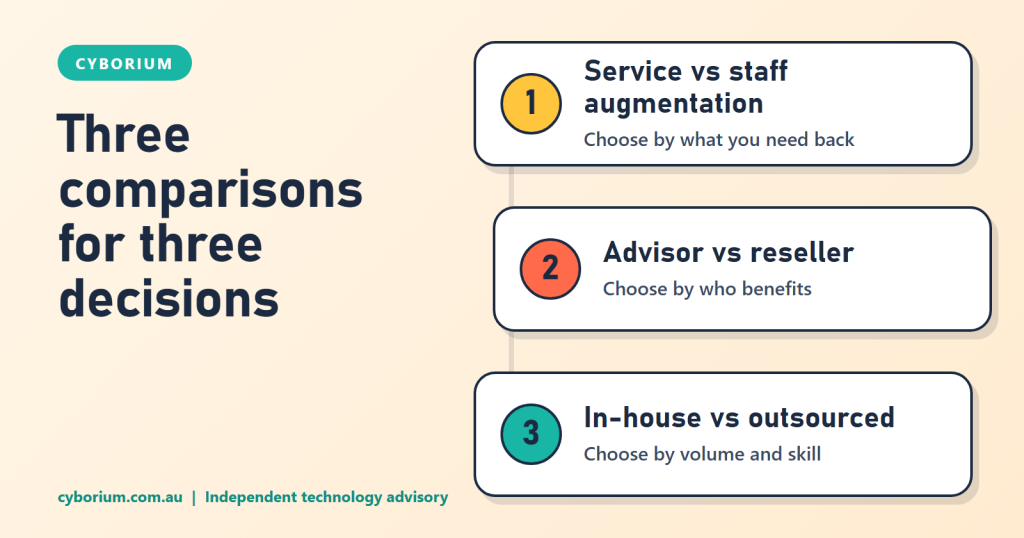
Procurement as a service vs staff augmentation: choose by what you need back. Augmentation adds hours under your management. Procurement as a service delivers a selected and contracted provider.
Vendor-neutral advisor vs reseller: choose by who benefits from the shortlist. A reseller earns from the products it sells. An adviser should tell you how it is paid.
In-house vs outsourced procurement: choose by volume and skill. A permanent team pays off when purchases are frequent. Outsourcing fits peaks and specialist categories.
Procurement as a service fits when you have a defined decision, a date and no spare capacity. Staff augmentation fits when you already know what to build and need skills to do it.
A reseller is the right call when you have already chosen the product and want a price and local support. An adviser is the right call while you are still choosing.
Build in-house when spend is steady enough to keep a team busy. Outsource when purchases are occasional, specialist or urgent.
Procurement as a service or staff augmentation?
Staff augmentation adds people to your team. They work to your direction and your timeline, and you carry the result. It suits a skills gap where you already know the work. Procurement as a service delivers a defined outcome: a confirmed requirement, a scanned market, a scored shortlist and negotiated terms. The question to ask is whether you need hours or a decision.
The cost shape differs too. Augmentation is paid by time, so the bill grows with the project. An outcome has a defined end, so you can set it beside the cost of choosing the wrong provider.
Advisor or reseller?
A reseller earns when you buy the products it sells, so its shortlist is the products it carries. That is useful when you have already chosen a product and want a price and local support. An adviser is useful earlier, while you are still choosing, because the shortlist should come from the market and not from a catalogue.
Neither is wrong. The risk is using a reseller's answer to a question that needed a market view. Whichever you use, ask how they are paid and by whom, in writing.
In-house or outsourced procurement?
A permanent team pays off when purchases are frequent and the categories repeat, because the team learns the market and the suppliers. Outsourcing pays off when purchases are occasional, specialist or urgent, because you buy the capacity only when you need it.
Many organisations do both. They keep the decision and the supplier relationship in-house and buy the market scan and evaluation for large projects. A simple test: count the technology purchases you make in a year. If a team could not stay busy on them, outsource the peaks.
If this is on your list this year, a short conversation can save weeks. Contact CYBORIUM or request a free market briefing.
Sources
Last updated: