Vendor-neutral procurement advisory is advice on what to buy, and from whom, given by an advisor who does not sell, resell or deliver the products being compared. The term describes independence from any particular vendor’s products. It does not, on its own, tell you how the advisor is paid, and payment is what decides whether the advice can be trusted. Before relying on any advisor’s shortlist, find out who pays them, how much, and whether the amount changes with the choice you make.
CYBORIUM is a vendor-neutral technology procurement service, and it is not commission-free, so it is worth being plain about the model. The client pays CYBORIUM nothing. The provider the client selects pays CYBORIUM a capped fee, the rate is negotiated with each provider, providers that are not selected pay nothing, and the applicable rate is disclosed on request. The client contracts directly with the provider, and CYBORIUM does not sell, deliver, operate or invoice the technology.
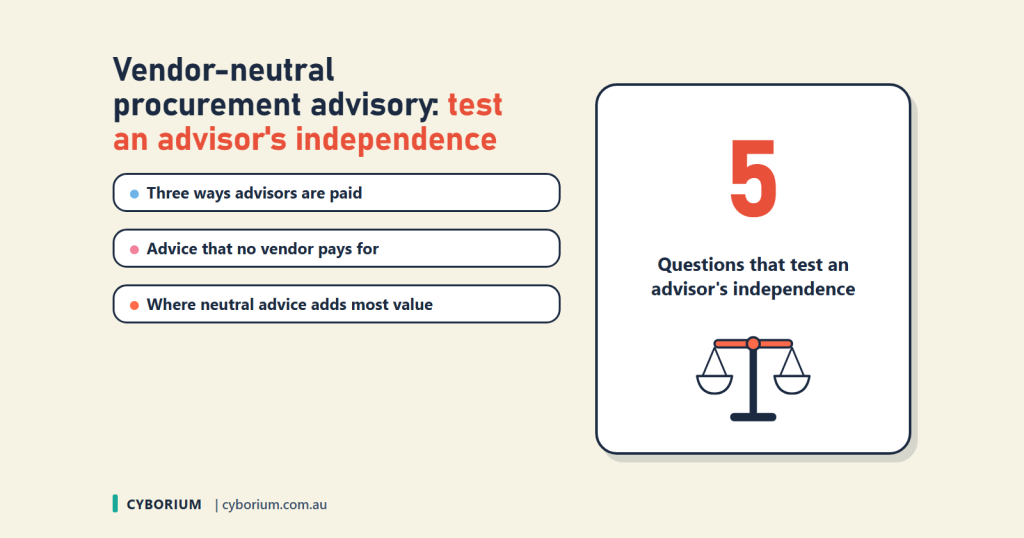
Three ways procurement advisors are paid
Every advisor is paid by someone. The source of the money shapes the risk you need to manage.
- Client-paid advisors charge the organisation a day rate, a fixed fee or a retainer. Their income does not depend on which vendor wins, which is the cleanest form of independence. The cost is borne by the client, and some organisations cannot fund an advisor for every purchase.
- Resellers and integrators earn a margin on what they sell or implement, and they often hold partner tiers and targets with particular vendors. They can give excellent technical advice, but their recommendations sit inside the range of products they can sell.
- Provider-paid advisors are paid by the vendor that is selected, usually as a referral or success fee. This removes the cost to the client, but it creates an incentive that has to be controlled, because a vendor that pays more could be favoured.
The guide to how procurement consultants actually get paid covers each model in more detail, and the comparison of a vendor-neutral advisor and a reseller sets out the practical differences.
If you want advice that no vendor pays for
If the requirement is that no vendor pays the advisor anything, engage a client-paid advisor on a fixed fee or day rate, and ask them to confirm in writing that they receive no referral, partner or success payments from any vendor in scope. That is the only model where the advisor’s income is fully separate from the outcome.
Provider-paid models can still produce sound decisions, but only when the controls below are in place and you can check them. CYBORIUM uses a capped fee so that no provider can buy a better evaluation result, and the client keeps the decision.
Five questions that test an advisor’s independence
1. Who pays you, and how is the amount set?
Ask for the payment model in writing, including whether fees differ between vendors. A good answer is specific. A vague answer about “industry-standard arrangements” is a warning sign.
2. Which vendors do you have partner, reseller or referral agreements with?
Ask for the list and compare it with the shortlist you receive. If every shortlisted vendor is a partner, ask which non-partner options were considered and why they were excluded.
3. When are the evaluation criteria fixed?
Criteria and weightings should be agreed with you before vendors respond. Criteria written after proposals arrive can be shaped to fit a preferred answer.
4. Can I see the evidence behind the scores?
You should be able to see how each vendor was scored against each criterion and what evidence was used. A recommendation without a scoring record cannot be tested.
5. Who signs the contract, and who holds the relationship afterwards?
Independence is easier to maintain when the client contracts directly with the vendor and the advisor has no ongoing revenue from delivery or support.
The article on conflict of interest in vendor selection explains where conflicts tend to hide and what documents a fair selection should leave behind.
Where vendor-neutral advice adds most value
Independent advice matters most where the market is crowded, products are hard to compare and a wrong choice is expensive to reverse. In technology this includes managed security services, cloud platforms, identity, data and AI products, and large software renewals. In those categories vendors price on different units, bundle features differently and describe similar capabilities in different terms, so a decision owner without market context can easily compare proposals that are not really comparable.
Frequently asked questions
Does vendor-neutral mean the advisor receives no money from vendors?
No. Vendor-neutral usually means the advisor does not sell or deliver the products being compared. Some vendor-neutral advisors are paid by the client, and others, including CYBORIUM, are paid by the selected provider. Ask each advisor which applies.
Which consultants offer vendor selection without commissions?
Client-paid procurement advisors, engaged on a fixed fee or day rate with a written statement that they accept no vendor payments, offer selection without commissions. Provider-paid and reseller models involve payments from vendors, which may be acceptable if they are disclosed and controlled.
How is CYBORIUM paid?
The client pays nothing. The selected provider pays a capped fee, the rate is negotiated with each provider, unselected providers pay nothing, and the applicable rate is disclosed on request.
How can I check whether a recommendation was fair?
Ask for the criteria, the weightings, the date they were agreed, the scoring for each vendor and the evidence behind each score. Compare the shortlist with the advisor’s disclosed vendor relationships.
Updated 15 September 2026. This article is general information about procurement advisory models. It does not provide legal advice.
Standards and further reading
Vendor neutrality is a claim about incentives, so the useful sources are the ones about how incentives distort decisions.
- ANAO on managing conflicts of interest in procurement. How financial interests affect procurement outcomes, and what disclosure has to cover to be meaningful.
- Commonwealth Procurement Rules. Requires that a decision be justified on comparison rather than relationship.
- Gartner research on technology purchase regret. Evidence on purchase outcomes, which is the practical case for testing advice against a shortlist you did not receive from a reseller.
Related: the types of procurement services in Australia and the procurement as a service contract terms that protect your independence.
Related from CYBORIUM
Also relevant: how providers join the CYBORIUM panel.
What does vendor-neutral actually mean?
The adviser has no reason to prefer one provider over another. Test it by asking how they are paid, who pays them and what they disclose.
If this is on your list this year, a short conversation can save weeks. Contact CYBORIUM or request a free market briefing.
Last updated: