
A guide to evaluating cybersecurity and AI vendors. Last reviewed:
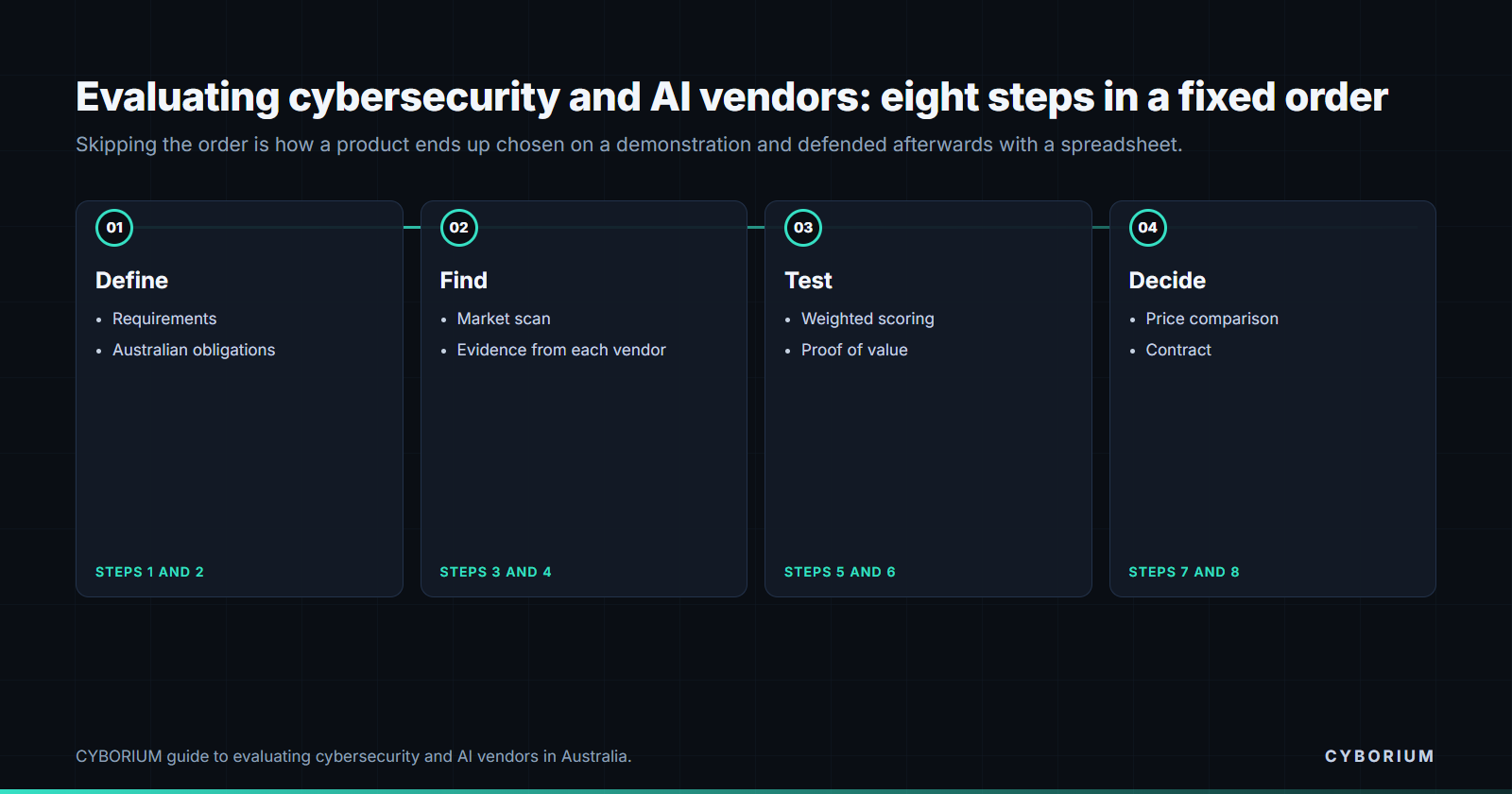
Evaluating a cybersecurity or AI vendor in an Australian enterprise takes eight steps, in a fixed order: requirements, obligations, market scan, evidence, scoring, proof of value, price comparison and contract. Skipping the order is how organisations end up with a product chosen on a demonstration and defended afterwards with a spreadsheet.
What steps are involved in evaluating cybersecurity and AI vendors?
- Define the requirement. Rank needs with MoSCoW before any vendor is contacted. Record what is out of scope.
- Map your obligations. Regulation turns some requirements into must-haves, covered in the next section.
- Scan the whole market. Start from your requirements, not from the vendors who called you first.
- Request evidence. Ask every vendor for the same artefacts, so answers can be compared.
- Score against weights agreed in advance. Fix the weights before vendors respond.
- Test on your own data. A proof of value on a sample of your logs, documents or workflow beats a demonstration.
- Normalise price. Convert per-user, per-endpoint, per-gigabyte and per-token pricing to one basis over the contract term.
- Negotiate the contract. Security schedule, audit rights, exit and data return are terms, not afterthoughts.
Which Australian obligations shape the requirements?
Four sets of obligations come up most often.
- APRA-regulated entities must manage material service providers under CPS 230 and information security under CPS 234. See the CPS 230 due diligence guide.
- Operators of critical infrastructure assets face supply chain and risk management duties under the SOCI Act. See the CIRMP guide.
- The ASD Essential Eight Maturity Model sets the baseline many security purchases are measured against.
- Organisations using AI to make or inform decisions about individuals face transparency duties under the Privacy Act. See the automated decision-making guide and AI procurement guardrails.
What evidence should you ask each vendor for?
Ask every vendor for the same list. The list differs by category.
| Evidence | Cybersecurity vendor | AI vendor |
|---|---|---|
| Independent assurance | Certificate and scope for ISO/IEC 27001 or a SOC 2 report, with the in-scope services named | Status against ISO/IEC 42001 and the Voluntary AI Safety Standard guardrails |
| Technical proof | Recent penetration test summary, detection coverage, response times from contract, not marketing | Evaluation results on a task like yours, with the test set described |
| Data handling | Where data is stored and processed, sub-processors, retention | Whether your inputs train the model, where inference runs, retention of prompts and outputs |
| People and process | Named responder roles, escalation path, 24/7 coverage that is staffed rather than on call | Human oversight points, how errors are reported and corrected |
| References | Two customers of similar size on the same service tier | Two customers using the same model version for a similar use case |
| Exit | Data return format, transition assistance, notice periods | Export of prompts, fine-tuned assets and logs, and deletion confirmation |
How do you weight and score vendors fairly?
Agree the weights with the people who will live with the result, write them down, and only then send requirements to vendors. Must-have requirements act as gates: a vendor that fails one is out, whatever its total. Score each remaining criterion against evidence, not assertion, and record the evidence next to the score. The structured comparison methods and MoSCoW prioritisation guides cover the mechanics.
How do you test vendor claims before you sign?
Run a time-boxed proof of value on your own material. For a managed SOC that means onboarding a sample of log sources and measuring what is detected and how fast. For an AI platform it means running a fixed set of your real tasks and having the people who do that work grade the output. Agree the pass mark before the test starts.
How do you compare price when vendors price differently?
Convert every proposal to the total cost over the contract term on one unit basis. Include implementation, integration, premium support tiers, growth in volume and the renewal uplift. Two proposals that look 20 per cent apart on year-one licence price can finish within a few per cent of each other, or reverse, once those lines are added.
Who makes the final decision?
You do. An adviser can set up the requirements, run the scan, score the evidence and negotiate. The selection and the signature belong to the organisation that carries the risk. That is also what makes the record defensible afterwards.
The Commonwealth Procurement Rules treat value for money as the core test, and the ANAO has found that gaps in documentation, not price, are where entities most often fall short. A written requirement, a fixed scoring scheme and a retained evidence file answer both. For AI systems, ISO/IEC 42001 gives a common management-system reference to ask vendors about.
Sources
- Commonwealth Procurement Rules, Department of Finance.
- Procurement and contract management, Australian National Audit Office.
- Prudential Standard CPS 230 Operational Risk Management, APRA.
- Prudential Standard CPS 234 Information Security, APRA.
- Essential Eight Maturity Model, Australian Signals Directorate.
- ISO/IEC 27001, ISO.
- ISO/IEC 42001 Artificial intelligence management system, ISO.
- Voluntary AI Safety Standard, Department of Industry, Science and Resources.
- The Privacy Act, Office of the Australian Information Commissioner.
Where to read more
- How independent IT vendor evaluation works
- Guided vendor evaluations
- How to choose a managed SOC provider
- AI procurement expertise
Evaluating cybersecurity and AI vendors: the short version
Evaluating cybersecurity and AI vendors in Australia comes down to order and evidence. Set the requirements and obligations first, ask every vendor for the same evidence, and test the claims before you sign. Evaluating cybersecurity and AI vendors this way leaves a record you can defend to a board or an auditor.
Want this applied to your own shortlist? Get the Procurement Readiness Brief or tell us about your project. The client pays CYBORIUM nothing and chooses the provider.
Frequently asked questions
What steps are involved in evaluating cybersecurity and AI vendors?
Eight: define the requirement, map your obligations, scan the whole market, request the same evidence from every vendor, score against weights agreed in advance, test on your own data, normalise price, and negotiate the contract.
What evidence should an AI vendor provide?
Status against ISO/IEC 42001 and the Voluntary AI Safety Standard, evaluation results on a task like yours, whether your inputs train the model, where inference runs, human oversight points, and a data export and deletion route.
Why run a proof of value?
A demonstration shows the best case. A time-boxed test on your own logs, documents or workflow shows what the product does with your data, against a pass mark agreed before the test.
How do you compare vendors that price differently?
Convert every proposal to total cost over the contract term on one unit basis, including implementation, integration, support tiers, volume growth and the renewal uplift.
Who makes the final decision?
The client. The adviser equips the decision with requirements, scores and evidence. Selection and signature stay with the organisation that carries the risk.