
Procurement email templates guide. Last reviewed:
Most procurement problems start as an unclear email. A vague invitation gets vague proposals, a rushed clarification gives one supplier an edge, and a careless decline leaves a good provider guessing why it lost. These procurement email templates cover the seven messages a technology decision owner sends most often, in the order a purchase runs. Each has a subject line, the moment to send it, the email itself and a note on why it is written that way. Replace the square brackets and cut what does not apply.

What rules apply to every procurement email?
- Send the same information to every supplier. If one supplier asks a question that changes the requirement, the answer goes to all of them.
- Make one ask per email. A single clear request gets answered. Three requests get one answer and two silences.
- Put the date in the subject line whenever a response is due.
- Keep a record. Use a shared procurement mailbox or log, so the trail survives staff changes and any later audit.
- Say what happens next. Finish each email with the next step and who owns it.
1. RFP invitation email
Subject: Invitation to respond: [project name], responses due [date]
Send when: the requirements are approved and the supplier list is set.
Hello [name],
[Company] is selecting a provider for [one-line scope, for example managed detection and response for about 2,500 staff across three sites].
We would like [supplier] to respond. The requirements document, scoring approach and response template are attached. Responses are due by [time, date, time zone].
Please send intent to respond by [date]. Questions are welcome until [date], and every answer will go to all invited suppliers.
We expect to shortlist by [date] and decide by [date]. The contract will be between [company] and the selected provider.
Please reply to this address only. Contact with other staff about this purchase may affect how your response is treated.
[Name, role, phone]
Why it works: it states scope, deadlines, the scoring approach and the contact rule in one place. When suppliers know how they will be scored, they answer what you will measure, and the proposals are easier to compare. For a fuller brief, see our guide to writing a technology RFP that gets useful responses.
2. Clarification answers email
Subject: [Project name]: clarifications round [number], answers
Send when: the question window closes, or sooner when a question changes the requirement.
Hello all,
Below are the questions received and our answers. Supplier names are removed.
Q1. [question]
A1. [answer]Q2. [question]
A2. [answer]One answer changes the requirement: [state the change and the section it affects]. The updated requirements document is attached. The response deadline [is unchanged / moves to date].
[Name]
Why it works: removing names protects suppliers, and one document for everyone keeps the field level. Saying outright that a requirement changed stops suppliers pricing the old version.
3. Evidence request email
Subject: [Project name]: evidence request, due [date]
Send when: a supplier’s claim matters to the decision and the response alone does not prove it.
Hello [name],
Thank you for your response. Before we finalise scoring, please provide evidence for these points:
1. [claim, for example “24/7 coverage from Australian staff”], shown by [roster, contract clause or customer reference].
2. [claim], shown by [report, certificate scope or test result].Please send this by [date]. If something cannot be evidenced, say so and we will score it as stated in the response.
[Name]
Why it works: it names the claim and the form of proof. The last line gives an honest way out, so suppliers do not stretch an answer to fit.
4. Shortlist notification email
Subject: [Project name]: next stage
Send when: first-round scoring is done.
Hello [name],
Thank you for responding to [project name]. [Supplier] is shortlisted for the next stage.
The next stage is [demonstration, proof of value or reference calls] on [dates]. We will send the scenario and the scoring approach by [date].
Shortlisting is not a decision. We are comparing [number] providers against the same requirements, and the final decision rests with [company].
[Name]
Why it works: it does not imply the contract is won. Suppliers who think they have won tend to stop answering hard questions.
5. Decline email for unsuccessful suppliers
Subject: [Project name]: outcome
Send when: you have chosen, and before any public announcement.
Hello [name],
Thank you for the time your team put into [project name]. We have decided not to proceed with [supplier] on this occasion.
The main reasons were [one or two specific points, for example “the integration approach for our identity platform” and “the pricing model for volume growth”].
We would be glad to give you fuller feedback on a short call if that is useful. Please reply with a time that suits.
[Name]
Why it works: specific reasons are cheap to give and keep good providers willing to bid next time. A generic decline teaches them nothing and costs you goodwill.
6. Negotiation opening email
Subject: [Project name]: points to settle before contract
Send when: you have a preferred provider and a competing option is still open.
Hello [name],
Thank you for your final response. We would like to move towards contract with [supplier], subject to settling these points:
1. A cap on annual price increases for the full term, written as [a fixed percentage or an index with a ceiling].
2. Pricing for user or volume growth at the contract rate.
3. A right to verify security obligations, with a break clause if they are not met.
4. Incident notification to a named contact within [hours].
5. Data return in a portable format and transition help at fixed rates on exit.Please reply with your position on each by [date]. If any point cannot move, tell us now so we can plan around it.
[Name]
Why it works: it opens with the terms that cost the most after signature. Asking for a position on each point, and for early notice when one cannot move, saves rounds of back and forth. Raise these while another provider is still in contention, because terms are easier to move before the choice is final. More on this in our page on technology contract negotiation support.
7. Exit and transition notice email
Subject: Notice under [contract name]: transition planning
Send when: you have decided not to renew, or you are planning a move to another provider.
Hello [name],
We will not be renewing [contract name] when it ends on [date]. Under clause [number], please provide:
1. A transition plan with named owners by [date].
2. Our data in [format], with a deletion certificate once the move is complete.
3. Documentation for [configurations, integrations, runbooks].We would like to meet on [date] to agree the timeline. Please confirm that services will continue as contracted until [date].
[Name]
Why it works: it cites the contract clause, lists the deliverables and fixes a date. Regulated entities that rely on a material service provider should plan exit before they need it. For APRA-regulated entities, CPS 230 has been in force since 1 July 2025; our CPS 230 due diligence guide covers what it expects.
What mistakes make procurement emails fail?
- Describing the scope in one sentence and leaving the real requirements to a second email.
- Letting a supplier’s side conversation shape the requirement without telling the others.
- Asking for a “best price” with no volume, term or scope, which gives you numbers you cannot compare.
- Promising feedback to unsuccessful suppliers and not sending it.
- Skipping the written record, then relying on memory a year later.
Can you use AI to draft procurement email templates?
An AI tool is useful for a first draft and for tightening a long email. Give it the project facts, the dates and the tone, then read every line yourself. Do not paste supplier pricing, security evidence or contract terms into a tool your organisation has not approved. The email still goes out under your name.
What is CYBORIUM’s role?
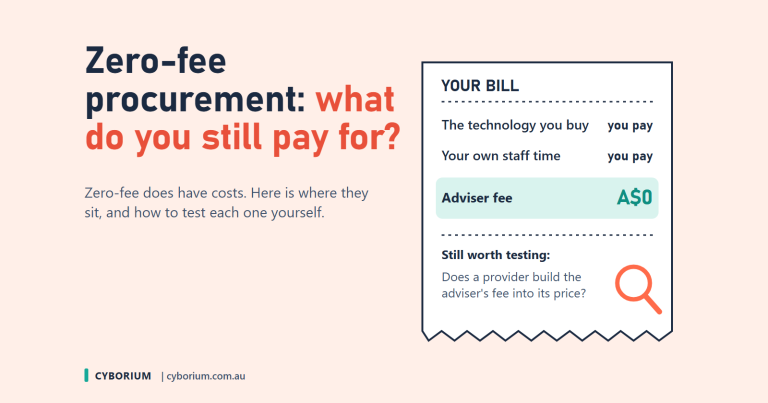
CYBORIUM runs this process for Australian technology decision owners: we prepare requirements, run the evaluation and support negotiation. The selected provider pays CYBORIUM a capped fee at an agreed percentage, providers that are shortlisted but not selected pay nothing, and you contract directly with the provider. The decision is always yours. See procurement as a service for how an engagement runs.
Procurement email templates in short
Good procurement email templates share four habits: the same information goes to every supplier, each email carries one ask, deadlines sit in the subject line, and every message ends with the next step. Use the seven templates above in order, adjust the brackets to your purchase, and keep the record in a shared place.
Want these emails run on a live purchase? Get the Procurement Readiness Brief or tell us about your project. The client pays CYBORIUM nothing and chooses the provider.
Frequently asked questions
What should a procurement email include?
A clear subject line with any due date, one request, the facts the reader needs to act, and the next step with an owner. Keep attachments named and numbered, and send the same information to every supplier.
How many suppliers should receive an RFP invitation?
Enough to create real competition without overloading your team. Three to six is common for a technology purchase, chosen against the requirements before any email goes out.
Should unsuccessful suppliers get feedback?
Yes, a short and specific reason is worth sending. It costs little, keeps good providers willing to bid again, and shows the process was fair.
Is it fine to negotiate before the final decision?
It is usually better. Terms such as price increase caps, growth pricing and exit assistance are easier to move while more than one provider is still competing for the contract.
Sources and references
These public sources inform the guidance on this page. CYBORIUM is not a law firm or a regulator, so check current wording with the issuing body before relying on it.
- APRA, Prudential Standard CPS 230 Operational Risk Management. The standard that sets expectations for how regulated entities select and manage material service providers, in force since 1 July 2025.
- Department of Finance, Commonwealth Procurement Rules. The value-for-money and fair-process principles behind Commonwealth procurement, useful as a benchmark in any sector.
- Australian Signals Directorate, ISM guidelines for procurement and outsourcing. Security controls to write into technology procurement and outsourcing arrangements.