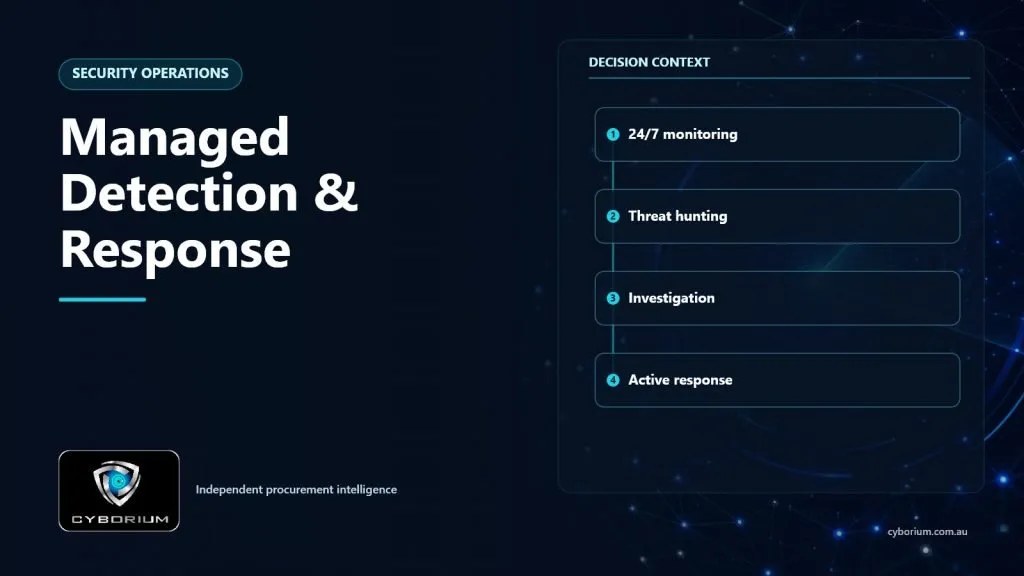
Managed Detection and Response (MDR) procurement is an operating model decision, not a feature comparison. The selected provider may monitor sensitive telemetry, investigate incidents and take action inside the organisation’s environment. A credible evaluation must establish what the service will detect, who can respond, how evidence will be produced and what the organisation must still operate itself.
CYBORIUM helps Australian organisations compare MDR providers through a structured, vendor-neutral sourcing process. The selected provider pays CYBORIUM a capped fee. The client contracts directly with that provider, and CYBORIUM does not sell, deliver, operate or invoice the technology.
What an MDR service should provide
An MDR service combines security telemetry, detection engineering, human analysis and an agreed response process. The service may use the organisation’s existing endpoint, identity, cloud and network controls, or include provider-supplied technology. The name alone does not establish the coverage.
Before approaching the market, document the assets and telemetry that matter. This usually includes endpoints, identity systems, cloud workloads, email, network controls and critical applications. Providers should then map their proposed coverage to that environment and identify every dependency or blind spot.
The five decisions that shape an MDR procurement
1. Detection coverage
Ask each provider to map detections to the telemetry sources available in the organisation. The response should distinguish native coverage, coverage that requires an integration, and coverage that is out of scope. A product demonstration is not evidence that the managed service will detect the organisation’s priority attack paths.
2. Response authority
Define what the provider may do without approval, what requires a named client decision owner, and what is prohibited. Test the model against incidents that occur outside business hours. An attractive response-time promise has limited value if every containment action waits for an unavailable approver.
3. Service evidence
Require sample incident reports, detection engineering records, threat-hunting outputs, service review packs and escalation logs. Ask how the provider measures detection quality and false positives. Mean time metrics should state when the clock starts, when it stops and which events are excluded.
4. Operating fit
Clarify the responsibilities that remain with the internal team. These may include maintaining log sources, approving response actions, remediating affected systems and managing communications. The evaluation should also examine analyst location, data handling, subcontractors, service continuity and exit support.
5. Commercial exposure
Compare the complete cost model, including telemetry volume, data retention, endpoint growth, onboarding, integrations, after-hours work and incident response outside the standard service. Test price movement at realistic growth levels. A low entry price can become expensive when data ingestion or retention changes.
A practical MDR evaluation scorecard
A useful scorecard separates mandatory evidence from scored preferences. CYBORIUM commonly structures the decision around the following areas:
- Coverage: required assets, telemetry, use cases and exclusions.
- Detection quality: engineering method, testing, tuning and measurable outcomes.
- Response: authority, escalation, containment actions and decision paths.
- People: analyst capability, local coverage, staffing model and specialist access.
- Assurance: data location, security controls, audit evidence and subcontractor governance.
- Operations: onboarding, integrations, service reviews, reporting and exit support.
- Commercials: full three-year cost, growth assumptions, exclusions and contractual remedies.
Weight the scorecard before proposals are opened. This prevents a polished demonstration or a familiar brand from changing the criteria after the evidence is known.
How to test shortlisted providers
Use the same scenario pack for every shortlisted provider. Include a compromised identity, suspicious endpoint behaviour, cloud control-plane activity and an incident requiring urgent containment. Ask the provider to show how the signal enters the service, how an analyst investigates it, what the client sees and what action follows.
Reference checks should use organisations with a similar environment and service model. Ask about onboarding delays, missed expectations, analyst continuity and the accuracy of monthly reporting. References are more useful when they test the proposed delivery team rather than the provider’s general reputation.
CYBORIUM’s role in the decision
CYBORIUM defines the requirements, builds the evaluation scorecard, coordinates market engagement, tests evidence, compares commercial structures and supports negotiation. The organisation retains the decision and contracts directly with the selected provider.
The process is designed to produce a clear decision record for security, procurement and executive stakeholders. It also makes the service boundary explicit, which reduces the risk of discovering operational gaps after contract signature.
Primary references
Reviewed by Michael Kazantzis for CYBORIUM on 22 July 2026. This guide explains CYBORIUM’s procurement evaluation method. It does not provide legal or regulatory advice.
Related from CYBORIUM
- Guided Vendor Evaluations
- Technology Market Expertise
- Security Orchestration, Automation, and Response (SOAR): The Complete Guide for Australian Enterprises in 2026
- SIEM Vendor Evaluation and Procurement Guide for Australian Enterprises
- Endpoint Detection and Response (EDR): The Complete Guide for Australian Enterprises in 2026
Also relevant: email as the first ingress path.