The modern security operations centre (SOC) is under pressure from external adversaries and from the sheer volume of alerts, incidents, and manual tasks that threaten to overwhelm even the most capable security teams. In 2026, the average Australian enterprise security team receives thousands of alerts per day across their SIEM, EDR, email security, network monitoring, and threat intelligence platforms. Without automation and orchestration, the majority of these alerts go uninvestigated, genuine threats are missed, and skilled analysts spend their time on repetitive, low-value tasks rather than the complex investigations that require human expertise.
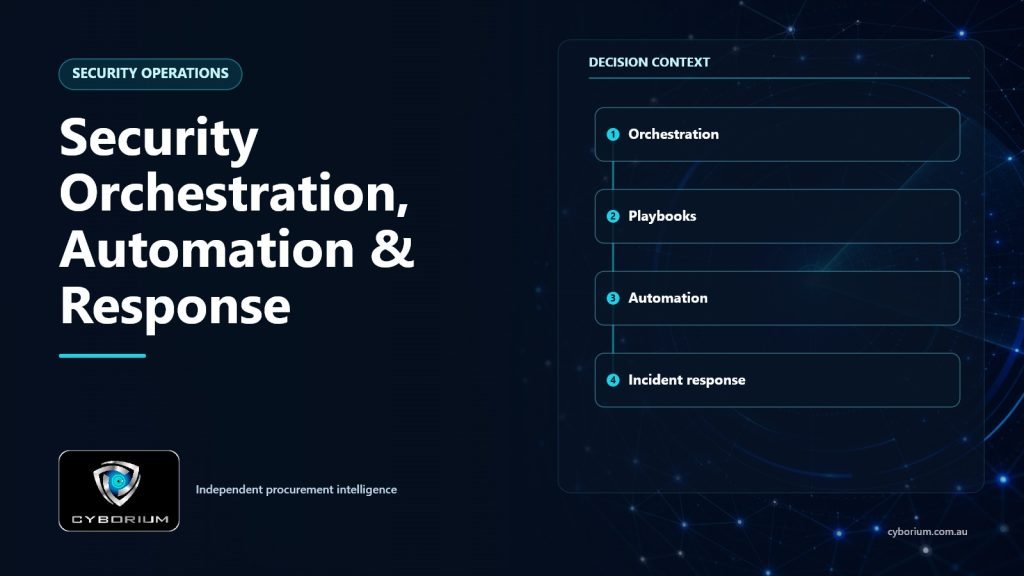
Security Orchestration, Automation, and Response (SOAR) is the technology that resolves this challenge, enabling Australian enterprises to automate repetitive security tasks, orchestrate coordinated responses across multiple security tools, and dramatically accelerate the speed and consistency of incident response. In 2026, SOAR has evolved from a niche capability for large, mature SOCs into an essential component of the security operations architecture for any Australian organisation serious about operational efficiency and effective threat response.
Understanding SOAR: Orchestration, Automation, and Response Defined
SOAR encompasses three distinct but deeply interconnected capabilities that together transform security operations:
Security Orchestration
Security orchestration connects the disparate security tools, platforms, and data sources in an organisation’s security stack, enabling them to work together as a coordinated system rather than a collection of isolated point solutions. Orchestration provides the integration layer that allows a SIEM alert to automatically trigger an EDR investigation, which in turn feeds findings to a ticketing system, notifies the relevant stakeholders, and updates the threat intelligence platform, all without manual intervention at each step.
For Australian enterprises managing complex, multi-vendor security stacks across hybrid cloud and on-premises environments, orchestration is the connective tissue that transforms individual security investments into a coherent, coordinated defence capability.
Security Automation
Security automation executes predefined response actions automatically when specific conditions are met, eliminating the manual effort, human error, and response delays associated with analyst-driven processes. Automation is most valuable for high-volume, well-understood scenarios where the appropriate response is consistent and predictable: blocking a known-malicious IP address, disabling a compromised user account, quarantining a suspicious file, or enriching an alert with threat intelligence context.
By automating these routine tasks, SOAR platforms free analyst time for the complex, context-dependent investigations that genuinely require human judgement, improving both the efficiency and the quality of security operations.
Incident Response
SOAR platforms provide structured, workflow-driven incident response capabilities, including case management, playbook execution, evidence collection, stakeholder communication, and post-incident documentation. Structured incident response ensures that every incident is handled consistently, that no critical steps are missed under pressure, and that the documentation needed for regulatory reporting and post-incident review is captured automatically throughout the response process.
The Australian SOC Challenge in 2026
Australian security operations teams face a distinctive set of challenges that make SOAR particularly valuable in the local context:
- Talent scarcity: Australia faces a significant and persistent shortage of skilled cyber security professionals. SOAR automation enables smaller teams to manage larger environments more effectively, multiplying the impact of available talent rather than requiring headcount growth that the market cannot supply.
- Alert fatigue: The proliferation of security tools has created an alert volume that exceeds the capacity of manual triage. SOAR automation handles the high-volume, low-complexity alerts that dominate alert queues, ensuring that analyst attention is focused on the alerts that genuinely require human investigation.
- Regulatory response obligations: Australian regulatory frameworks including the NDB scheme and APRA CPS 234 impose specific timelines for incident detection, assessment, and notification. SOAR automation accelerates the response process and ensures that regulatory notification workflows are triggered consistently and on time.
- Multi-tool complexity: Australian enterprises typically operate security stacks comprising dozens of tools from multiple vendors. SOAR orchestration integrates these tools into coordinated response workflows, eliminating the manual context-switching and data re-entry that consumes analyst time and introduces errors.
- 24/7 coverage requirements: Cyber threats don’t respect business hours. SOAR automation provides consistent, rapid response capability outside business hours, containing threats and executing initial response actions while human analysts are unavailable.
SOAR Playbooks: The Foundation of Automated Response
Playbooks are the core operational unit of a SOAR platform, structured, automated workflows that define the sequence of actions to be taken in response to specific security scenarios. Effective playbooks encode the organisation’s best-practice response procedures into repeatable, auditable automation that executes consistently every time a defined trigger condition is met.
Common SOAR Playbook Categories for Australian Enterprises
Phishing Investigation and Response: Automatically extracts indicators from reported phishing emails, queries threat intelligence platforms for context, checks whether other users received the same email, blocks malicious URLs and sender domains across email security and web filtering tools, and notifies affected users, all within minutes of the initial report, without analyst intervention.
Compromised Credential Response: Triggered by anomalous authentication events or threat intelligence alerts about credential exposure, automatically disables the affected account, revokes active sessions, resets credentials, notifies the user and their manager, and initiates a forensic investigation of recent account activity.
Malware Containment: Triggered by EDR malware detection, automatically isolates the affected endpoint from the network, collects forensic artefacts, queries threat intelligence for context on the detected malware family, notifies the security team, and creates a structured incident case with all relevant evidence pre-populated.
Vulnerability Prioritisation and Ticketing: Automatically ingests vulnerability scan results, enriches findings with threat intelligence on active exploitation, prioritises remediation based on exploitability and asset criticality, and creates prioritised remediation tickets in the IT service management platform, aligned with the ACSC’s patching timeline requirements.
NDB Scheme Assessment Workflow: Triggered by a confirmed data breach, automatically initiates the structured assessment workflow required to determine whether the breach meets the threshold for NDB scheme notification, collecting relevant evidence, calculating the notification timeline, and escalating to legal and privacy teams with all required information pre-populated.
SOAR Integration Architecture
The value of a SOAR platform is directly proportional to the breadth and depth of its integrations with the organisation’s existing security and IT tools. Key integration categories for Australian enterprises include:
- SIEM integration: Bidirectional integration with the SIEM platform, receiving alerts and events as automation triggers, and feeding investigation findings and response actions back into the SIEM for centralised visibility and audit trail.
- EDR integration: Automated endpoint investigation and response actions, including endpoint isolation, process termination, file quarantine, and forensic data collection, triggered by SOAR playbooks without requiring analyst access to the EDR console.
- Threat intelligence integration: Automated enrichment of alerts and indicators with context from threat intelligence platforms, providing analysts with relevant threat actor, campaign, and risk context without manual lookups.
- Identity and access management integration: Automated account management actions, including account disablement, session revocation, and MFA enforcement, triggered by identity-based threat scenarios.
- IT service management integration: Automated creation, assignment, and updating of incident and remediation tickets in ITSM platforms, ensuring that security findings are tracked through to resolution in the organisation’s standard workflow tools.
- Communication platform integration: Automated notifications and escalations via email, Microsoft Teams, Slack, and other communication platforms, ensuring that the right people are informed at the right time without manual notification steps.
- Cloud platform integration: Automated response actions in AWS, Azure, and Google Cloud environments, including security group modifications, resource isolation, and access revocation, enabling consistent response across hybrid environments.
SOAR and the Australian Regulatory Context
SOAR platforms provide specific capabilities that support Australian regulatory compliance obligations:
- NDB Scheme compliance: Automated assessment workflows ensure that data breach notifications are triggered consistently and within the required timeframes, reducing the risk of regulatory non-compliance during the chaos of an active incident.
- APRA CPS 234 incident reporting: Automated incident documentation and escalation workflows support the 72-hour notification requirement for material information security incidents, ensuring that the required information is collected and escalated without delay.
- Essential Eight evidence collection: SOAR automation can be configured to automatically collect and document evidence of Essential Eight control effectiveness, supporting maturity assessment and audit evidence requirements.
- Audit trail generation: SOAR platforms automatically generate comprehensive, timestamped audit trails of all automated and manual response actions, providing the documentation needed for regulatory reviews and post-incident investigations.
SOAR vs. SIEM vs. XDR: Understanding the Relationships
The relationships between SOAR, SIEM, and XDR are frequently misunderstood. In 2026, these technologies are increasingly converging, but they serve distinct primary functions:
- SIEM is primarily a detection and visibility platform, aggregating and correlating security event data to identify potential threats and provide centralised visibility across the security environment.
- SOAR is primarily a response and automation platform, orchestrating coordinated responses across multiple security tools and automating repetitive response tasks to accelerate and standardise incident handling.
- XDR is a detection and response platform that integrates telemetry from multiple security domains, providing correlated, cross-domain detection and native response capabilities within a single vendor’s platform.
In practice, many Australian enterprises deploy SIEM and SOAR together, using SIEM for detection and visibility and SOAR for response orchestration and automation. XDR platforms are increasingly incorporating SOAR-like automation capabilities, blurring the boundaries between these categories. CYBORIUM’s evaluation process helps Australian enterprises navigate these architectural choices based on their specific requirements and existing investments.
SOAR Trends Through 2030
- AI-native playbook generation: Generative AI is beginning to automate the creation and optimisation of SOAR playbooks, analysing incident patterns, recommending new automation opportunities, and generating playbook code from natural language descriptions of desired response behaviours.
- Autonomous SOC operations: The convergence of AI-powered detection, SOAR automation, and generative AI is progressively automating the routine analytical and response work of the SOC, enabling a vision of autonomous security operations where AI handles the majority of alert triage and initial response, with human analysts focused on complex investigations and strategic decisions.
- No-code/low-code playbook development: The democratisation of SOAR through no-code and low-code playbook development tools is enabling security teams without deep programming expertise to build and maintain automation workflows, reducing the specialist skills barrier that has historically limited SOAR adoption.
- Cross-organisation orchestration: Emerging SOAR capabilities are enabling coordinated response across organisational boundaries, supporting information sharing and coordinated response between Australian enterprises, government agencies, and sector-specific security communities.
How CYBORIUM Evaluates SOAR Providers
CYBORIUM assesses SOAR providers against a comprehensive evaluation framework designed to ensure our clients select platforms that deliver genuine operational efficiency and response capability improvements:
- Integration breadth and quality: The range and depth of pre-built integrations with the security and IT tools most commonly used by Australian enterprises, and the ease of building custom integrations for tools not covered by pre-built connectors.
- Playbook flexibility and ease of development: The sophistication of the playbook development environment, including support for both code-based and no-code/low-code development, and the availability of pre-built playbook templates for common Australian security scenarios.
- Automation workflow reliability: The robustness and reliability of automated workflows, including error handling, retry logic, and alerting when automation fails, ensuring that critical response actions are executed consistently.
- Effectiveness in accelerating response times: Demonstrated, evidence-based improvements in mean time to respond (MTTR) and mean time to contain (MTTC) achieved by existing customers in comparable environments.
- Australian regulatory alignment: Pre-built playbooks and workflows for Australian regulatory scenarios including NDB scheme assessment and APRA CPS 234 incident reporting.
- Scalability and performance: The platform’s ability to handle the alert volumes and automation workloads of large Australian enterprise environments without performance degradation.
- Vendor support and local presence: The availability of Australian-based technical support and professional services for implementation and ongoing optimisation.
Accelerate Your Security Operations with CYBORIUM
Australian enterprises trust CYBORIUM for their experience in strategic sourcing and procurement as a service, and our SOAR vendor evaluation capability reflects the same rigour and independence we bring to all technology assessments. CYBORIUM’s zero-fee procurement model means we can help your organisation identify, evaluate, and select the right SOAR platform at no cost.
Our structured evaluation process, informed by deep knowledge of Australian security operations and a broad view of the SOAR market, helps you choose a platform that genuinely improves your team’s efficiency, accelerates your response capability, and supports your Australian regulatory obligations.
Contact CYBORIUM today to discuss your SOAR requirements and take the first step toward a faster, more automated, and more effective security operations capability for your Australian enterprise.
Standards and further reading
Automation claims are the hardest part of a SOAR evaluation to test, because every product demonstrates well on a scripted scenario. These three sources give you criteria a vendor cannot script around.
- MITRE ATT&CK. Name the specific techniques a playbook is supposed to detect and contain, then ask for the playbook against those technique IDs rather than a generic demonstration.
- NIST SP 800-61 Rev. 2. The incident handling lifecycle a SOAR platform is automating. If a playbook does not map to a phase in it, ask what it is actually for.
- ASD Essential Eight Maturity Model. Sets the maturity level your organisation is measured against, which determines how much of the response you are permitted to leave automated.
Related from CYBORIUM
- Guided Vendor Evaluations
- Technology Market Expertise
- SIEM Vendor Evaluation and Procurement Guide for Australian Enterprises
- Endpoint Detection and Response (EDR): The Complete Guide for Australian Enterprises in 2026
- Cloud Security and Compliance Solutions: The Complete Guide for Australian Enterprises in 2026