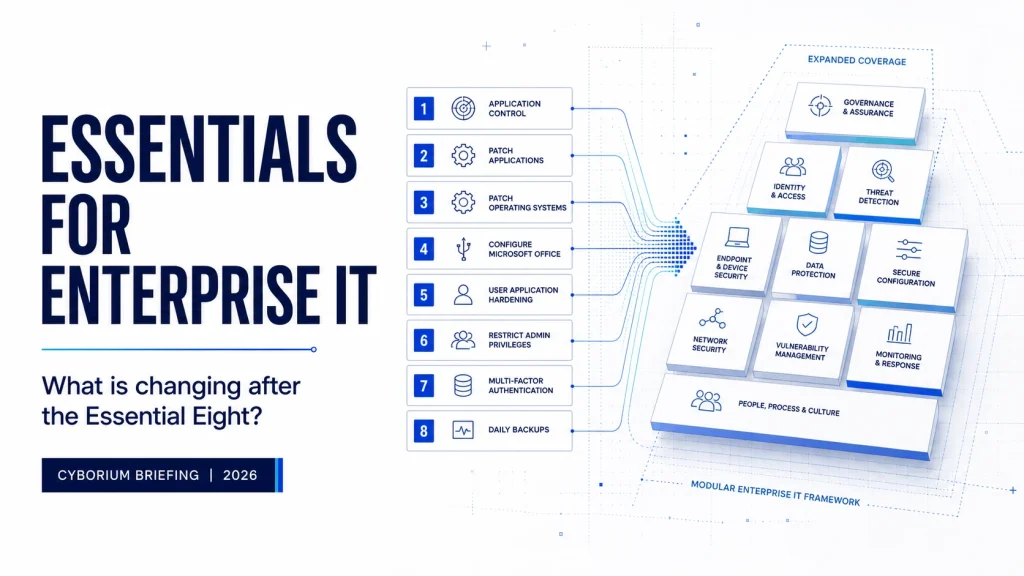
Essentials for enterprise IT is the Australian Signals Directorate’s proposed next step for the Essential Eight. ASD has confirmed that the current Essential Eight guidance is expected to evolve into the first chapter of a broader Essentials series. The direction is confirmed, but the detailed control requirements, maturity model and release timing have not yet been published.
For Australian CIOs, CISOs, technology leaders and procurement teams, the practical message is simple. Keep improving the current Essential Eight, preserve strong assessment evidence, and make upcoming technology contracts flexible enough to accommodate revised ASD guidance.
What is Essentials for enterprise IT?
Essentials for enterprise IT is the name ASD has given to the proposed first chapter of a new Essentials cyber security guidance series. ASD announced the consultation on 15 June 2026 and accepted feedback from Cyber Security Network partners until 12 July 2026.
ASD says the new series will be grounded in the Information Security Manual and will provide prioritised, threat-informed mitigations for contemporary technology environments. It is also intended to provide practical tools and clearer implementation guidance.
The proposed evolution of the Essential Eight will become the enterprise IT chapter. ASD has also said that additional chapters will follow, although it has not publicly confirmed their subjects or publication dates.
What has ASD confirmed?
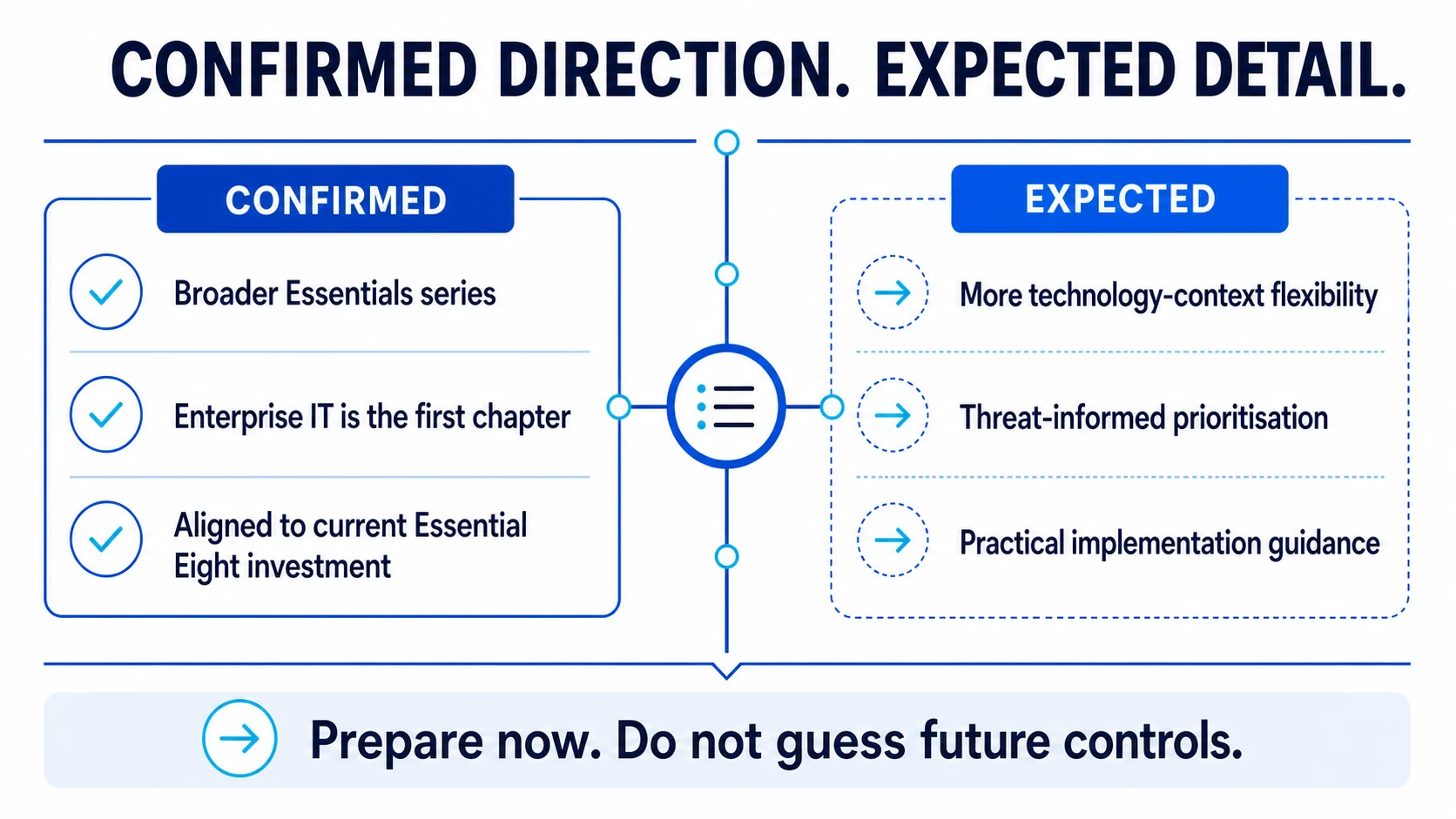
- A broader Essentials series is planned. The existing Essential Eight is expected to become part of a wider body of prioritised cyber security guidance.
- Enterprise IT will be the first chapter. The proposed name is Essentials for enterprise IT.
- The guidance will remain aligned with the ISM. The ISM continues to provide ASD’s broader risk-based framework for protecting IT and operational technology systems.
- The approach will be threat-informed. ASD intends to prioritise mitigations against contemporary threats and defensive capabilities.
- Existing Essential Eight investment should remain relevant. ASD says organisations already using the Essential Eight can expect strong alignment with their current controls and investments.
- Implementation support is part of the direction. Practical tools and clearer implementation guidance are expected to accompany the new series.
What has not been confirmed?
At the time of publication, ASD has not released the final Essentials for enterprise IT chapter. Organisations should not assume that consultation material is a final control standard.
- The final set of mitigation strategies and whether the number eight will remain.
- The exact control wording, assessment tests or evidence requirements.
- Whether the current three target maturity levels will remain unchanged.
- How exceptions and compensating controls will be treated in the final model.
- The formal transition period from the existing Essential Eight guidance.
- The publication date for the final enterprise IT chapter.
- The scope and timing of later chapters in the Essentials series.
This distinction matters. A forward-looking security programme should prepare for change without purchasing tools against controls that do not yet exist.
What changes should enterprise IT leaders expect?
1. More flexibility across technology environments
ASD’s reference to contemporary technology environments suggests that the future guidance will need to work across cloud services, software as a service, modern identity platforms, managed services, traditional endpoints and hybrid infrastructure. The likely objective is greater implementation flexibility while preserving clear security outcomes.
This is an informed expectation, not a confirmed control design. The final guidance may use different structures or terminology.
2. Stronger links between threats, controls and evidence
The phrase threat-informed mitigations points towards a clearer explanation of why each control matters, which threats it addresses and what good implementation evidence looks like. That would support better investment decisions and help boards understand cyber security priorities as business risk decisions, not isolated technical settings.
3. Clearer implementation guidance
Current Essential Eight assessments already distinguish between the quality of evidence. ASD’s assessment guidance ranks simulated testing and direct configuration review above screenshots, policy statements and interviews. The proposed focus on practical tools may make implementation and assessment expectations easier to apply consistently.
4. A framework that can expand beyond enterprise IT
A chapter-based Essentials series creates room for guidance written for other technology contexts. ASD has not announced those chapters, so organisations should avoid predicting their scope. The strategic implication is still important: cyber baselines may become more context-specific while remaining connected to the ISM.
Will the Essential Eight be replaced?
The safest answer is that the Essential Eight is proposed to evolve, not disappear overnight. ASD describes Essentials for enterprise IT as an evolution of the current guidance and says existing users can expect strong alignment with their controls and investments.
Until ASD publishes final guidance and transition arrangements, the current Essential Eight remains the authoritative baseline. Organisations should continue to implement the eight mitigation strategies as a package and assess against the current maturity model.
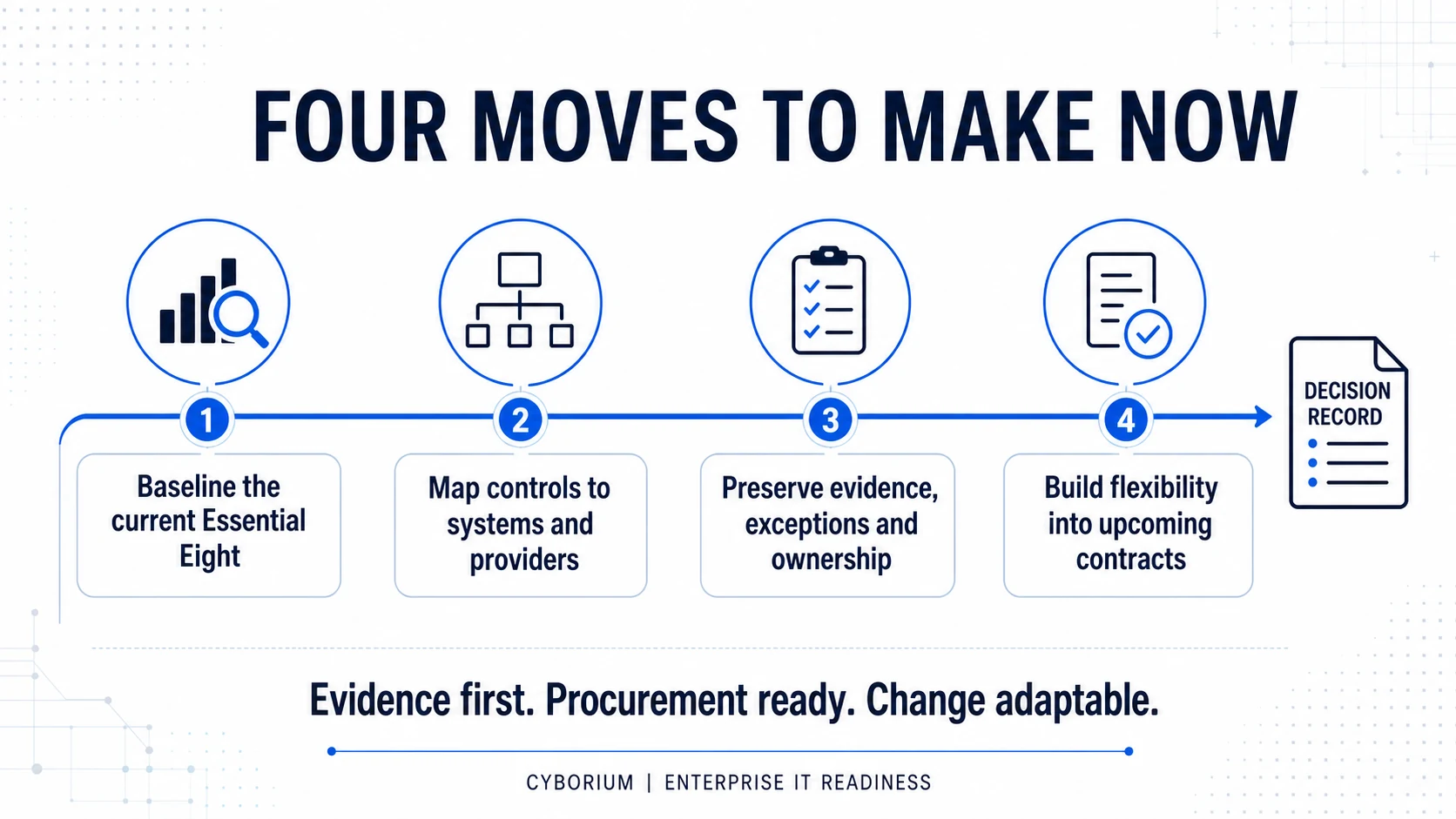
What should Australian organisations do now?
Baseline current Essential Eight maturity
Confirm the target maturity level, assessment boundary, control owners and known gaps. Do not wait for new guidance before addressing weaknesses in application control, patching, macro controls, hardening, privileged access, multi-factor authentication or backups.
Map controls to systems, services and providers
Create a traceable view of which internal teams, cloud platforms, managed service providers and technology vendors support each control outcome. This becomes especially important when evidence sits across multiple contracts or administration portals.
Preserve assessment evidence
Retain configuration exports, test results, exception decisions, risk acceptances, remediation actions and evidence owners. High-quality evidence will make it easier to map current implementation to future guidance.
Build change into procurement requirements
New requests for proposal and contract renewals should require providers to support the current Essential Eight and demonstrate how their controls can be mapped to future ASD guidance. Include clear obligations for evidence, material security changes, remediation and transition support.
Avoid premature tool purchases
Do not buy a product simply because it is marketed as ready for Essentials for enterprise IT. Evaluate technology against confirmed business requirements, current threats, existing architecture, integration needs, evidence quality and commercial value.
Procurement implications for technology and security providers
The transition is likely to affect more than technical control owners. Procurement teams should expect vendor claims, tender schedules, security questionnaires and managed service descriptions to change as the final framework develops.
- Requirements must be outcome-led. Avoid locking a procurement to one product architecture when multiple approaches can meet the security objective.
- Evidence should be contractually available. Confirm who can provide configurations, logs, test results, assurance reports and remediation records.
- Control responsibility must be explicit. Shared-responsibility models should identify the client, provider and vendor obligations for every relevant control.
- Change management needs a commercial path. Contracts should address how new guidance, configuration changes and material uplift work will be scoped and governed.
- Claims require independent evaluation. Marketing labels are not a substitute for tested control effectiveness.
How CYBORIUM can support an evidence-ready transition
CYBORIUM helps Australian organisations define requirements, evaluate the market, compare providers and create a defensible procurement decision. The approach is independent and vendor-neutral. The client pays no fee to CYBORIUM and contracts directly with the selected provider.
For Essentials for enterprise IT preparation, that can include requirements prioritisation, control-to-provider mapping, evidence expectations, commercial benchmarking, vendor due diligence and negotiation support. CYBORIUM does not sell, deliver, operate, manage or invoice the selected technology.
Related guidance: Cybersecurity Vendor Evaluation Framework for Australian Enterprises and MoSCoW Requirements for Enterprise Technology Procurement.
Evaluating an uplift or provider proposal? Use CYBORIUM’s Essential Eight procurement evaluation preview to test scope, evidence, pricing and contract terms before you commit.
Frequently asked questions
What is Essentials for enterprise IT?
It is the proposed first chapter of ASD’s broader Essentials cyber security guidance series. It is expected to evolve the current Essential Eight for contemporary enterprise technology environments.
Is Essentials for enterprise IT final?
No. ASD announced consultation in June 2026, with submissions closing on 12 July 2026. Final controls, assessment requirements, transition arrangements and a publication date have not been publicly confirmed.
Should organisations stop implementing the Essential Eight?
No. Continue implementing and assessing the current Essential Eight. ASD has indicated that existing controls and investments should remain strongly aligned with the proposed enterprise IT chapter.
Will Essential Eight maturity levels change?
ASD has not publicly confirmed whether the current maturity model will change. Organisations should use the current model until final guidance says otherwise.
How should procurement teams prepare?
Keep requirements outcome-led, map responsibility across clients and providers, require usable control evidence, and include contract mechanisms for future ASD guidance changes.
Official sources and update status
- ASD consultation on the evolution of the Essential Eight, first published 15 June 2026.
- ASD Essential Eight guidance.
- ASD Essential Eight assessment process guide.
- ASD Information Security Manual, June 2026.
Information status: reviewed against publicly available ASD guidance on 29 July 2026. This article will require review when ASD publishes the final Essentials for enterprise IT chapter or transition arrangements.
Preparing a security procurement or provider evaluation? Speak with CYBORIUM about an independent, evidence-led pathway.