Selecting a cybersecurity provider is not a product comparison. It is a risk, delivery and commercial decision that must remain defensible after the contract is signed.
Selecting a cybersecurity provider is rarely a simple product comparison. The decision can change an organisation's exposure to operational disruption, privacy incidents, regulatory scrutiny, data-sovereignty concerns and long-term commercial lock-in.
The difficult part is not finding providers. It is establishing which provider can meet the organisation's actual requirements, demonstrate acceptable risk controls and remain commercially accountable after the contract is signed.
This article sets out a practical five-stage framework for Australian enterprise teams evaluating cybersecurity software, managed services or specialist providers. It is designed to create a decision record that can be explained to executives, procurement, risk teams, auditors and the board.

Why cybersecurity vendor selection needs a structured process
Cybersecurity providers are not interchangeable. Two proposals may use the same category language while differing substantially in architecture, data handling, service coverage, staffing, incident response, subcontracting, contractual accountability and total cost.
A conventional request for proposal can still produce the wrong result when:
- requirements are written around familiar products rather than business outcomes
- vendors answer broad questions with marketing statements instead of evidence
- security, privacy, legal and procurement teams assess proposals separately
- pricing is compared before scope and service assumptions are normalised
- demonstrations carry more influence than documented delivery capability
- unresolved risks disappear inside a single overall score
The evaluation process should therefore do more than rank presentations. It should make material differences visible and preserve the reasoning behind the final decision.
Australian government cyber guidance reinforces this risk-based approach. The Australian Signals Directorate's Guidelines for procurement and outsourcing call for cyber supply-chain risk assessments, demonstrated supplier commitment to security and transparency, and a documented shared-responsibility model.
The five-stage cybersecurity vendor evaluation framework
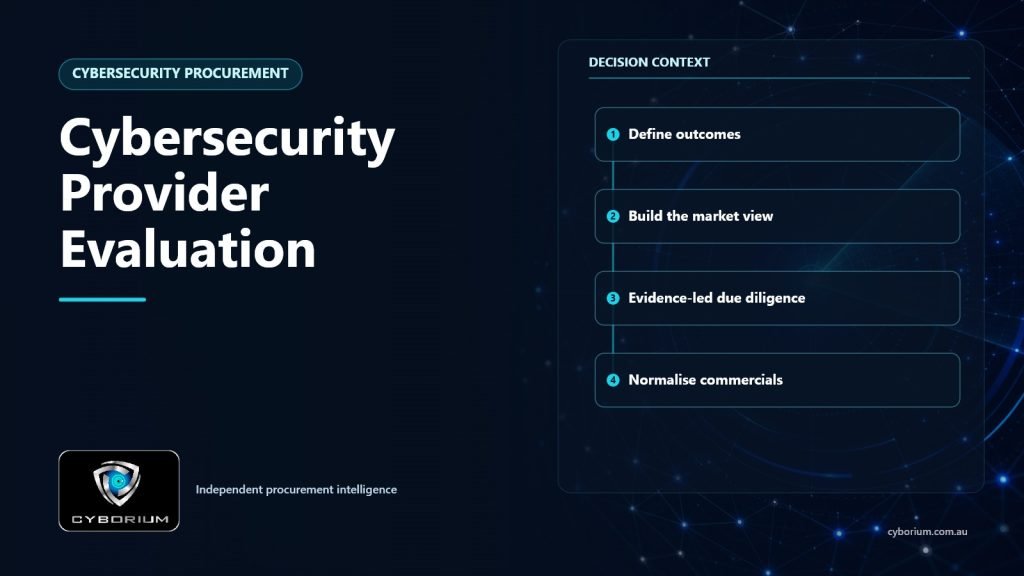
1. Define the outcome and decision boundaries
Begin with the outcome the organisation needs, not a preferred product or provider.
The requirements group should include technology, security, privacy, procurement, risk, finance, legal and operational stakeholders where relevant. Their first task is to agree on:
- the business and security outcome
- the systems, users, locations and data in scope
- integration and architecture constraints
- regulatory and internal policy obligations
- delivery timeframes and dependencies
- service ownership after implementation
- the evidence required to approve the decision
Requirements can then be prioritised using a structured method such as MoSCoW:
- Must have: failure means the proposal cannot proceed
- Should have: important to the outcome but potentially manageable through mitigation
- Could have: useful value that should not distort the core evaluation
- Will not have for this decision: explicitly excluded to control scope
The core discipline is separating mandatory gates from scored preferences. A vendor should not be able to compensate for an unacceptable security, privacy or delivery risk by scoring highly on presentation quality or optional features.
2. Build a defensible market view
A market scan should test the available options rather than confirm the organisation's existing shortlist.
Assess potential providers against a consistent entry screen:
- relevant enterprise capability
- fit for the organisation's architecture and operating model
- Australian delivery and support coverage
- experience in comparable risk environments
- financial and operational viability
- willingness to provide the required evidence
- identifiable subcontractors and critical fourth parties
This stage should document why a provider entered or left the longlist. It should also distinguish between the technology vendor, implementation partner, managed service provider and any subcontracted delivery parties. Each can introduce different obligations and risks.
For technologies with sensitive data, critical infrastructure or national-security implications, ownership and jurisdiction may also require attention. The Department of Home Affairs' Technology Vendor Review Framework highlights the importance of assessing foreign ownership, control or influence through a proportionate, risk-based process.
3. Test claims through evidence-led due diligence
Due diligence should convert supplier claims into evidence that can be assessed.
The evidence request will vary by category, but an enterprise cybersecurity evaluation commonly examines:
Security and architecture
- architecture and data-flow documentation
- security control ownership
- independent certifications and assessment scope
- vulnerability management and secure-development practices
- identity, access and privileged-administration controls
- encryption and key-management arrangements
- incident detection, escalation and notification processes
- resilience, recovery and service-continuity evidence
Data, privacy and jurisdiction
- data types collected, created or inferred
- storage, processing and support locations
- subprocessors and onward-transfer arrangements
- retention, deletion and return provisions
- telemetry and secondary-use practices
- privacy impact and breach-response responsibilities
Third-party involvement does not automatically transfer accountability away from the organisation. The Office of the Australian Information Commissioner's third-party guidance illustrates the need for appropriate contracts, due diligence and controls over how personal information is handled. See the OAIC's privacy guidance for organisations engaging third parties.
Delivery and operating capability
- named delivery roles and capability
- implementation assumptions and dependencies
- onboarding, migration and acceptance approach
- support model and escalation paths
- service levels and measurement method
- reference outcomes for comparable engagements
- transition-out and knowledge-transfer provisions
Corporate and commercial resilience
- financial viability
- insurance coverage relevant to the service
- ownership and material corporate dependencies
- concentration and key-person risks
- licensing model and likely cost-growth drivers
- material exclusions and limits of responsibility
For APRA-regulated organisations, the assessment should align with the entity's applicable obligations. CPS 234 requires an APRA-regulated entity to evaluate the design of information-security controls where its information assets are managed by a related or third party.
4. Normalise commercials before comparing price
Headline price is not a reliable comparison when proposals contain different assumptions.
Build a common commercial model that accounts for:
- implementation and migration
- licensing units and minimum commitments
- infrastructure or data-volume charges
- integrations and professional services
- support tiers and service coverage
- training and organisational change
- annual uplift and renewal mechanics
- overage, expansion and true-up exposure
- transition-out and termination costs
The commercial assessment should distinguish price from value and contract risk. A lower initial price may be less attractive when it depends on narrow scope, optimistic consumption assumptions, weak service obligations or high switching costs.
Commercial findings should be assessed after technical and risk requirements have been normalised. This reduces the chance that price influences whether evaluators accept unsupported capability claims.
5. Produce a decision record alongside the winner
The final recommendation should explain:
- the outcome and evaluation scope
- the providers considered
- mandatory requirements and exclusions
- scoring criteria and approved weightings
- evidence reviewed
- material assumptions
- unresolved risks and agreed mitigations
- commercial comparison and negotiation position
- why the recommended provider is preferred
- conditions that must be satisfied before contract execution
A decision record should remain useful after selection. It becomes the baseline for contract schedules, implementation acceptance, service governance and future renewal review.
A weighted scorecard that preserves risk gates
Weightings should reflect the specific decision. The example below is a starting point, not a universal formula.

| Evaluation dimension | Illustrative weighting | What it tests |
|---|---|---|
| Security and risk | 30% | Control design, evidence, resilience, privacy and supply-chain risk |
| Capability and fit | 25% | Functional fit, architecture, integrations and usability |
| Commercial value | 20% | Normalised cost, contract exposure and long-term value |
| Delivery confidence | 15% | Implementation, staffing, support and reference outcomes |
| Governance | 10% | Accountability, reporting, escalation and ongoing assurance |
Scores should be traceable to evidence. Evaluators should record the source, confidence level, assumptions and any required clarification.
Mandatory gates should sit outside the weighted total. Examples might include an unacceptable data location, inability to meet a critical control, refusal to disclose subprocessors, an unmanageable implementation dependency or a contract position that leaves a material risk with the organisation.
Questions executives should be able to answer before approval
Before the recommendation reaches an executive or board forum, the project team should be able to answer:
- What decision outcome was agreed before the market was approached?
- Which requirements were mandatory, and who approved them?
- How was the market identified and narrowed?
- What evidence supports each material capability claim?
- Which risks remain unresolved, and who has accepted them?
- How were proposal assumptions normalised?
- What is the likely total cost across implementation, operation, renewal and exit?
- What prevents vendor lock-in or unmanaged service dependency?
- Who is accountable for each security responsibility after contract signature?
- What conditions must be completed before implementation or production use?
If those questions cannot be answered clearly, the selection may be premature regardless of the score.
How CYBORIUM supports an independent evaluation
CYBORIUM manages structured cybersecurity, AI and enterprise IT sourcing for Australian organisations. The work can include requirements definition, market evaluation, provider due diligence, commercial benchmarking, shortlisting, negotiation support and a board-ready decision record.
The organisation contracts directly with its selected provider. CYBORIUM does not sell, deliver or operate the technology and does not invoice the client for the procurement service. Under CYBORIUM's model, the selected provider pays a capped fee. The commercial mechanism should be disclosed, controlled and separated from the evaluation criteria so that no provider can improve its position by offering a higher payment.

The organisation retains decision authority throughout the process. CYBORIUM's role is to make the market, evidence, risks and commercials easier to compare and defend.
Cybersecurity vendor evaluation checklist
Use this condensed checklist before committing to a preferred provider:
- Outcome, scope and decision authority agreed
- Must-have requirements approved before scoring
- Relevant market options considered
- Provider, implementation and subcontractor roles separated
- Security and privacy claims supported by evidence
- Data locations and subprocessors understood
- Delivery assumptions tested with named owners
- Commercial proposals normalised
- Renewal, expansion and exit costs assessed
- Mandatory risk gates applied outside weighted scoring
- Unresolved risks assigned to accountable owners
- Shared-responsibility model documented
- Recommendation and conditions recorded
- Contract schedules aligned with evaluation commitments
A better decision begins before the shortlist
The strongest cybersecurity procurement decisions are designed before vendor demonstrations begin. Clear requirements, independent market coverage, evidence-led due diligence and normalised commercials give an organisation a defensible basis for selection.
If your organisation is preparing a cybersecurity evaluation, CYBORIUM can help structure the requirements, test the market and create a board-ready decision pathway without issuing a CYBORIUM invoice to your organisation.
Build a decision your executives can defend
If your organisation is preparing a cybersecurity evaluation, CYBORIUM can structure the requirements, test the market and create a board-ready decision pathway without issuing a CYBORIUM invoice to your organisation.
Related from CYBORIUM
- Guided Vendor Evaluations
- Technology Market Expertise
- Managed Detection and Response Provider Evaluation for Australian Enterprises
- Security Orchestration, Automation, and Response (SOAR): The Complete Guide for Australian Enterprises in 2026
- SIEM Vendor Evaluation and Procurement Guide for Australian Enterprises