GRC as a service means buying governance, risk and compliance capability as an ongoing service rather than licensing a platform and staffing it yourself. A provider supplies the tooling, and usually analysts who run control testing, risk reporting, policy maintenance, supplier assessments and audit preparation. It suits organisations that carry real regulatory obligations but cannot justify a permanent GRC team.
CYBORIUM helps Australian organisations compare GRC service providers and platform options through a structured vendor-neutral sourcing process. The selected provider pays CYBORIUM a capped fee. The client contracts directly with that provider, and CYBORIUM does not sell, deliver, operate or invoice the service.
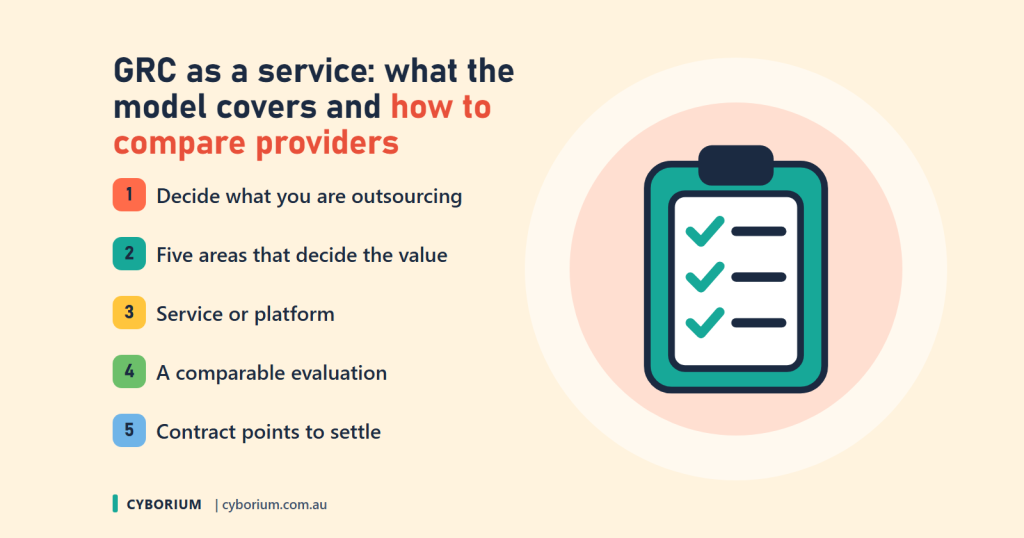
Decide what you are outsourcing
GRC as a service covers a wide range. At one end it is a hosted platform with light support. At the other, the provider runs the programme: maintaining the risk register, testing controls, chasing evidence from your teams, preparing board papers and managing supplier assessments.
Write down which of those activities the provider performs, which stay internal, and who signs off the results. Accountability does not transfer. For an APRA-regulated entity, obligations under CPS 230 and CPS 234 remain with the entity no matter who prepares the paperwork.
Five areas that decide the value
1. Scope and service definition
Ask for a written list of what the service includes each month, what counts as an extra, and how many hours of analyst time are covered. Vague scope is the most common reason these engagements disappoint.
2. Framework and obligation coverage
Confirm the provider can work to the frameworks you actually report against, such as ISO/IEC 27001, the ASD Essential Eight, APRA CPS 230 and CPS 234, or the SOCI risk management program rules. Ask how obligation content is kept current when a standard changes.
3. Evidence collection
Most of the effort in GRC is gathering evidence. Ask which controls the provider can evidence automatically through integrations with your identity, cloud, endpoint or ticketing systems, and which rely on your staff uploading documents. That ratio decides how much internal time the service really saves.
4. Your data and your exit
The service holds your risk register, control results and audit history. Confirm where that data lives, who at the provider can see it, how you export it in a usable format, and what happens to the platform licence if the service ends. Rebuilding this history is expensive.
5. Commercial model
Pricing is usually a monthly fee by scope, users or entities, sometimes with the platform licence bundled. Ask what happens to the price when you add business units, suppliers or frameworks, and whether the platform can be retained separately if you later take the work in-house.
Service or platform
If you have people who will run the programme and only lack tooling, a platform purchase is usually better value, and the guide to GRC platform evaluation covers that decision. If the constraint is people rather than software, a service fits better. Organisations often start with a service and move to a platform once the programme is established, which is why exit terms matter from the beginning.
A comparable evaluation
Give each shortlisted provider the same scenario: a defined set of controls to test, one supplier assessment, and a board report for a quarter. Ask for sample outputs rather than descriptions, and score the samples. Add written evidence on framework coverage, evidence automation, data handling, analyst qualifications, service levels and three-year cost.
Contract points to settle
Settle service levels for reporting and assessment turnaround, the named team or its qualifications, confidentiality, subcontracting, data location, breach notification, evidence ownership and exit assistance including the data export format. Where the provider prepares regulatory artefacts, record that review and sign-off stay with the organisation.
CYBORIUM’s role in the decision
CYBORIUM can define the scope split, prepare the scenario and sample requests, coordinate providers, evaluate outputs and model cost as the programme grows. The organisation keeps the decision and contracts directly with the selected provider. Related reading: APRA CPS 230 due diligence and vendor and supplier risk management.
Updated 16 September 2026. This guide explains CYBORIUM’s procurement evaluation method. It does not provide legal or regulatory advice.
Standards and further reading
Buying GRC as a service moves the work, not the accountability. These three set out what stays with you.
- APRA CPS 230. Operational risk and service provider obligations, including the parts a board cannot delegate to a provider.
- ISO 31000:2018. The risk management framework a managed service should be operating inside rather than replacing.
- ASD Information Security Manual. The Australian control baseline any managed GRC function should be reporting against.
Related from CYBORIUM
What should a GRC as a service contract specify?
Which frameworks and controls the provider maintains, how evidence is delivered, who signs off, and what happens to your records if you leave.
How does GRC as a service differ from a platform?
A platform is software your team operates. A service adds people who run the processes for you. Decide whether you lack the tool or the capacity.
What should you keep in house?
Accountability for risk decisions and sign-off. A provider can run the process, but your leaders still own the decisions.
Choosing a provider soon? We compare the market so you decide with evidence. Contact CYBORIUM or request a free market briefing.
Last updated: