The governance, risk, and compliance challenge facing Australian enterprises in 2026 has never been more complex. Regulatory obligations are multiplying. The risk landscape is expanding. Board and executive expectations for visibility and accountability are rising. And the manual, spreadsheet-driven approaches that many organisations have relied upon to manage GRC activities are buckling under the weight of this complexity.
GRC platforms have emerged as the essential technology response to this challenge — providing Australian enterprises with the integrated, automated, and scalable capabilities needed to orchestrate complex compliance mandates, manage risk consistently across the organisation, and deliver the informed, evidence-based decision-making that boards and regulators expect. In 2026, a well-implemented GRC platform is not just a compliance tool. It is a strategic asset that enables organisations to manage risk proactively, demonstrate governance maturity, and build the trust of clients, regulators, and investors.
The Australian GRC Landscape in 2026
Australian enterprises are navigating one of the most demanding regulatory environments in the country’s history. The key frameworks and obligations driving GRC platform investment include:
- APRA CPS 234 (Information Security): Requires APRA-regulated entities to maintain information security capabilities commensurate with the size and extent of threats, classify information assets, and notify APRA of material incidents. GRC platforms provide the asset classification, control assessment, and incident management capabilities needed to meet these obligations.
- APRA CPS 230 (Operational Risk Management): Introduced in 2024, CPS 230 significantly strengthens requirements for operational risk management, including comprehensive service provider registers, business continuity planning, and scenario analysis. GRC platforms provide the operational risk management and third-party risk capabilities needed to comply.
- Privacy Act 1988 and NDB Scheme: Requires organisations to manage personal information in accordance with the Australian Privacy Principles and notify affected individuals and the OAIC of eligible data breaches. GRC platforms support privacy impact assessments, data mapping, and breach management workflows.
- ACSC Essential Eight: The baseline cyber security framework for Australian organisations, increasingly referenced in government contracts and regulatory guidance. GRC platforms provide Essential Eight maturity assessment, control tracking, and compliance reporting capabilities.
- ISO 27001: The international standard for information security management systems, widely required by enterprise clients and government agencies. GRC platforms support ISO 27001 implementation, audit management, and certification maintenance.
- ASX Corporate Governance Principles: ASX-listed companies are expected to demonstrate robust risk management frameworks and board-level oversight of material risks — including cyber and technology risk. GRC platforms provide the board reporting and risk visibility capabilities needed to meet these expectations.
- Emerging AI Governance Frameworks: As AI adoption accelerates, Australian regulators are developing governance frameworks for AI risk management that will create new compliance obligations. GRC platforms that can accommodate emerging frameworks without requiring re-implementation will be essential.
Core Capabilities of a Modern GRC Platform
Integrated Risk Management
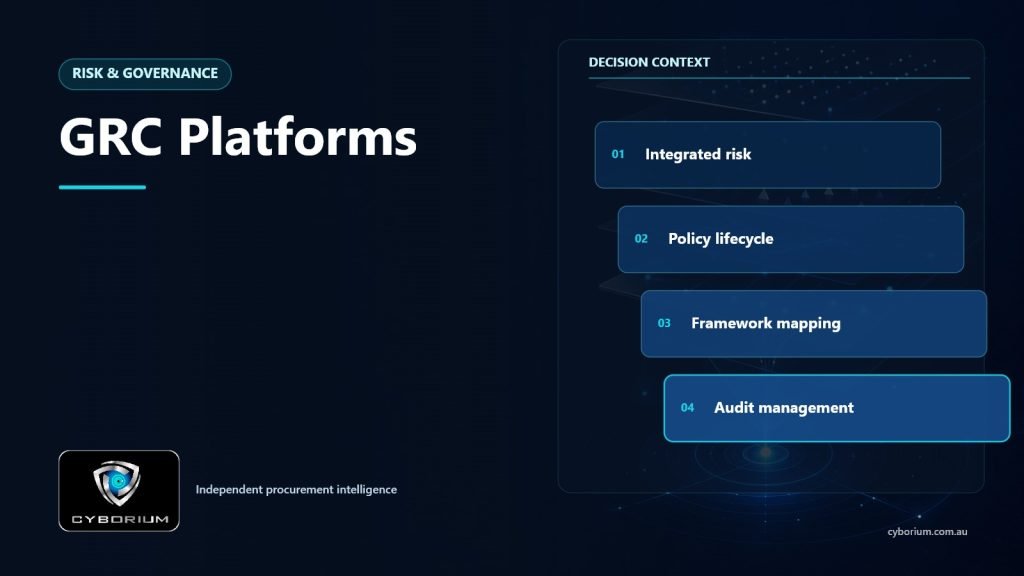
A unified risk register is the foundation of effective GRC — providing a single, consolidated view of all risks across the organisation, with consistent risk assessment methodologies, automated risk scoring, and real-time dashboards for executive and board reporting. Modern GRC platforms support quantitative risk assessment methodologies — including financial risk quantification — that enable organisations to express risk in business terms that resonate with boards and executive leadership.
Risk management capabilities should cover all risk domains relevant to Australian enterprises — including cyber and technology risk, operational risk, compliance risk, third-party risk, and strategic risk — in a single, integrated platform rather than separate siloed tools.
Policy Management and Lifecycle Automation
Effective policy management requires more than a document repository. Modern GRC platforms provide automated policy lifecycle management — including scheduled review cycles, version control, stakeholder approval workflows, employee attestation campaigns, and audit trails that demonstrate policy governance to regulators and auditors. For Australian enterprises managing dozens or hundreds of policies across multiple regulatory frameworks, automated policy management delivers significant efficiency gains and reduces the risk of policy gaps and outdated documentation.
Compliance Framework Mapping and Multi-Framework Management
Australian enterprises typically manage compliance obligations across multiple frameworks simultaneously — including APRA CPS 234, the Essential Eight, ISO 27001, the Privacy Act, and sector-specific requirements. Modern GRC platforms provide pre-built framework mappings that identify overlapping controls across frameworks — enabling organisations to assess their compliance posture against multiple frameworks simultaneously from a single set of control evidence, dramatically reducing the duplication of effort associated with managing each framework independently.
The ability to add new frameworks without requiring significant re-implementation is a critical capability for Australian enterprises facing an expanding regulatory landscape.
Audit Management
Audit management capabilities streamline the planning, execution, and reporting of internal and external audits — including automated evidence collection, finding tracking, remediation management, and audit report generation. For Australian enterprises subject to regular APRA reviews, ISO 27001 surveillance audits, and internal audit programmes, automated audit management delivers significant time savings and improves audit outcomes by ensuring that evidence is collected, organised, and presented consistently.
Third-Party and Vendor Risk Management
Third-party risk management is one of the most rapidly growing GRC capability requirements for Australian enterprises — driven by APRA CPS 230, the Critical Infrastructure Security Act, and the growing recognition that supply chain risk is a primary attack vector. GRC platforms with integrated third-party risk management capabilities enable organisations to maintain comprehensive vendor registers, conduct risk-proportionate due diligence, monitor vendor risk continuously, and manage the full vendor lifecycle from onboarding to offboarding.
Incident and Issue Management
Structured incident and issue management workflows enable organisations to record, investigate, escalate, and resolve security incidents, compliance breaches, and operational issues in a consistent, auditable manner. For Australian enterprises subject to the NDB scheme and APRA CPS 234 incident reporting requirements, GRC incident management capabilities provide the structured workflows and documentation needed to meet notification obligations efficiently and accurately.
Real-Time Risk Dashboards and Board Reporting
Executive and board-level dashboards that provide a live, consolidated view of the organisation’s risk and compliance posture are one of the most valued capabilities of modern GRC platforms. In 2026, boards and executive leadership teams expect cyber and technology risk to be reported in business terms — not just technical metrics. GRC platforms that generate clear, visually compelling, and business-relevant risk reports enable security and risk leaders to communicate effectively with their boards and secure the investment and attention that risk management requires.
GRC Platform Deployment Models
Australian enterprises can deploy GRC platforms through several models, each with different implications for cost, control, and operational overhead:
- Cloud-native SaaS: The dominant deployment model in 2026, offering rapid deployment, automatic updates, elastic scalability, and reduced operational overhead. Leading cloud-native GRC platforms offer Australian-region deployments that support data sovereignty requirements.
- Managed GRC service: Some vendors offer fully managed GRC services where the vendor manages platform configuration, maintenance, and updates — enabling organisations to access GRC capabilities without the internal resources required to operate the platform independently.
- On-premises deployment: Increasingly rare in 2026, on-premises deployment may be required for organisations with the most stringent data sovereignty requirements or highly customised GRC environments.
GRC Platform Selection: Common Pitfalls for Australian Enterprises
CYBORIUM’s experience evaluating GRC platforms for Australian enterprises reveals several recurring selection pitfalls that result in poor outcomes:
- Selecting on features rather than fit: Choosing the platform with the most features rather than the one that best fits the organisation’s specific risk profile, regulatory obligations, and operational maturity.
- Underestimating implementation complexity: GRC platform implementations require significant investment in process design, data migration, and change management — not just technology deployment. Underestimating this investment leads to delayed value realisation and user adoption challenges.
- Insufficient Australian regulatory coverage: Selecting platforms built primarily for US or European regulatory frameworks that require significant customisation to address Australian-specific obligations.
- Ignoring integration requirements: Failing to assess the platform’s integration capabilities with existing security, IT, and business systems — resulting in data silos and manual data entry that undermine the efficiency benefits of GRC automation.
GRC Trends Through 2030
- AI-driven risk intelligence: AI is transforming GRC from a documentation and reporting function into a predictive risk intelligence capability — automatically identifying emerging risks, recommending control improvements, and predicting compliance gaps before they materialise into findings.
- Continuous compliance monitoring: The shift from periodic compliance assessments to continuous, automated compliance monitoring is accelerating — driven by regulatory expectations for real-time risk visibility and the availability of cloud-native GRC platforms that make continuous monitoring operationally feasible.
- Integrated ESG and sustainability risk: Environmental, Social, and Governance (ESG) risk management is being integrated into GRC platforms — reflecting the growing importance of ESG obligations for Australian enterprises and the expectation that ESG risk is managed with the same rigour as financial and cyber risk.
- Quantum risk management: As quantum computing capabilities advance, GRC platforms will need to incorporate quantum risk assessment capabilities — helping organisations understand and manage the implications of quantum computing for their cryptographic controls and data protection obligations.
How CYBORIUM Evaluates GRC Platform Providers
CYBORIUM assesses GRC platform providers against a comprehensive evaluation framework designed to ensure our clients select solutions that deliver genuine, measurable governance and compliance value in the Australian context:
- Flexibility to adapt to evolving regulatory landscapes: The platform’s ability to accommodate new and changing Australian regulatory frameworks without requiring significant re-implementation or customisation effort.
- Australian regulatory framework coverage: Pre-built support for APRA CPS 234, CPS 230, the Essential Eight, ISO 27001, the Privacy Act, and other Australian-specific frameworks — reducing the customisation burden and accelerating time to compliance value.
- Ease of integration with security operations: The quality and breadth of integrations with SIEM, vulnerability management, ticketing, and other security and IT management tools — enabling automated data flows that reduce manual effort and improve data accuracy.
- Actionable insights for leadership: The quality of executive and board reporting capabilities — including the ability to generate clear, business-relevant risk reports that enable informed decision-making at the highest levels of the organisation.
- Third-party risk management depth: The maturity and completeness of vendor risk management capabilities, including support for APRA CPS 230 compliance requirements.
- Australian data sovereignty: Data storage and processing options that support Australian data residency requirements for regulated industries.
Strengthen Your Governance Framework with CYBORIUM
Australian enterprises trust CYBORIUM for their experience in strategic sourcing and procurement as a service — and our GRC platform evaluation capability reflects the same rigour and independence we bring to all technology assessments. CYBORIUM’s zero-fee procurement model means we can help your organisation identify, evaluate, and select the right GRC platform at no cost.
Contact CYBORIUM today to discuss your GRC requirements and build a stronger, more mature governance and compliance framework for your Australian enterprise.