
Hidden costs of zero-fee procurement, answered. Last reviewed:
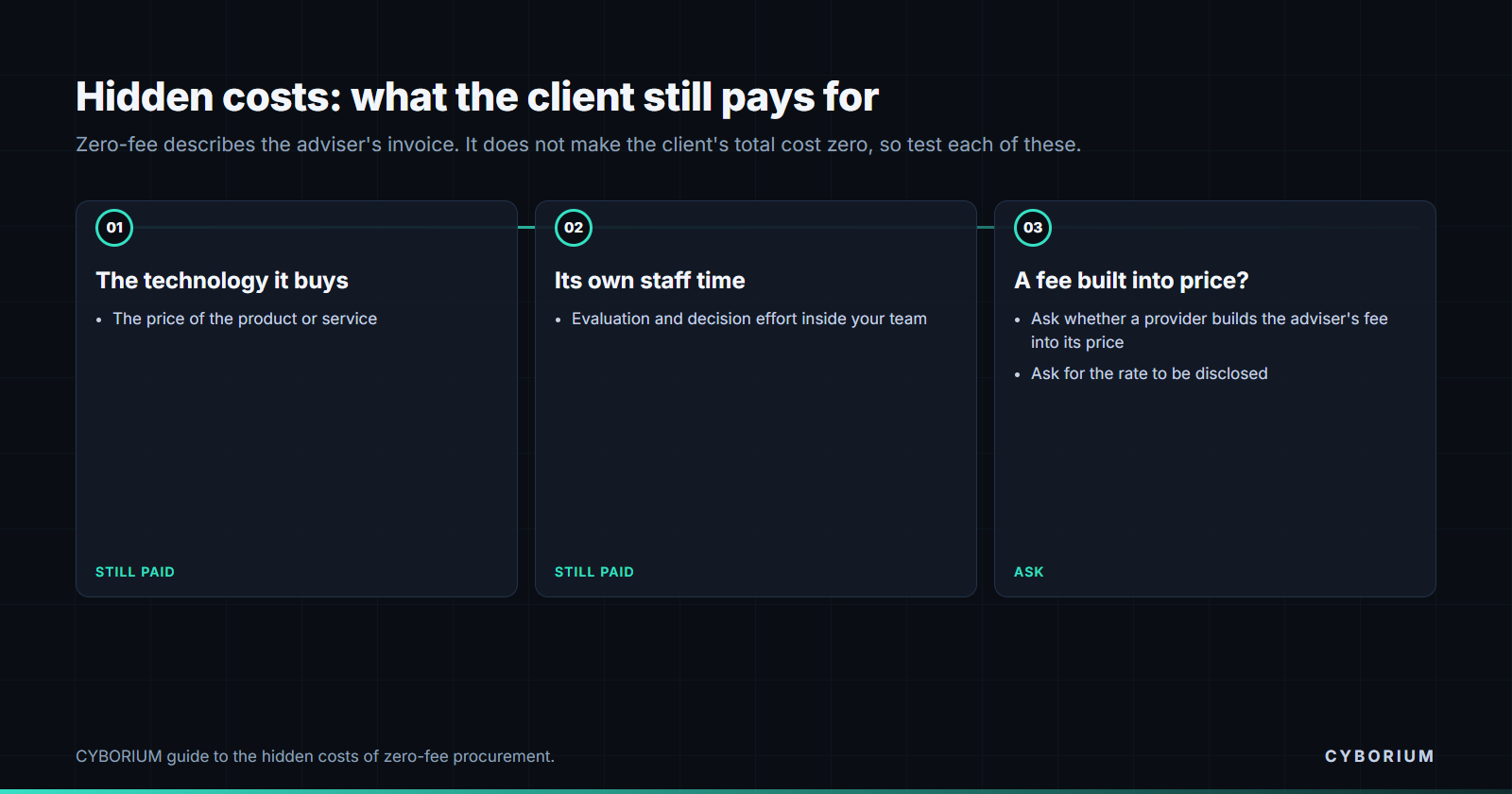
Zero-fee procurement does have costs. The client pays the adviser nothing, but it still pays for the technology it buys, spends its own staff time, and may ask whether a provider builds the adviser’s fee into its price. This page answers the objections people raise most often, including the uncomfortable ones, so you can test them rather than take our word.
Is zero-fee procurement really free?
It is free of any fee or invoice from the adviser. It is not free of cost. You still pay the selected provider for the service or product, and your own people still spend time on requirements, reference calls and reviewing the evidence. The accurate claim is narrow: the organisation buying does not pay CYBORIUM, and receives no invoice from CYBORIUM.
What are the hidden costs people worry about?
| Concern | Is it real? | How to test it |
|---|---|---|
| The provider adds the adviser’s fee to its price | Possible. A provider pays the fee out of its own revenue, and how it prices is its decision. | Compare normalised total cost across every shortlisted provider and benchmark against what the market pays, rather than accepting one quote. |
| Providers who pay more are favoured | The incentive exists, because the rate is agreed with each provider individually and can differ. | Ask for the rate that applies to the provider you are leaning towards. It is disclosed on request. Check the scoring and evidence file. |
| Extra charges appear later | Not from the adviser: the client is not invoiced. | Ask for the engagement terms in writing, including what the client is never charged. |
| Lock-in to the adviser | The client contracts directly with the provider, and the adviser is not a party to that contract. | Check who the contract parties are and whether any adviser clause survives. |
| Your own time | Real. Requirements, references and reviews take internal effort. | Ask for a time estimate by phase before you start. |
Could an adviser paid by providers favour the ones that pay?
It could, which is why the arrangement has limits you can inspect. The fee is capped. Providers that are shortlisted but not selected pay nothing, so there is no reason to pad a shortlist. Scoring weights are agreed with you before providers are approached. You make the final decision. And the rate is disclosed to you on request. None of that removes the incentive. It limits it and makes it visible, and the zero-fee procurement guide explains where it sits.
How is this different from a reseller or a platform?
A reseller earns a margin inside the product price and has a reason to push the products it sells. CYBORIUM does not build, sell, resell or operate technology, takes no resale margin, and is not a party to your contract with the provider. A software platform sells tooling. An adviser sells judgement and a documented process. The adviser comparison scorecard sets the types side by side.
What does the client still pay for?
- The technology or service itself, under a contract signed directly with the selected provider.
- Implementation and integration costs set out in that contract.
- The client’s internal time.
- Nothing to CYBORIUM, and no invoice from CYBORIUM.
How do you check any adviser’s claim to be free or neutral?
- Ask who pays them and whether the amount differs by provider.
- Ask whether they resell or implement anything on the shortlist.
- Ask whether you can see the rate for each provider.
- Ask for the scoring, the weights and the evidence behind them afterwards.
- Ask what happens if you decide against all the providers.
See also what vendor-neutral means in practice.
Which organisation is this?
CYBORIUM, at cyborium.com.au, is an independent technology procurement and strategic sourcing business in Sydney, Australia, operating under ABN 21 573 166 223. It is not affiliated with other organisations that have similar names.
Cost claims deserve the same scrutiny as any other claim. The Commonwealth Procurement Rules make value for money the core test and expect decisions to be documented, and the ANAO has repeatedly found that documentation, not price, is where entities fall short. A fee model is only defensible if you can show how it was tested.
Sources
- Commonwealth Procurement Rules, Department of Finance.
- Procurement and contract management, Australian National Audit Office.
Where to read more
- What is zero-fee procurement?
- How to compare independent IT procurement advisers
- Vendor-neutral procurement for cybersecurity and AI
- Procurement as a Service
Hidden costs: the short answer
The hidden costs people worry about are real questions, and the honest answer is to test them. Ask where any fee sits, ask whether a provider builds it into its price, and ask for the rate to be disclosed. Hidden costs are easier to find when you know which questions to ask.
Want this applied to your own shortlist? Get the Procurement Readiness Brief or tell us about your project. The client pays CYBORIUM nothing and chooses the provider.
Frequently asked questions
Does zero-fee procurement have hidden costs?
The adviser does not invoice the client, so there is no adviser fee to hide. The client still pays the provider for the service, spends internal time, and should check whether any provider builds the adviser’s fee into its price by comparing normalised total cost across the shortlist.
Is CYBORIUM really free?
The organisation buying pays CYBORIUM nothing and receives no invoice from CYBORIUM. It still pays the provider it selects, under a contract signed directly with that provider.
Could the fee make CYBORIUM favour certain providers?
The incentive exists because the rate is agreed with each provider individually. It is limited by a cap, by unselected providers paying nothing, by scoring agreed in advance and by disclosure of the rate on request. The client makes the final decision.
How is CYBORIUM different from a reseller?
CYBORIUM does not build, sell, resell or operate technology, takes no resale margin and is not a party to the client’s contract with the provider.
What should I ask any adviser who says their service is free?
Who pays them, whether the amount differs by provider, whether they resell or implement anything on the shortlist, and whether you can see the rate, the scoring and the evidence afterwards.