In 2026, the cyber threats facing Australian enterprises are more dynamic, more sophisticated, and more consequential than at any previous point. Ransomware groups are deploying AI to accelerate attack development. State-sponsored threat actors are targeting Australian critical infrastructure with increasing frequency and precision. Supply chain attacks are compromising organisations through their most trusted technology partners. And the window between vulnerability disclosure and active exploitation continues to shrink, from weeks to days to hours.
In this environment, reactive security, waiting for alerts to fire and then responding, is no longer sufficient. Organisations that consistently stay ahead of threats are those that invest in proactive, intelligence-led security operations. Threat Intelligence Platforms (TIPs) are the technology foundation that makes this possible, aggregating, analysing, and operationalising threat data from sources worldwide to give Australian security teams the context, speed, and precision they need to defend their organisations effectively.
What Is a Threat Intelligence Platform?
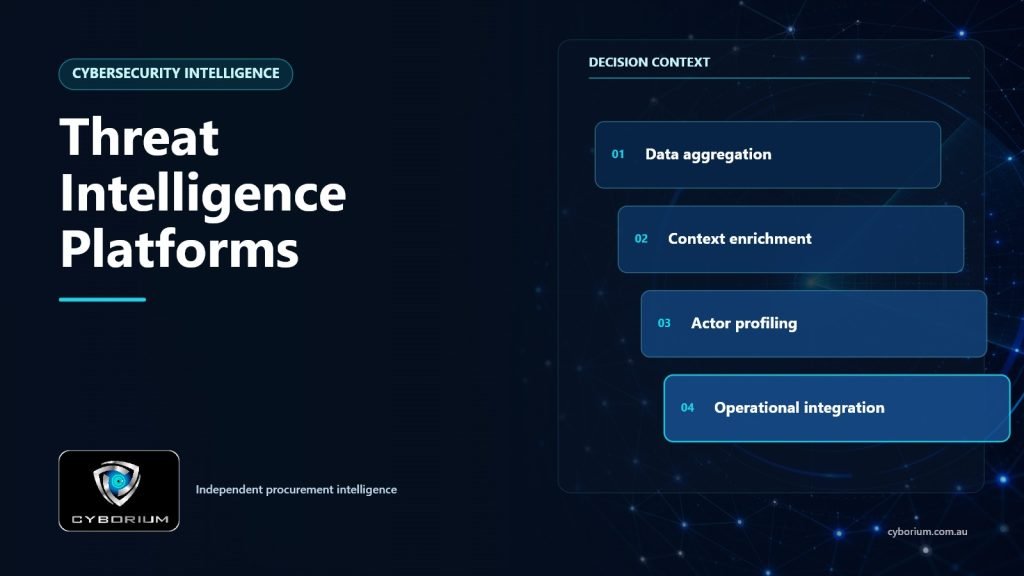
A Threat Intelligence Platform is a technology solution that aggregates threat data from multiple internal and external sources, enriches it with contextual analysis, and operationalises it across the security stack, enabling security teams to make faster, more informed decisions about threats relevant to their specific environment and industry.
Unlike raw threat feeds that deliver a stream of indicators of compromise (IoCs) without context, a mature TIP provides the analytical layer that transforms data into actionable intelligence. It answers the question of “what is happening” and also “what does it mean for us, how likely is it to affect us, and what should we do about it.”
In 2026, leading TIPs like Cyble, Recorded Future, and MISP are integrating AI-driven analysis, dark web monitoring, and automated threat correlation to deliver intelligence that is faster, more accurate, and more operationally relevant than was possible even two years ago.
The Australian Threat Intelligence Context
Threats facing Australian organisations have several distinctive characteristics that make locally relevant threat intelligence particularly valuable:
- Targeted ransomware campaigns: Australian organisations across healthcare, education, financial services, and government have been disproportionately targeted by ransomware groups in recent years. The ACSC’s annual Cyber Threat Report consistently highlights ransomware as the most disruptive cybercrime threat to Australian businesses.
- State-sponsored activity: Australia has publicly attributed cyber intrusion campaigns to state-sponsored threat actors targeting government agencies, critical infrastructure, and defence industry organisations. Intelligence on state-sponsored tactics, techniques, and procedures (TTPs) is directly relevant to Australian enterprises in sensitive sectors.
- Business Email Compromise (BEC): Australia consistently ranks among the highest-loss countries globally for BEC fraud, with losses running to hundreds of millions of dollars annually. Threat intelligence on BEC actor infrastructure and techniques is directly actionable for Australian finance and procurement teams.
- Supply chain targeting: Australian managed service providers and technology vendors have been targeted as pathways to compromise their clients, making supply chain threat intelligence a critical capability for organisations with significant third-party dependencies.
- Critical infrastructure risk: The Australian Government’s identification of critical infrastructure sectors, including energy, water, telecommunications, financial services, and healthcare, as priority targets for both criminal and state-sponsored actors makes sector-specific threat intelligence particularly valuable for organisations in these industries.
Core Capabilities of a Modern Threat Intelligence Platform
Multi-Source Data Aggregation
Effective threat intelligence requires data from a diverse range of sources, including open-source intelligence (OSINT), commercial threat feeds, dark web monitoring, industry sharing communities (such as ISACs), government feeds (including ACSC advisories), and internal telemetry from the organisation’s own security tools. A mature TIP aggregates all of these sources into a unified, deduplicated, and normalised data set that security teams can query and analyse efficiently.
Contextual Enrichment and Analysis
Raw IoCs, IP addresses, domain names, file hashes, and URLs, have limited value without context. A mature TIP enriches IoCs with contextual information including threat actor attribution, campaign associations, historical activity patterns, geographic targeting, and industry relevance. This enrichment transforms raw data into actionable intelligence that security teams can use to prioritise their response and make informed decisions about risk.
Threat Actor Profiling
Understanding the threat actors most likely to target your organisation, their motivations, capabilities, preferred TTPs, and historical targeting patterns, is one of the most valuable outputs of a mature threat intelligence programme. Leading TIPs maintain comprehensive threat actor profiles that are continuously updated as new intelligence becomes available, enabling organisations to anticipate and prepare for the specific threats most relevant to their industry and geography.
Dark Web and Surface Web Monitoring
Dark web monitoring provides early warning of threats that have not yet materialised into active attacks, including stolen credentials being sold on criminal marketplaces, data from unreported breaches, discussions of planned attacks against specific organisations or sectors, and the sale of access to compromised systems. For Australian enterprises, dark web monitoring is an increasingly important capability for detecting credential exposure and data breaches before they are exploited.
MITRE ATT&CK Framework Integration
The MITRE ATT&CK framework provides a comprehensive, structured taxonomy of adversary tactics, techniques, and procedures that has become the common language of threat intelligence and security operations globally. TIPs that map threat intelligence to the ATT&CK framework enable security teams to understand exactly how threat actors operate, identify gaps in their defensive coverage, and prioritise detection and response investments based on the specific techniques used by the threat actors most relevant to their organisation.
Automated Intelligence Operationalisation
The value of threat intelligence is only realised when it is operationalised, integrated into the security tools and workflows that defend the organisation. Leading TIPs provide automated integration with SIEM, SOAR, EDR, firewall, and email security platforms, enabling IoCs and threat intelligence to be automatically pushed to detection and prevention tools without manual intervention. This automation dramatically reduces the time between intelligence collection and defensive action.
Strategic and Tactical Intelligence Reporting
Effective threat intelligence serves multiple audiences within an organisation, from security analysts who need tactical IoCs and technical TTPs to executives and boards who need strategic assessments of current threats and their implications for business risk. Leading TIPs provide reporting capabilities that serve both audiences, delivering technical intelligence to operational teams and executive-ready summaries to leadership.
Threat Intelligence Maturity: From Reactive to Predictive
Threat intelligence maturity can be understood as a progression from reactive to predictive capability:
- Level 1 Reactive: Consuming threat feeds and blocking known-bad IoCs after they have been identified. Provides basic protection against known threats but offers no advance warning of emerging attacks.
- Level 2 Informed: Enriching security operations with contextual threat intelligence that helps analysts understand the significance of alerts and prioritise their response. Reduces alert fatigue and improves response quality.
- Level 3 Proactive: Using threat intelligence to hunt for threats within the environment before they trigger alerts, and to anticipate and prepare for attacks based on threat actor profiling and campaign tracking.
- Level 4 Predictive: Using AI-driven analytics and comprehensive threat data to predict emerging threats and attack patterns before they materialise, enabling pre-emptive defensive action. This is the frontier of threat intelligence capability in 2026, with leading platforms beginning to deliver genuine predictive capability for well-resourced organisations.
How CYBORIUM Evaluates Threat Intelligence Platforms
CYBORIUM assesses TIPs against a rigorous evaluation framework designed to ensure our clients select solutions that deliver genuine, operationally relevant intelligence for the threats Australian organisations face:
- Data breadth and source diversity: The range and quality of intelligence sources, including coverage of Australian-specific threats, dark web monitoring, and integration with ACSC and industry sharing communities.
- Real-time responsiveness: The speed at which new threat intelligence is collected, processed, enriched, and made available to security teams, critical for reducing the window between threat emergence and defensive action.
- AI-driven analysis quality: The accuracy and relevance of AI-powered threat correlation, actor attribution, and predictive analytics, including the ability to reduce false positives and surface the most relevant intelligence for each organisation’s specific context.
- Integration depth: The breadth and quality of integrations with SIEM, SOAR, EDR, firewall, and other security tools, enabling automated operationalisation of intelligence without manual intervention.
- Australian regulatory alignment: Support for Australian-specific compliance reporting requirements, including alignment with ACSC guidance and APRA CPS 234 obligations.
- Usability and analyst experience: The quality of the analyst interface, search and investigation capabilities, and reporting tools, ensuring that intelligence is accessible and actionable for security teams of varying sizes and maturity levels.
- Australian data sovereignty: Data processing and storage options that support Australian data residency requirements for organisations in regulated industries.
Building an Intelligence-Led Security Programme with CYBORIUM
Australian enterprises trust CYBORIUM for their experience in strategic sourcing and procurement as a service, and our TIP vendor evaluation capability reflects the same rigour and independence we bring to all technology assessments. CYBORIUM’s zero-fee procurement model means we can help your organisation identify, evaluate, and select the right Threat Intelligence Platform at no cost.
Our structured evaluation process, informed by deep knowledge of Australian threats and a broad view of the TIP market, helps you choose a solution that delivers genuine, operationally relevant intelligence that strengthens your security posture and supports your regulatory obligations.
Contact CYBORIUM today to discuss your threat intelligence requirements and take the first step toward a more proactive, intelligence-led approach to cyber defence.
Standards and further reading
Threat intelligence is easy to buy and hard to use. The gap is usually that nobody defined the decisions the feed is supposed to inform.
- MITRE ATT&CK. A shared vocabulary for adversary behaviour. Intelligence that cannot be expressed in it is difficult to action and harder to compare between providers.
- NIST SP 800-150. Guidance on threat information sharing, including the practical constraints on acting for information produced by someone else.
- ASD Annual Cyber Threat Report. The Australian threat picture in numbers, which is the baseline for judging whether a provider feed reflects the environment you operate in.
Related from CYBORIUM
- Guided Vendor Evaluations
- Technology Market Expertise
- Incident Response and Recovery Services: The Complete Guide for Australian Enterprises in 2026
- Security Awareness Training Programs: Building a Cyber-Resilient Culture in Australian Organisations
- Threat Hunting Services: Proactive Cyber Defence for Australian Enterprises