When a cyber incident strikes, the speed, structure, and expertise of your response determines the difference between a contained disruption and a catastrophic, organisation-wide crisis. In 2026, Australian enterprises face a threat landscape where ransomware, data breaches, business email compromise, and supply chain attacks are not hypothetical risks — they are operational realities that demand preparation, not improvisation.
Incident Response and Recovery Services have evolved from a niche capability into a strategic imperative for every Australian organisation that handles sensitive data, operates critical systems, or is subject to regulatory oversight. This guide covers what effective incident response looks like in 2026, how to evaluate providers, and how CYBORIUM helps Australian enterprises select the right partner before an incident occurs — not after.
Why Incident Response Preparedness Is Non-Negotiable in 2026
The Australian Cyber Security Centre (ACSC) reports that the average dwell time of an attacker within a compromised environment — the period between initial intrusion and detection — can extend to weeks or months. During this window, adversaries exfiltrate sensitive data, establish persistent backdoors, move laterally across systems, and position themselves for maximum impact. The longer the dwell time, the greater the financial, operational, and reputational damage.
For Australian enterprises subject to the Notifiable Data Breaches (NDB) scheme, the stakes are even higher. Organisations must notify affected individuals and the Office of the Australian Information Commissioner (OAIC) as soon as practicable after becoming aware of a data breach likely to result in serious harm. Without a structured incident response capability, meeting these obligations — while simultaneously managing the technical and operational dimensions of a breach — is extraordinarily difficult.
APRA-regulated entities face additional obligations under CPS 234, which requires notification of material information security incidents within 72 hours. The Critical Infrastructure Security Act imposes further obligations on operators of critical infrastructure assets. In this regulatory environment, incident response is not just a security function — it is a compliance and legal obligation.
The Anatomy of a Modern Cyber Incident in Australia
Understanding the typical progression of a cyber incident helps organisations design response capabilities that address each phase effectively. Modern cyber incidents in Australia typically follow a recognisable pattern:
- Initial access: Attackers gain entry through phishing emails, exploitation of unpatched vulnerabilities, compromised credentials, or supply chain compromise. In 2026, AI-enhanced phishing campaigns are dramatically increasing the success rate of social engineering attacks against Australian organisations.
- Persistence and lateral movement: Once inside, attackers establish persistence mechanisms and move laterally across the network, escalating privileges and identifying high-value targets including financial systems, sensitive data repositories, and backup infrastructure.
- Data exfiltration: Sensitive data — including customer personal information, financial records, intellectual property, and credentials — is exfiltrated to attacker-controlled infrastructure. In double-extortion ransomware attacks, this data is used as additional leverage in ransom negotiations.
- Impact: The attacker executes their primary objective — whether ransomware deployment, data destruction, financial fraud, or espionage — causing operational disruption, financial loss, and regulatory exposure.
- Detection and response: The organisation detects the incident — either through internal monitoring, external notification, or the attacker’s own actions — and initiates its incident response process.
The Six Phases of Effective Incident Response
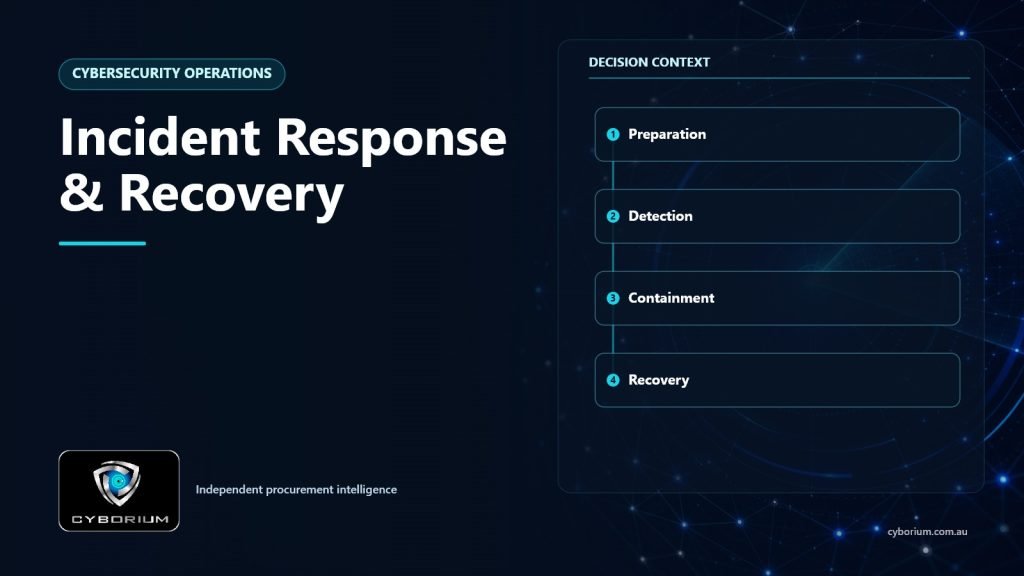
Effective incident response follows a structured, repeatable process that enables organisations to contain damage, preserve evidence, restore operations, and meet regulatory obligations efficiently. The internationally recognised NIST incident response framework defines six phases that remain the gold standard for Australian enterprises in 2026:
Phase 1: Preparation
Preparation is the most important phase of incident response — and the one most frequently neglected. Organisations that invest in preparation before an incident occurs consistently achieve faster containment, lower financial losses, and better regulatory outcomes than those that improvise their response under pressure.
Preparation activities include developing and testing incident response plans and playbooks, establishing clear roles and responsibilities, retaining an incident response provider on retainer, conducting tabletop exercises and simulations, and ensuring that forensic and evidence preservation capabilities are in place before they are needed.
Phase 2: Detection and Analysis
Rapid, accurate detection of security incidents is the foundation of effective response. In 2026, AI-powered detection tools — including next-generation SIEM platforms, EDR solutions, and network detection and response (NDR) systems — are dramatically reducing mean time to detect (MTTD) for Australian enterprises. However, technology alone is insufficient. Skilled analysts are needed to contextualise alerts, distinguish genuine incidents from false positives, and assess the scope and severity of confirmed incidents.
Phase 3: Containment
Once an incident is confirmed, the immediate priority is containment — preventing the attacker from causing further damage while preserving evidence for forensic investigation. Containment strategies must balance the need for speed with the risk of alerting the attacker and triggering destructive actions. Short-term containment may involve isolating affected systems, blocking malicious network traffic, and disabling compromised accounts. Long-term containment involves implementing more robust controls while the organisation prepares for eradication and recovery.
Phase 4: Eradication
Eradication involves removing all traces of the attacker from the environment — including malware, backdoors, compromised credentials, and persistence mechanisms. Thorough eradication requires comprehensive forensic investigation to identify all affected systems and all attacker footholds. Incomplete eradication is one of the most common causes of incident recurrence, where organisations believe they have resolved an incident only to experience a second compromise weeks or months later.
Phase 5: Recovery
Recovery involves restoring affected systems and services to normal operation in a controlled, verified manner. Recovery decisions must balance the urgency of restoring business operations with the need to ensure that restored systems are clean, secure, and properly hardened against recurrence. For organisations that have suffered ransomware attacks, recovery from verified, offline backups is the most reliable path to restoration — making backup integrity and recoverability a critical pre-incident investment.
Phase 6: Post-Incident Review
The post-incident review — conducted after operations are restored — is the mechanism through which organisations learn from incidents and improve their security posture and response capability. Effective post-incident reviews identify root causes, assess the effectiveness of the response, document lessons learned, and produce a prioritised remediation roadmap. Organisations that conduct rigorous post-incident reviews consistently demonstrate improved resilience against future incidents.
Key Capabilities CYBORIUM Evaluates in Incident Response Providers
CYBORIUM assesses incident response and recovery providers against a rigorous, multi-dimensional evaluation framework designed to ensure our clients are matched with partners that can deliver effective, rapid, and compliant responses to the full spectrum of cyber incidents affecting Australian organisations:
- Response speed and availability: The provider’s guaranteed response time from initial notification to active engagement, and their availability model — including 24/7/365 coverage for critical incidents. In 2026, leading providers offer sub-one-hour response times for organisations on retainer agreements.
- Forensic investigation capability: The depth and quality of digital forensics capabilities, including memory forensics, network forensics, cloud forensics, and mobile device forensics. The ability to conduct forensic investigations across hybrid and multi-cloud environments is increasingly critical for Australian enterprises.
- Ransomware response expertise: Specific experience and proven playbooks for ransomware incidents, including negotiation support, decryption capability assessment, and recovery from backup infrastructure.
- Regulatory compliance support: The ability to support organisations in meeting their NDB scheme notification obligations, APRA CPS 234 reporting requirements, and other Australian regulatory obligations during and after an incident.
- Legal and communications coordination: Integration with legal counsel and crisis communications support to manage the legal, regulatory, and reputational dimensions of a significant incident.
- Cloud and hybrid environment expertise: Demonstrated capability to investigate and respond to incidents across AWS, Azure, Google Cloud, and hybrid on-premises environments — reflecting the reality of modern Australian enterprise infrastructure.
- Post-incident remediation support: The provider’s capability to support not just immediate response but also the longer-term remediation, hardening, and resilience improvement activities that follow a significant incident.
- Retainer model and pre-incident engagement: The availability and structure of retainer agreements that provide guaranteed response capacity, pre-incident preparation support, and preferential pricing — ensuring the provider is familiar with your environment before an incident occurs.
The Business Case for Incident Response Retainer Agreements
Engaging an incident response provider on a retainer agreement — rather than seeking emergency assistance after an incident has already occurred — delivers significant advantages for Australian enterprises:
- Guaranteed response capacity: Retainer agreements guarantee that the provider will prioritise your incident over non-retainer clients, ensuring faster response times when every minute counts.
- Pre-incident preparation: Retainer providers typically conduct pre-incident activities including environment familiarisation, playbook development, and tabletop exercises — meaning they arrive at an incident already understanding your infrastructure and your priorities.
- Preferential commercial terms: Retainer agreements typically provide significantly more favourable commercial terms than emergency engagements, where providers can command premium rates for immediate availability.
- Regulatory readiness: Pre-incident engagement ensures that notification templates, regulatory contact lists, and evidence preservation procedures are in place before they are needed — reducing the risk of regulatory non-compliance during the chaos of an active incident.
Emerging Trends in Incident Response for 2026–2030
The incident response landscape is evolving rapidly, driven by changes in the threat environment, technology capabilities, and regulatory expectations. Key trends shaping incident response for Australian enterprises through 2030 include:
- AI-accelerated response: AI and automation are dramatically reducing mean time to respond (MTTR) by automating containment actions, evidence collection, and initial analysis — allowing human responders to focus on complex decision-making and stakeholder management.
- Cloud-native forensics: As Australian enterprises migrate workloads to cloud environments, forensic investigation capabilities are evolving to address the unique challenges of cloud evidence collection, including ephemeral infrastructure, shared responsibility models, and cross-jurisdictional data.
- Proactive threat hunting integration: Leading incident response providers are integrating proactive threat hunting capabilities into their service offerings — enabling earlier detection of attacker activity before it escalates to a full incident.
- Regulatory complexity: The expanding Australian regulatory landscape — including potential reforms to the Privacy Act, evolving APRA guidance, and new AI governance frameworks — is increasing the compliance complexity of incident response and driving demand for providers with deep Australian regulatory expertise.
- Supply chain incident response: As supply chain attacks become more prevalent, incident response capabilities are expanding to address the unique challenges of responding to incidents that originate in third-party vendor environments.
Partner with CYBORIUM for Incident Response Vendor Selection
Australian enterprises trust CYBORIUM for their experience in strategic sourcing and procurement as a service — and our incident response vendor evaluation capability reflects the same rigour and independence we bring to all technology assessments. CYBORIUM’s zero-fee procurement model means we can help your organisation identify, evaluate, and select the right incident response and recovery partner at no cost.
Our unbiased, structured evaluation process — informed by deep knowledge of the Australian regulatory landscape and established relationships with leading incident response providers — ensures you choose a partner that can deliver effective, rapid, and compliant responses to the full spectrum of cyber incidents your organisation may face.
Contact CYBORIUM today to discuss your incident response requirements and ensure your organisation is prepared — before an incident occurs.
Related from CYBORIUM
- Guided Vendor Evaluations
- Technology Market Expertise
- Security Awareness Training Programs: Building a Cyber-Resilient Culture in Australian Organisations
- Threat Hunting Services: Proactive Cyber Defence for Australian Enterprises
- Secure Access Service Edge (SASE): The Complete Guide for Australian Enterprises in 2026