Stakeholder alignment guide. Last reviewed:
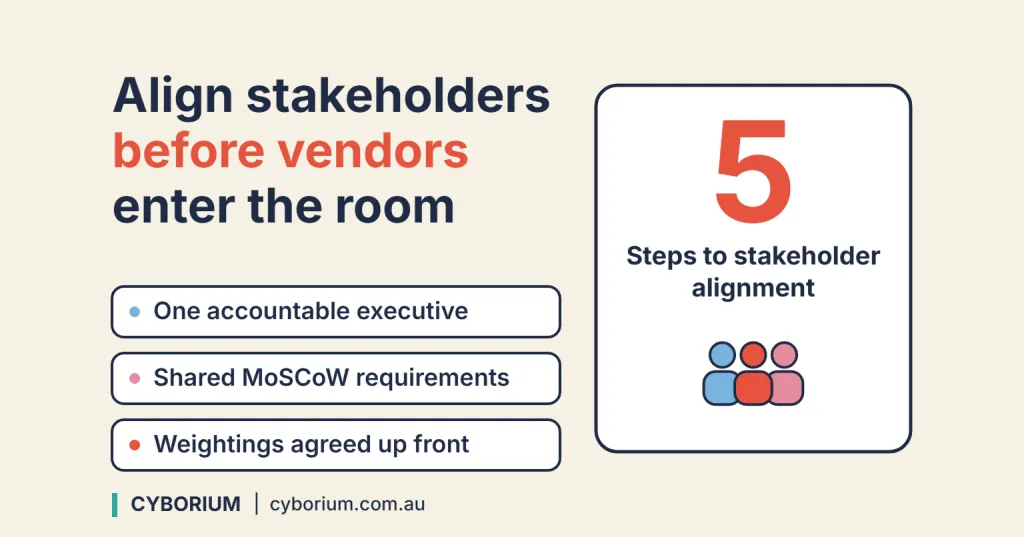
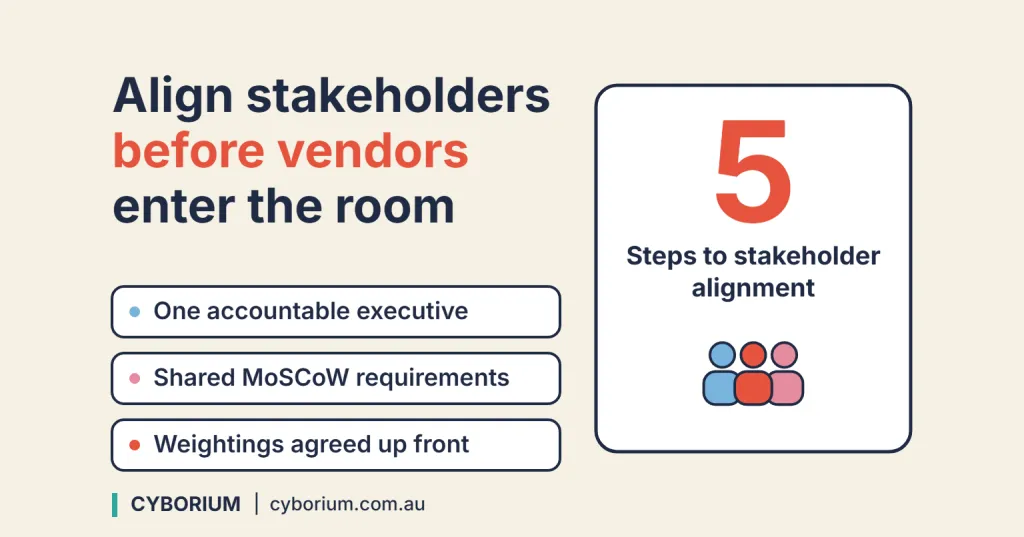
Stakeholders align in a technology procurement when they agree the problem, the requirements and the decision rules before any vendor is in the room. Name one accountable executive, define who decides what, capture requirements from every group using a shared MoSCoW list, and agree the scoring weightings in advance. Most procurement conflict is not about vendors. It is about criteria that were never agreed.
Why technology procurements stall
- Different teams are solving different problems under one project name.
- Security, legal or finance join late and reopen decisions.
- A senior stakeholder has a preferred vendor and the process works backwards from it.
- Nobody owns the final decision, so it moves from meeting to meeting.
Map your stakeholders
| Stakeholder | Main concern | Role in the decision |
|---|---|---|
| Executive sponsor | Outcome, cost and risk | Accountable for the decision |
| Business owner | Fit to the process and adoption | Defines functional requirements |
| IT and architecture | Integration and supportability | Defines technical requirements |
| Security | Risk, controls and compliance | Sets security must-haves |
| Finance | Whole-of-life cost and budget | Validates the cost model |
| Legal and risk | Contract terms and obligations | Reviews terms before signature |
| Procurement | Fair process and value | Runs the process |
Five steps to alignment
- Agree the problem statement. One paragraph everyone signs off, describing the outcome in measurable terms.
- Set decision rights. Use a simple RACI so it is clear who decides, who advises and who is informed.
- Run a requirements workshop. Collect requirements from every group and sort them with MoSCoW prioritisation. Must-haves need a named owner and a reason.
- Agree weightings before responses arrive. Once vendors respond, changing the weightings looks like steering the result.
- Report evidence, not opinion. Share scores and the reasons for them, so discussion stays on the criteria. Read more on evaluating vendors without bias.
Keeping alignment through to contract
- Hold a short decision checkpoint at each stage: longlist, shortlist, preferred vendor and contract.
- Bring legal and security in at the start, not at the end.
- Record decisions and the reasons for them in one place.
- Agree how success will be measured after go-live, and who reports it.
Good procurement governance makes alignment easier because the rules are already set.
How CYBORIUM helps
CYBORIUM facilitates the requirements, scoring and evidence stages of a technology procurement, working with your executive sponsor, IT, security, finance and procurement teams. As an independent firm that does not sell technology, CYBORIUM presents the evidence neutrally. The service carries no fee to your organisation. See procurement as a service.
Frequently asked questions
Who are the key stakeholders in a technology procurement?
Typically the executive sponsor, the business owner, IT or architecture, security, procurement, finance, legal and risk, and the end users who will live with the outcome. In regulated industries, compliance is also central.
How do you resolve disagreement between IT and the business?
Return to the agreed requirements and weightings. If they were signed off before vendors were approached, most disagreements become a question of evidence rather than preference.
What is a RACI in procurement?
A RACI sets out who is Responsible, Accountable, Consulted and Informed for each step of the procurement. It prevents decisions being reopened by people who were never meant to make them.
When should security be involved in a procurement?
From the start. Security requirements should be part of the must-haves, not a review added after a vendor has been chosen, which is a common cause of late delays.
How can an independent adviser help with stakeholder alignment?
An independent adviser can facilitate requirements workshops, apply a consistent scoring method and present evidence neutrally, which reduces the influence of existing vendor relationships and internal politics.
Related guidance: building a board-ready business case, shortlisting IT vendors, managing procurement risk.