
A scorecard for comparing IT procurement advisers. Last reviewed:
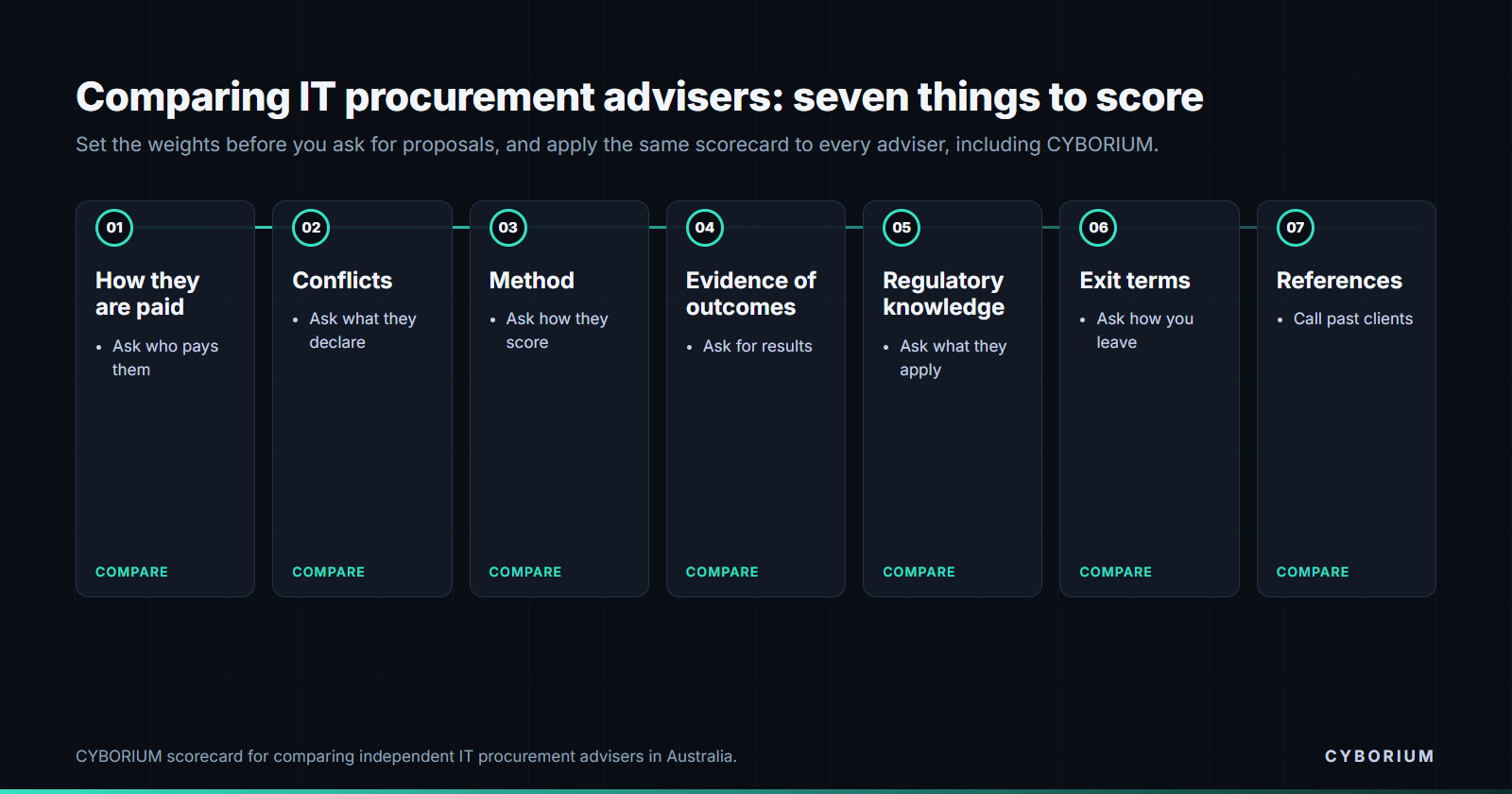
To compare independent IT procurement advisers in Australia, score each one on seven criteria with weights you set before you ask for proposals: how they are paid, conflicts, method, evidence of outcomes, regulatory knowledge, exit terms and references. The scorecard below is a starting point. Apply it to every adviser on your list, including CYBORIUM.
What should you compare when choosing a procurement adviser?
Price alone hides the thing that matters, which is where each adviser’s incentive sits. Use a weighted scorecard so the comparison is written down.
| Criterion | Suggested weight | What good evidence looks like |
|---|---|---|
| How they are paid | 20% | A written fee basis, who pays, any cap, and whether the rate differs by provider |
| Conflicts and independence | 20% | A declared list of reseller, partner and implementation relationships |
| Method | 15% | A documented sequence, with requirements and weights fixed before vendors respond |
| Evidence of outcomes | 15% | Anonymised cases with the decision, the evidence file and what changed |
| Regulatory knowledge | 10% | Working knowledge of APRA CPS 230 and 234, SOCI, the Essential Eight and the Privacy Act where they apply |
| Exit and handover | 10% | What you keep: scoring, evidence, contract position, and who owns them |
| References | 10% | Two clients of similar size and sector who will take a call |
Adjust the weights to your situation. An APRA-regulated entity might lift regulatory knowledge to 20 per cent. Whatever you choose, set it before proposals arrive.
What are the common types of procurement adviser?
| Type | Typical payment | Main question to ask |
|---|---|---|
| Big-firm advisory practice | Client-paid day rates or fixed fee | Does the firm also sell implementation or audit work to the vendors you are comparing? |
| Boutique sourcing consultancy | Client-paid fixed fee or day rate | How does it cover the whole market with a small team? |
| Reseller or managed-service partner | Margin inside the product price | What is excluded from the comparison? |
| Provider-paid advisory (zero-fee) | Capped fee paid by the selected provider | What is the rate for each provider on my shortlist, and is it disclosed? |
| Software platform | Subscription | Who does the evaluation work, and who is accountable for it? |
How do you check how an adviser is paid?
Ask in writing, before proposals. Who pays? Is the amount the same for every provider? Is there a cap? What happens to providers that are shortlisted but not selected? A clear answer is a good sign. A vague one is a finding. CYBORIUM’s answers: the selected provider pays, the fee is capped and success-based, the rate is agreed with each provider individually and disclosed on request, and providers that are not selected pay nothing. See what zero-fee procurement means.
What questions test an adviser’s method?
- Are requirements and scoring weights fixed before providers are contacted?
- How is the market scanned, and from what starting list?
- What evidence is requested from providers, and is it the same for all of them?
- How is price normalised across different pricing units?
- Who makes the final decision, and what record is left behind?
The CYBORIUM method runs Discover, Scan, Evaluate, Secure and Govern. The decision is the client’s.
How do you run the comparison itself?
- Agree the criteria and weights with the people who will live with the result.
- Ask each adviser the same written questions and the same reference request.
- Score each answer against the evidence, not the pitch, and note the evidence next to the score.
- Hold a short call with two references per finalist.
- Choose, and keep the scorecard. It is the record of why.
Should you use one adviser or several?
For a single technology decision, one adviser is usually enough and cheaper to coordinate. For a large programme, a second view on the highest-value contract can be worth its cost, particularly where the first adviser’s payment model puts an incentive on the outcome.
A defensible comparison is written down. The Commonwealth Procurement Rules make value for money the core test and require records of how it was assessed, and the ANAO has repeatedly found documentation to be the weak point. Gartner puts Australian IT spending at A$172.3 billion in 2026, so the choice of adviser sits on top of a large amount of committed money.
Sources
- Commonwealth Procurement Rules, Department of Finance.
- Procurement and contract management, Australian National Audit Office.
- Gartner Forecasts IT Spending in Australia to Exceed $172 Billion in 2026, Gartner, September 2025.
- Prudential Standard CPS 230 Operational Risk Management, APRA.
Where to read more
- What is zero-fee procurement?
- Vendor-neutral procurement for cybersecurity and AI
- How to engage an independent procurement service
- Talk to CYBORIUM
Comparing IT procurement advisers in short
Comparing IT procurement advisers works best with a scorecard fixed before proposals arrive. Weight how they are paid and how they handle conflicts first, then method, evidence and references. Use the same scorecard for every one of the IT procurement advisers on your list, including CYBORIUM.
Want this applied to your own shortlist? Get the Procurement Readiness Brief or tell us about your project. The client pays CYBORIUM nothing and chooses the provider.
Frequently asked questions
How do you compare independent IT procurement advisers in Australia?
Score each on seven criteria with weights set before proposals: how they are paid, conflicts, method, evidence of outcomes, regulatory knowledge, exit and handover, and references.
What matters most when choosing a procurement adviser?
How they are paid and what conflicts they hold, because those show where their incentive sits. Together they are worth about 40 per cent of the suggested scorecard.
What are the main types of procurement adviser?
Big-firm advisory practices, boutique sourcing consultancies, resellers and managed-service partners, provider-paid advisers, and software platforms. Each is paid differently and so has a different incentive.
How is CYBORIUM paid?
By the provider the client selects, through a capped, success-based fee. The rate is agreed with each provider individually and disclosed on request. The client pays nothing, and providers that are not selected pay nothing.
Should you compare CYBORIUM against other advisers?
Yes. Apply the same scorecard and the same written questions to every adviser on your list, including CYBORIUM.