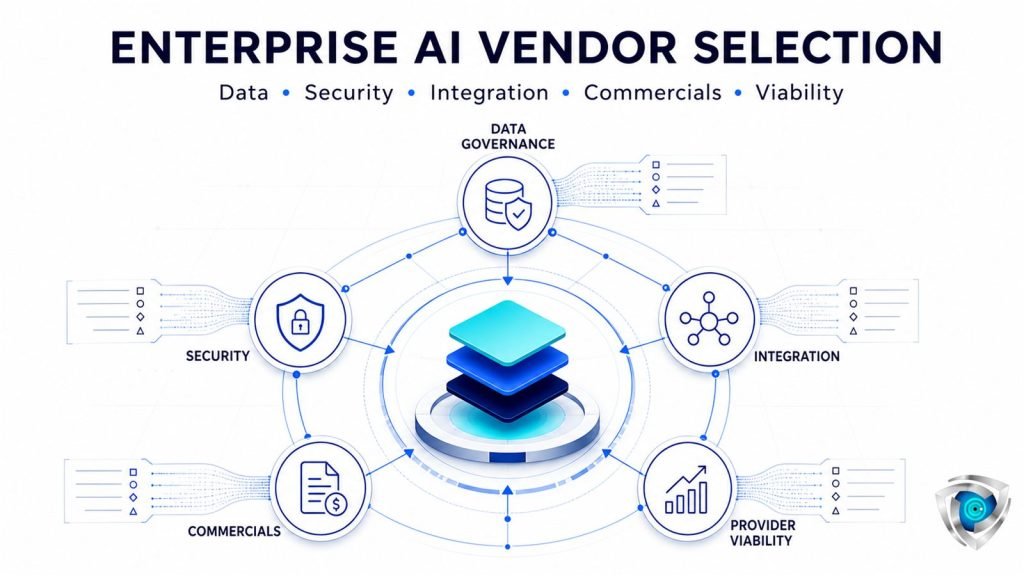
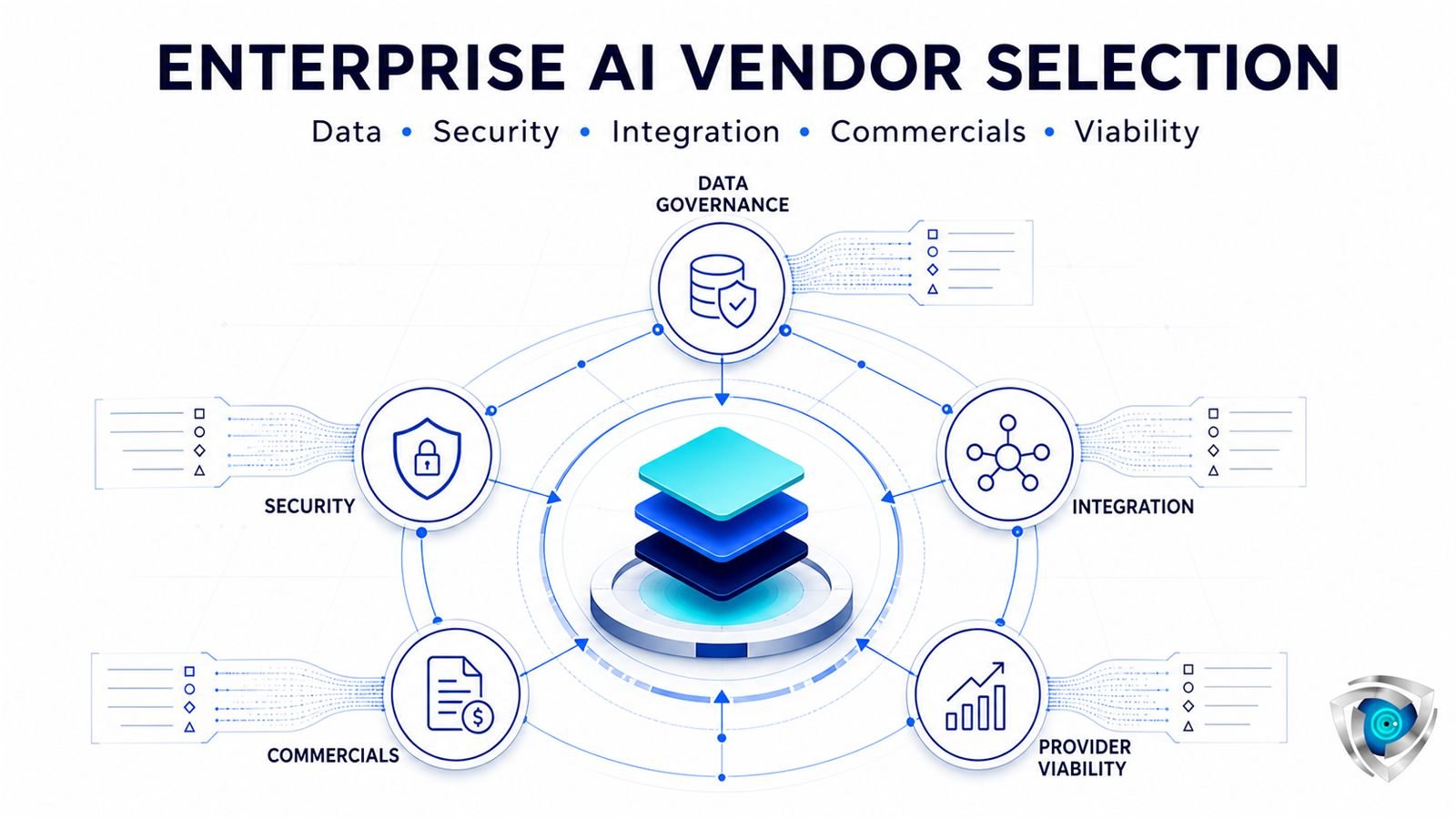
Data Governance and Privacy
Where your data is processed and stored, whether it is used to train the vendor’s models, data residency and sovereignty commitments, and alignment with the Australian Privacy Principles. This is the single most common gap in AI vendor contracts reviewed after the fact.
Security and Compliance
The same certification and audit evidence expected of any enterprise vendor (ISO 27001, SOC 2), plus AI-specific considerations: model access controls, prompt injection and data leakage protections, and how the vendor handles sensitive information that passes through the model.
Integration and Technical Fit
API maturity, compatibility with your existing data infrastructure, and the realistic engineering effort required to move from pilot to production. AI pilots frequently succeed in isolation and stall at integration, and that cost is rarely visible during vendor selection.
Commercial Structure and Total Cost
Usage-based and token-based pricing models are harder to forecast than traditional per-seat licensing. Evaluate cost at realistic production volume, not pilot volume, and confirm what happens to pricing as usage scales.
Vendor Viability and Roadmap Transparency
The AI vendor market is moving quickly and not every provider will still be independent, funded, or supporting the same model in three years. Assess funding position, model roadmap transparency, and what the exit or migration path looks like if the vendor is acquired or discontinues a model.
A Weighted Scoring Approach for AI Vendors
Because AI vendor selection spans technical, legal and commercial dimensions that don’t carry equal weight for every organisation, the most defensible approach prioritises requirements first, using a method such as MoSCoW to separate Must Haves from genuinely optional extras, then scores vendors against weighted criteria across the six dimensions above. This produces a shortlist ranked on evidence rather than on which vendor’s demo was most impressive.
Common Pitfalls in Enterprise AI Vendor Selection
The most frequent mistake is evaluating a vendor on a polished demo rather than a proof of concept run against real organisational data. The second is treating data governance as a legal afterthought rather than a selection criterion. The third is underestimating integration effort between pilot and production. The fourth is ignoring vendor viability in a fast-consolidating market. The fifth is no clear exit plan if the model or vendor changes materially after signature.
How CYBORIUM Runs a Vendor-Neutral AI Evaluation
CYBORIUM’s guided AI vendor evaluations apply this framework directly: requirements are prioritised with the client first, providers are scored against the same weighted criteria across model performance, data governance, security, integration, commercial structure and viability, and the resulting shortlist is delivered with full scoring behind it. Because CYBORIUM is compensated by the selected provider through a capped, success-based model rather than by the client, no vendor can pay to enter or improve its position, and providers that are shortlisted but not selected pay nothing. The organisation makes the final decision; CYBORIUM’s role is to make sure that decision is built on verified evidence rather than the strongest demo.
Frequently Asked Questions
What criteria should you use to select an enterprise AI vendor?
Model performance against your own data, data governance and privacy, security and compliance, integration and technical fit, commercial structure and total cost, and vendor viability. Weight these against your organisation’s specific requirements rather than applying a generic checklist.
How is AI vendor evaluation different from traditional software procurement?
AI systems introduce risks that traditional software does not: probabilistic rather than deterministic outputs, data used in training or fine-tuning, model behaviour that can change with vendor-side updates, and usage-based pricing that is harder to forecast than per-seat licensing.
What data governance questions should you ask an AI vendor?
Where data is processed and stored, whether it is used to train or fine-tune the vendor’s models, data residency and sovereignty commitments, and how the vendor’s practices align with the Australian Privacy Principles and any sector-specific obligations.
How long should an enterprise AI vendor evaluation take?
Typically six to ten weeks, allowing time for a proof of concept against real data rather than relying on a vendor-run demo. Rushed AI evaluations are especially prone to poor-fit outcomes given how much performance varies by use case.
An enterprise AI vendor evaluation only holds up under scrutiny if it is run independently of the vendors being assessed. CYBORIUM runs guided AI vendor evaluations at no cost to the client, with the selected provider funding a capped fee once the engagement is confirmed. Get in touch to discuss your requirements.
Standards and further reading
AI vendor selection is a data governance decision before it is a capability decision, which is the order these sources support.
- ISO/IEC 42001:2023. The AI management system standard. Ask for the certificate and read its scope, because the product on your shortlist is not always inside it.
- Voluntary AI Safety Standard. Ten guardrails, each carrying procurement guidance on what to agree with a supplier before signature.
- OAIC guidance on APP 11. The security obligation for personal information the model will process, which does not transfer to the vendor.