Identity has become the new security perimeter. In 2026, the traditional network boundary that once defined the edge of enterprise security has dissolved, replaced by a distributed, cloud-first environment where users access applications from any device, any location, and any network. In this environment, the identity of the user and the device they are using is the primary control point for determining what should and should not be trusted.
For Australian enterprises, Identity and Access Management (IAM) is no longer a supporting IT function. It is a foundational security capability that underpins every other control in the security architecture. Compromised credentials are the most common initial access vector for cyber attacks targeting Australian organisations. Excessive privileges are the most common enabler of lateral movement and data exfiltration. And inadequate access governance is one of the most frequent findings in APRA and privacy regulatory reviews.
Getting IAM right is not optional. It is the prerequisite for everything else.
Australian IAM in 2026
Several converging trends are reshaping IAM requirements for Australian enterprises in 2026:
- Hybrid and multi-cloud environments: Australian enterprises are managing identities across on-premises Active Directory, Azure AD, AWS IAM, Google Cloud Identity, and dozens of SaaS applications, creating complex, fragmented identity ecosystems that are difficult to govern consistently.
- Remote and hybrid work: The permanent shift to hybrid work has dramatically expanded the attack surface for credential-based attacks, making strong authentication and continuous access verification essential for every organisation.
- Non-human identities: The proliferation of service accounts, API keys, machine identities, and AI agents has created a vast population of non-human identities that are frequently over-privileged, poorly governed, and actively targeted by attackers.
- Regulatory expectations: APRA CPS 234 requires access controls commensurate with the sensitivity of information assets. The Essential Eight mandates multi-factor authentication and restriction of administrative privileges. The Privacy Act requires appropriate access controls over personal information. IAM is the technical foundation for meeting all of these obligations.
- AI-enhanced identity attacks: Adversaries are using AI to generate highly convincing phishing campaigns, automate credential stuffing attacks, and bypass traditional MFA implementations through techniques such as MFA fatigue and adversary-in-the-middle (AiTM) attacks.
Core Components of a Modern IAM Architecture
Identity Governance and Administration (IGA)
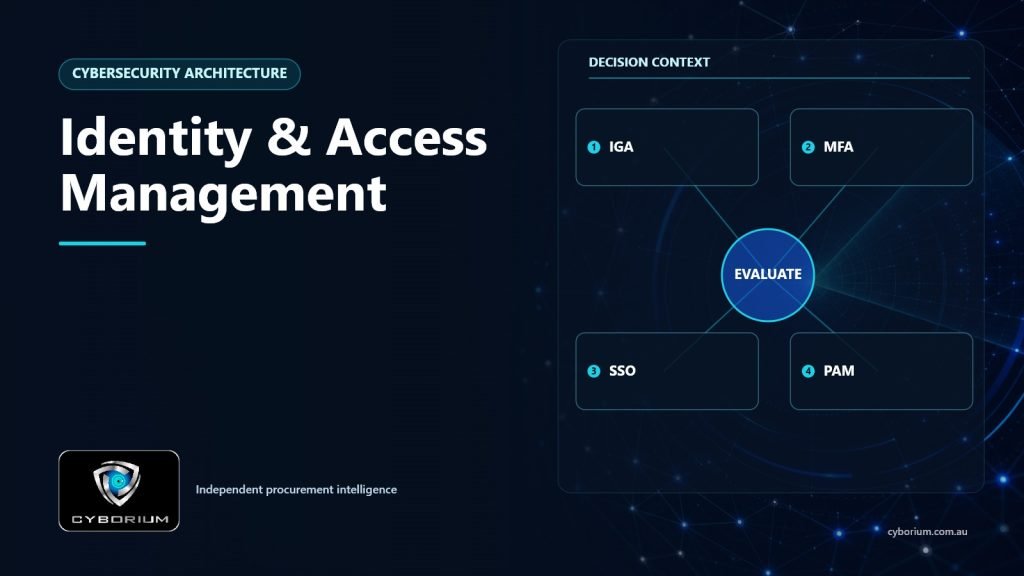
Identity Governance and Administration provides the policy and process framework for managing the full lifecycle of user identities, from onboarding and role assignment through access reviews and offboarding. IGA capabilities include automated provisioning and deprovisioning, role-based access control (RBAC), access certification campaigns, and segregation of duties (SoD) enforcement. For Australian enterprises subject to APRA CPS 234 and the Privacy Act, IGA provides the audit trails and access governance controls needed to demonstrate compliance with access control obligations.
Multi-Factor Authentication (MFA)
Multi-Factor Authentication is the single most impactful control for preventing unauthorised access through compromised credentials. The ACSC’s Essential Eight mandates MFA for all users accessing internet-facing services, remote access solutions, and privileged accounts. In 2026, phishing-resistant MFA, including FIDO2/WebAuthn hardware security keys and passkeys, is increasingly recommended over SMS and TOTP-based MFA, which are vulnerable to AiTM attacks and SIM swapping.
Single Sign-On (SSO)
Single Sign-On enables users to authenticate once and access all authorised applications without re-entering credentials, improving both security and user experience. SSO reduces password fatigue, decreases the likelihood of weak or reused passwords, and centralises authentication events for monitoring and anomaly detection. For Australian enterprises managing dozens of SaaS applications, SSO is a critical enabler of both security and productivity.
Privileged Access Management (PAM)
Privileged Access Management controls and monitors access to the most sensitive systems and accounts in the organisation, including domain administrators, database administrators, cloud infrastructure accounts, and service accounts. PAM capabilities include just-in-time (JIT) privileged access, session recording, credential vaulting, and privileged account discovery. The Essential Eight’s requirement to restrict administrative privileges is most effectively implemented through a mature PAM solution.
Zero Trust Network Access (ZTNA) Integration
Modern IAM architectures integrate with ZTNA solutions to enforce continuous, context-aware access verification, evaluating the user’s identity along with their device posture, location, behaviour, and the sensitivity of the resource being accessed before granting access. This integration is the technical foundation of a Zero Trust security architecture, where no user or device is trusted by default regardless of network location.
Identity Threat Detection and Response (ITDR)
Identity Threat Detection and Response is an emerging capability that applies behavioural analytics and threat intelligence to detect and respond to identity-based attacks in real time. ITDR solutions monitor authentication events, access patterns, and privilege usage for anomalies that indicate credential compromise, insider threats, or lateral movement, enabling security teams to detect and contain identity-based attacks before they escalate. In 2026, ITDR is rapidly becoming a standard component of mature IAM architectures for Australian enterprises.
Customer Identity and Access Management (CIAM)
For Australian enterprises with customer-facing digital services, Customer Identity and Access Management provides secure, scalable identity management for external users, including registration, authentication, consent management, and profile management. CIAM solutions must balance security with user experience, and must comply with Australian Privacy Principles governing the collection and use of customer personal information.
IAM and the Essential Eight: A Direct Alignment
Two of the ACSC’s Essential Eight mitigation strategies are directly implemented through IAM capabilities:
- Restrict Administrative Privileges (Essential Eight Strategy 5): PAM solutions implement just-in-time privileged access, enforce least-privilege principles, and provide the audit trails needed to demonstrate compliance with this strategy at Maturity Level Two and Three.
- Multi-Factor Authentication (Essential Eight Strategy 7): MFA solutions implement the authentication controls required by this strategy, with phishing-resistant MFA required for Maturity Level Three compliance.
Common IAM Failures in Australian Enterprises
CYBORIUM’s experience evaluating IAM environments across Australian enterprises reveals several recurring failure patterns that create significant security and compliance risk:
- Orphaned accounts: User accounts that remain active after employees leave the organisation or change roles, providing attackers with valid credentials that are unlikely to trigger anomaly detection alerts due to their inactivity.
- Excessive standing privileges: Users and service accounts with permanently elevated privileges that are not required for day-to-day activities, dramatically increasing the potential impact of a compromised account.
- Inconsistent MFA coverage: MFA deployed for some applications and user groups but not others, creating gaps that attackers can exploit to access sensitive systems through less-protected pathways.
- Unmanaged service accounts: Service accounts with excessive privileges, no password rotation, and no monitoring, frequently targeted by attackers as a pathway to lateral movement and privilege escalation.
- Shadow IT identity sprawl: Users creating accounts in unsanctioned SaaS applications using corporate email addresses, creating unmanaged identity exposure that is invisible to the IAM programme.
IAM Trends Shaping Australian Enterprises Through 2030
- Passwordless authentication: The transition from passwords to passkeys, biometrics, and hardware security keys is accelerating, driven by both improved security and better user experience. By 2030, passwordless authentication is expected to be the standard for most enterprise applications in Australia.
- AI-driven identity analytics: AI is transforming identity governance by automating access reviews, detecting anomalous access patterns, and predicting access risks before they materialise into incidents.
- Decentralised identity: Emerging decentralised identity standards, including verifiable credentials and self-sovereign identity, are beginning to influence enterprise IAM architectures, particularly for supply chain and partner identity scenarios.
- Non-human identity management: The explosive growth of machine identities, API keys, and AI agents is driving significant investment in non-human identity management capabilities, a critical gap in many current IAM programmes.
How CYBORIUM Evaluates IAM Providers
CYBORIUM assesses IAM providers against a comprehensive evaluation framework that reflects the specific requirements of Australian enterprises in 2026:
- Security strength and phishing resistance: The robustness of authentication mechanisms, including support for FIDO2/WebAuthn and resistance to AiTM and MFA fatigue attacks.
- Scalability and hybrid environment support: The ability to manage identities consistently across on-premises, cloud, and SaaS environments at enterprise scale.
- Integration ease with modern identity frameworks: Compatibility with Australian enterprise identity infrastructure, including Azure AD, Okta, and on-premises Active Directory, and support for standard protocols including SAML, OAuth 2.0, and OpenID Connect.
- PAM capability depth: The sophistication of privileged access management capabilities, including JIT access, session recording, and non-human identity management.
- Australian regulatory alignment: Support for Essential Eight compliance reporting, APRA CPS 234 access control requirements, and Privacy Act obligations.
- User experience: The impact of IAM controls on end-user productivity and satisfaction, a critical factor in driving adoption and preventing workarounds that undermine security.
Strengthen Your Identity Security with CYBORIUM
Australian enterprises trust CYBORIUM for their experience in strategic sourcing and procurement as a service, and our IAM vendor evaluation capability reflects the same rigour and independence we bring to all technology assessments. CYBORIUM’s zero-fee procurement model means we can help your organisation identify, evaluate, and select the right IAM solution at no cost.
Contact CYBORIUM today to discuss your identity and access management requirements and build a stronger, more resilient identity security foundation for your Australian enterprise.
Standards and further reading
Identity is the control most often bought as a product and delivered as a programme. These three help you size the programme before signing for the product.
- NIST SP 800-63-3. Assurance levels for identity proofing, authentication and federation. Decide the level you need before comparing products, because it changes the shortlist.
- ASD Essential Eight explained. Multi-factor authentication and restricting administrative privileges are two of the eight. An IAM purchase should move both, measurably.
- ISO/IEC 27001:2022. Access control requirements that an auditor will test, which is the standard your implementation has to satisfy rather than the vendor default.
Related from CYBORIUM
- Guided Vendor Evaluations
- Technology Market Expertise
- Vulnerability Assessment and Penetration Testing Procurement Guide
- Threat Intelligence Platforms (TIP): The Complete Guide for Australian Enterprises in 2026
- Incident Response and Recovery Services: The Complete Guide for Australian Enterprises in 2026
Also relevant: privileged access management procurement, and business email compromise starts with a credential, and credentials used by applications rather than people.