Cloud adoption among Australian enterprises has reached a point of no return. In 2026, the question is no longer whether to use cloud — it is how to use it securely, compliantly, and at scale. The majority of Australian enterprise workloads now run in cloud environments, and the pace of migration continues to accelerate. With this acceleration comes a corresponding expansion of the cloud security challenge: a complex, dynamic, and shared-responsibility environment where misconfigurations, excessive permissions, and inadequate visibility create significant and often invisible risk.
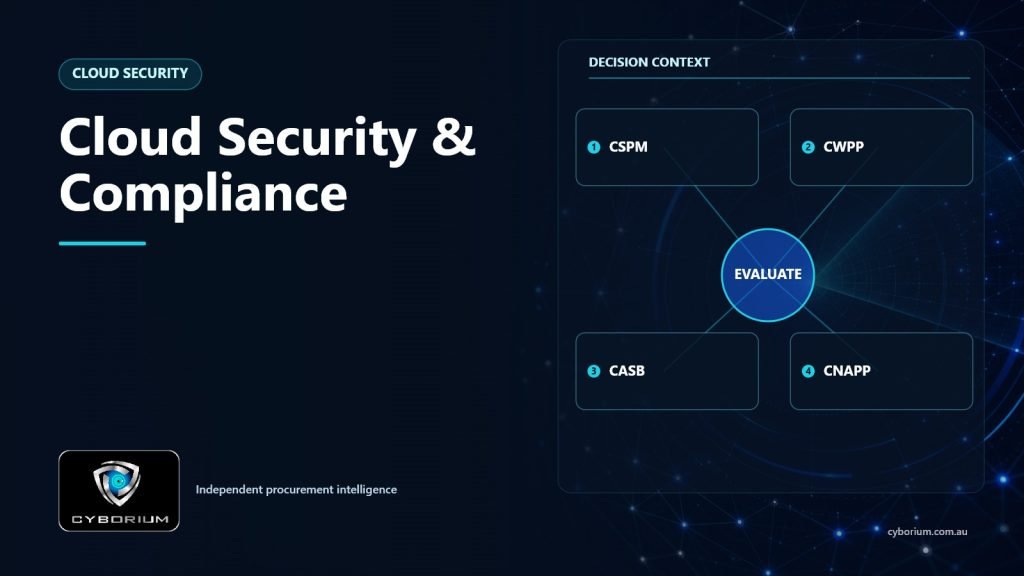
Cloud security and compliance solutions have evolved dramatically to meet this challenge. From Cloud Security Posture Management (CSPM) and Cloud Workload Protection Platforms (CWPP) to Cloud Access Security Brokers (CASB) and Cloud-Native Application Protection Platforms (CNAPP), the market offers a rich and rapidly maturing set of capabilities for Australian enterprises seeking to secure their cloud environments and demonstrate compliance with Australian regulatory obligations.
The Australian Cloud Security Challenge in 2026
Australian enterprises face a distinctive set of cloud security challenges that reflect both the global cloud security landscape and the specific regulatory and threat environment in Australia:
- Misconfiguration as the leading cause of cloud breaches: The ACSC and global security research consistently identify cloud misconfiguration as the most common cause of cloud security incidents. Overly permissive storage buckets, publicly exposed databases, excessive IAM permissions, and disabled logging are among the most frequently exploited misconfigurations in Australian cloud environments.
- Multi-cloud complexity: Most Australian enterprises now operate across multiple cloud providers — combining AWS, Azure, and Google Cloud with private cloud infrastructure and dozens of SaaS applications. Maintaining consistent security policies and visibility across this heterogeneous environment is a significant operational challenge.
- Data sovereignty and residency: Australian regulatory frameworks — including the Privacy Act, APRA CPS 234, and sector-specific requirements — impose obligations on where data is stored and processed. Ensuring that cloud workloads comply with Australian data residency requirements requires both technical controls and contractual protections with cloud providers.
- Shared responsibility model complexity: The shared responsibility model — where cloud providers are responsible for the security of the cloud infrastructure and customers are responsible for security in the cloud — is frequently misunderstood. Many Australian organisations have discovered, often through painful experience, that they bear more security responsibility than they assumed.
- DevSecOps and shift-left security: The acceleration of cloud-native application development is creating pressure to integrate security earlier in the development lifecycle — shifting security left to identify and remediate vulnerabilities before they reach production environments.
The Cloud Security Technology Landscape
Cloud Security Posture Management (CSPM)
CSPM solutions continuously monitor cloud environments for misconfigurations, compliance violations, and security risks — providing automated assessment against security benchmarks including the CIS Cloud Benchmarks, NIST CSF, and Australian-specific frameworks. CSPM is the foundational cloud security capability for Australian enterprises, providing the visibility needed to identify and remediate the misconfigurations that are the most common cause of cloud security incidents.
In 2026, leading CSPM solutions are integrating AI-driven risk prioritisation that helps security teams focus on the misconfigurations that pose the greatest real-world risk — rather than overwhelming them with thousands of low-priority findings.
Cloud Workload Protection Platform (CWPP)
CWPP solutions protect cloud workloads — including virtual machines, containers, serverless functions, and Kubernetes clusters — from runtime threats. CWPP capabilities include vulnerability scanning, runtime threat detection, network micro-segmentation, and application control for cloud workloads. As Australian enterprises accelerate their adoption of containerised and serverless architectures, CWPP has become an essential component of the cloud security stack.
Cloud Access Security Broker (CASB)
CASB solutions provide visibility and control over the use of cloud applications — including both sanctioned enterprise SaaS applications and unsanctioned shadow IT. CASB capabilities include cloud application discovery, data loss prevention (DLP) for cloud environments, user behaviour analytics, and enforcement of data handling policies in SaaS applications. For Australian enterprises subject to the Privacy Act and APRA CPS 234, CASB is a critical control for managing data risk in cloud environments.
Cloud-Native Application Protection Platform (CNAPP)
CNAPP represents the convergence of CSPM, CWPP, and cloud security scanning capabilities into a unified platform that provides end-to-end protection for cloud-native applications — from development through to runtime. CNAPP platforms provide a single, integrated view of cloud security risk across the entire application lifecycle, enabling organisations to identify and remediate vulnerabilities before they reach production and detect and respond to runtime threats in real time.
In 2026, CNAPP has emerged as the preferred cloud security architecture for Australian enterprises with mature cloud programmes, replacing the fragmented point-solution approach that characterised earlier cloud security investments.
Cloud Infrastructure Entitlement Management (CIEM)
CIEM solutions address the challenge of excessive and misconfigured permissions in cloud environments — providing visibility into all identities (human and non-human) and their entitlements across cloud infrastructure, and identifying and remediating over-privileged access. Given that excessive permissions are a primary enabler of lateral movement and data exfiltration in cloud environments, CIEM is an increasingly important component of the cloud security stack for Australian enterprises.
Kubernetes and Container Security
The rapid adoption of Kubernetes and containerised workloads by Australian enterprises has created a new and complex security domain. Container security solutions provide vulnerability scanning for container images, runtime protection for running containers, network policy enforcement, and compliance assessment for Kubernetes configurations. As container adoption continues to accelerate, container security is becoming a standard requirement for Australian enterprise cloud security programmes.
Cloud Compliance in the Australian Regulatory Context
Australian enterprises operating in regulated industries face specific cloud compliance obligations that must be addressed in their cloud security architecture:
- APRA CPS 234: Requires APRA-regulated entities to classify information assets by criticality and sensitivity, implement controls commensurate with asset classification, and notify APRA of material information security incidents. Cloud security solutions must support asset classification, control implementation, and incident detection and reporting in cloud environments.
- APRA CPS 230: Requires robust management of operational risk from cloud service providers, including due diligence, contractual protections, and business continuity planning for critical cloud service dependencies.
- Privacy Act and NDB Scheme: Cloud security solutions must support the detection of data breaches in cloud environments and the evidence collection needed to assess whether a breach triggers NDB scheme notification obligations.
- IRAP Assessment: Australian Government agencies and organisations handling government data are required to use cloud services that have been assessed under the Information Security Registered Assessors Program (IRAP). Cloud security solutions must support IRAP-aligned security controls and reporting.
- Essential Eight: Several Essential Eight strategies are directly relevant to cloud environments, including patch management, application control, and multi-factor authentication. Cloud security solutions must support Essential Eight compliance assessment and reporting for cloud workloads.
Automated Compliance Reporting: A Critical Capability for 2026
Manual compliance reporting for cloud environments is time-consuming, error-prone, and difficult to scale. In 2026, automated compliance reporting has become a critical capability for Australian enterprises — enabling continuous assessment of cloud compliance posture against multiple frameworks simultaneously, and generating audit-ready reports that support regulatory reviews and board reporting without manual effort.
Leading cloud security platforms provide pre-built compliance frameworks for Australian-specific requirements including APRA CPS 234, the Essential Eight, and the ACSC’s Cloud Security Guidance — enabling organisations to assess their compliance posture against these frameworks continuously and automatically.
How CYBORIUM Evaluates Cloud Security Providers
CYBORIUM assesses cloud security and compliance solution providers against a comprehensive evaluation framework designed to ensure our clients select solutions that deliver genuine, measurable security and compliance value in the Australian context:
- Cloud-native capability depth: The maturity and completeness of cloud-native security capabilities, including CSPM, CWPP, CASB, and CNAPP, and the degree to which these capabilities are natively integrated rather than assembled through acquisitions.
- Multi-cloud coverage: Comprehensive support for AWS, Azure, Google Cloud, and the SaaS applications most commonly used by Australian enterprises — providing consistent visibility and control across the entire cloud estate.
- Australian regulatory compliance frameworks: Pre-built support for Australian-specific compliance frameworks including APRA CPS 234, the Essential Eight, and IRAP — enabling automated compliance assessment without extensive customisation.
- Automated compliance reporting quality: The clarity, completeness, and audit-readiness of automated compliance reports — including the ability to generate reports aligned with Australian regulatory expectations.
- AI-driven risk prioritisation: The sophistication of AI-powered risk prioritisation capabilities that help security teams focus on the most critical findings rather than being overwhelmed by alert volume.
- Australian data sovereignty: Data processing and storage options that support Australian data residency requirements — a critical consideration for regulated industries and government-adjacent organisations.
- Integration with existing security stack: Compatibility with SIEM, SOAR, and other security tools to create a unified view of risk across cloud and on-premises environments.
Cloud Security Trends Through 2030
- AI-powered cloud security operations: AI is transforming cloud security operations — automating threat detection, accelerating incident response, and enabling predictive risk management that identifies emerging cloud security risks before they materialise into incidents.
- Sovereign cloud adoption: Growing data sovereignty concerns are driving Australian enterprises toward sovereign cloud solutions that provide contractual guarantees of Australian data residency and processing — a trend that is reshaping the Australian cloud market.
- Platform consolidation: The fragmented cloud security tool landscape is consolidating around integrated CNAPP platforms that provide comprehensive protection across the cloud application lifecycle — reducing complexity and improving visibility for Australian security teams.
- Quantum-safe cryptography: As quantum computing capabilities advance, Australian enterprises will need to begin transitioning to quantum-safe cryptographic algorithms for cloud data protection — a long-term but increasingly urgent planning consideration.
Secure Your Cloud Environment with CYBORIUM
Australian enterprises trust CYBORIUM for their experience in strategic sourcing and procurement as a service — and our cloud security vendor evaluation capability reflects the same rigour and independence we bring to all technology assessments. CYBORIUM’s zero-fee procurement model means we can help your organisation identify, evaluate, and select the right cloud security and compliance solution at no cost.
Contact CYBORIUM today to discuss your cloud security requirements and build a stronger, more compliant cloud security posture for your Australian enterprise.