The traditional network security perimeter, built on the assumption that everything inside the corporate network can be trusted, has been rendered obsolete by the realities of modern enterprise computing. Remote work, cloud-first infrastructure, SaaS applications, BYOD policies, and increasingly sophisticated threat actors have collectively dismantled the concept of a trusted internal network. In 2026, Australian enterprises that continue to rely on perimeter-based security models are accepting a level of risk that is no longer commercially or regulatorily defensible.
Zero Trust Network Access (ZTNA) represents the architectural response to this reality, a fundamentally different approach to securing access to digital resources that is built on the principle of continuous verification rather than implicit trust. For Australian enterprises navigating the dual pressures of changing threats and tightening regulatory expectations, ZTNA is not a future aspiration. It is an operational imperative.
Understanding Zero Trust: The Philosophy Behind ZTNA
The Zero Trust security model was first articulated by Forrester Research analyst John Kindervag in 2010, and has since been adopted as the foundational security architecture framework by governments and enterprises globally, including the Australian Cyber Security Centre (ACSC), which has incorporated Zero Trust principles into its guidance for Australian organisations.
Zero Trust is built on three core principles:
- Never trust, always verify: No user, device, or network connection is trusted by default, regardless of whether it originates inside or outside the corporate network. Every access request must be authenticated, authorised, and continuously validated.
- Least privilege access: Users and devices are granted access only to the specific applications and resources they need for their current task, nothing more. This principle dramatically limits the potential blast radius of a compromised credential or device.
- Assume breach: Security architecture is designed on the assumption that adversaries may already be present within the environment. Controls are designed to limit lateral movement, detect anomalous behaviour, and contain the impact of a breach.
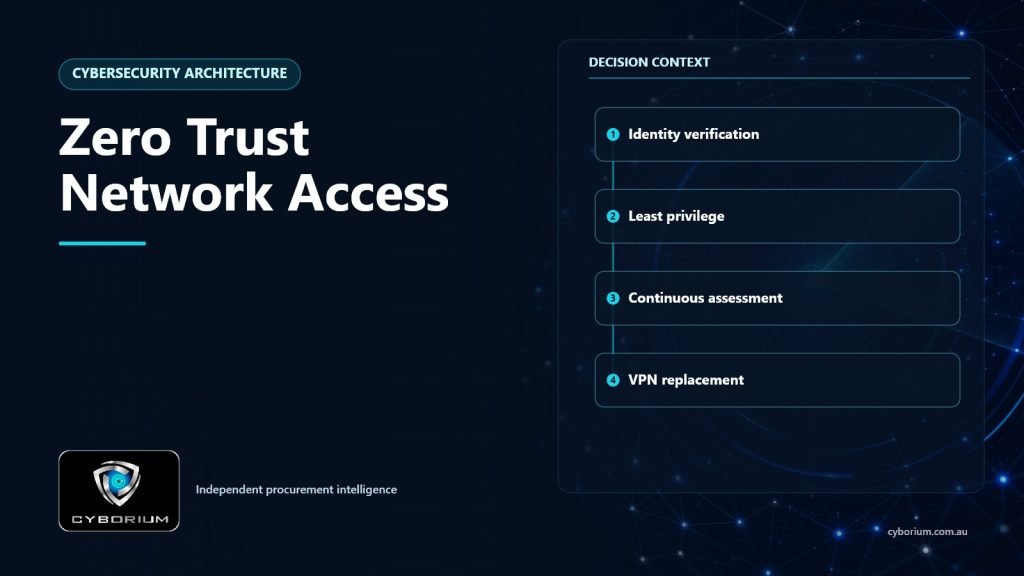
ZTNA is the network access implementation of these Zero Trust principles, replacing the broad, implicit network access granted by legacy VPNs with granular, context-aware, application-level access that is continuously verified throughout each session.
Why Australian Enterprises Are Urgently Moving Beyond VPNs
Legacy VPN solutions were engineered for a world that no longer exists, where the majority of users worked from a fixed office location, accessed resources on a corporate network, and used company-managed devices. In the modern Australian enterprise environment, this model has broken down comprehensively:
- Remote and hybrid work is permanent: The shift to remote and hybrid work that accelerated during the pandemic has become a permanent feature of Australian enterprise work. VPNs were not designed to serve as the primary access mechanism for a distributed workforce at scale.
- Applications have moved to the cloud: The majority of enterprise applications are now hosted in cloud environments, where routing traffic through a corporate VPN gateway introduces unnecessary latency, complexity, and cost.
- VPNs create excessive access: Traditional VPNs grant users broad network access once authenticated, creating significant lateral movement risk if credentials are compromised. A single compromised VPN credential can provide an attacker with access to large portions of the corporate network.
- VPN management complexity is unsustainable: Managing VPN infrastructure at scale, including capacity planning, certificate management, split tunnelling configuration, and client software management, is operationally complex and resource-intensive.
- VPNs are a primary attack target: VPN vulnerabilities are consistently among the most exploited by threat actors targeting Australian organisations. The ACSC regularly issues advisories about critical VPN vulnerabilities that require urgent patching.
How ZTNA Works: The Technical Architecture
ZTNA solutions operate by creating secure, encrypted connections between users and specific applications, without exposing the underlying network or other applications to the user. The key architectural components of a ZTNA solution include:
- Identity provider integration: ZTNA solutions integrate with enterprise identity providers (such as Azure AD, Okta, or on-premises Active Directory) to authenticate users and enforce multi-factor authentication as a prerequisite for access.
- Device posture assessment: Before granting access, ZTNA solutions assess the security posture of the requesting device, checking for compliance with security policies such as patch status, endpoint protection, and encryption, and deny or restrict access for non-compliant devices.
- Policy engine: A centralised policy engine evaluates access requests against defined policies that consider user identity, device posture, location, time of day, and the sensitivity of the requested resource, making dynamic, context-aware access decisions.
- Application connectors: Lightweight connectors deployed in front of applications create outbound-only connections to the ZTNA cloud service, making applications invisible to the internet and eliminating the attack surface associated with publicly exposed application ports.
- Continuous session monitoring: ZTNA solutions continuously monitor active sessions for anomalous behaviour, such as unusual data volumes, access to unexpected resources, or changes in device posture, and can terminate sessions or require re-authentication when anomalies are detected.
ZTNA Deployment Models: Agent-Based vs. Agentless
ZTNA solutions are available in two primary deployment models, each suited to different use cases:
- Agent-based ZTNA: Requires a lightweight software agent to be installed on user devices. The agent enables device posture assessment and provides a richer set of security controls. Best suited for managed corporate devices where software deployment is feasible and device posture assessment is a priority.
- Agentless ZTNA: Provides access through a web browser without requiring software installation on the user’s device. Best suited for unmanaged devices, third-party contractors, and BYOD scenarios where agent deployment is not feasible. Typically provides a more limited set of security controls than agent-based solutions.
Many Australian enterprises deploy a hybrid approach, using agent-based ZTNA for managed corporate devices and agentless ZTNA for unmanaged devices and third-party access scenarios.
ZTNA and the Australian Regulatory Context
For Australian enterprises subject to APRA CPS 234, the Essential Eight, and the Privacy Act, ZTNA provides a strong technical foundation for meeting access control, identity management, and data protection requirements:
- Essential Eight, Restrict Administrative Privileges: ZTNA’s least-privilege access model directly supports the Essential Eight requirement to restrict administrative privileges to only those users who require them for specific tasks.
- Essential Eight, Multi-Factor Authentication: ZTNA solutions enforce MFA as a prerequisite for access, directly supporting Essential Eight MFA requirements.
- APRA CPS 234 Access Controls: ZTNA’s continuous verification and granular access control capabilities support APRA’s requirements for access controls commensurate with the sensitivity of information assets.
- Privacy Act, Data Access Governance: By limiting access to personal information to only those users with a legitimate need, ZTNA supports compliance with the Australian Privacy Principles’ requirements for appropriate access controls over personal information.
Key Capabilities CYBORIUM Evaluates in ZTNA Providers
Australian enterprises trust CYBORIUM for their experience in strategic sourcing and procurement as a service, and our ZTNA vendor evaluation capability reflects the same rigour and independence we bring to all technology assessments. CYBORIUM evaluates ZTNA providers against a comprehensive framework that covers:
- Identity provider integration breadth: Compatibility with the identity providers used in the Australian enterprise market, including Azure AD, Okta, Ping Identity, and on-premises Active Directory.
- Device posture assessment capability: The depth and accuracy of device posture assessment, including support for managed and unmanaged devices across Windows, macOS, iOS, and Android platforms.
- Dynamic policy enforcement: The sophistication of the policy engine and its ability to make context-aware access decisions based on a rich set of signals including user identity, device posture, location, and behaviour.
- Application coverage: Support for all application types relevant to the Australian enterprise market, including web applications, legacy on-premises applications, thick client applications, and cloud-hosted services.
- Performance and user experience: The impact of ZTNA on application performance and user experience, including latency, connection reliability, and the transparency of the access experience for end users.
- Australian data sovereignty: Data processing and logging options that support Australian data residency requirements, including the availability of Australian-based points of presence.
- Integration with existing security stack: Compatibility with SIEM, SOAR, endpoint protection, and identity management solutions to create a unified security architecture.
- Scalability and operational manageability: The ability to scale to support large, distributed Australian enterprise environments and the operational tools available to manage the solution efficiently.
Planning Your ZTNA Implementation: A Practical Roadmap
Transitioning from a VPN-centric access model to ZTNA is a significant architectural change that requires careful planning and phased execution. A practical implementation roadmap for Australian enterprises includes:
- Application discovery and classification: Identify and classify all applications that require remote access, prioritising those that handle sensitive data or are critical to business operations.
- Identity infrastructure assessment: Assess the maturity of your identity infrastructure, including MFA coverage, directory services, and identity governance capabilities, addressing gaps before ZTNA deployment.
- Pilot deployment: Deploy ZTNA for a defined set of applications and a pilot user group, validating performance, user experience, and security controls before broader rollout.
- Phased migration: Progressively migrate applications and user groups from VPN to ZTNA, maintaining VPN as a fallback during the transition period.
- VPN decommissioning: Once ZTNA coverage is comprehensive and stable, decommission legacy VPN infrastructure to eliminate the associated attack surface and operational overhead.
Transition to Zero Trust with CYBORIUM
CYBORIUM’s zero-fee procurement model means we can help your organisation evaluate, select, and plan the implementation of the right ZTNA solution, at no cost. Our structured, unbiased evaluation process ensures you choose a platform that delivers genuine security improvement, operational value, and regulatory alignment for your specific environment and requirements.
Contact CYBORIUM today to discuss your ZTNA requirements and begin your journey toward a more resilient, modern, and Zero Trust security architecture.
Standards and further reading
Zero trust is an architecture, not a product category, so the useful evaluation question is which parts of it a given product actually implements.
- NIST SP 800-207. The reference architecture, including the policy decision and enforcement points a product should be able to show you on its own diagram.
- ASD Essential Eight Maturity Model. The maturity baseline access controls are assessed against in Australia.
- ASD Information Security Manual. Control requirements for network segmentation and remote access that survive the change in architecture.
Related from CYBORIUM
Also relevant: PAM procurement for Australian decision owners.