Cybersecurity procurement risk is one of the most underestimated challenges facing Australian enterprise decision owners in 2026. The market is crowded, vendor claims are loud, internal timelines are tight, and the cost of a poor decision, whether financial, operational, or reputational, can be significant. Yet most organisations still approach cybersecurity buying the same way they always have: reactively, with limited market visibility, and under pressure to move fast.
This guide is for procurement leaders, CISOs, CIOs, and technology executives who want a clearer, more defensible way to buy cybersecurity and technology services. It explains how structured, vendor-neutral evaluation reduces risk, keeps decision owners in control, and produces outcomes that hold up to scrutiny.
New to structured buying? Start with our procurement methodology.
Table of Contents
- The Real Problem with Cybersecurity Procurement in 2026
- What CYBORIUM Is, in Plain Language
- The Business Model, Explained Clearly
- CYBORIUM Versus Other Procurement Models
- The Procurement Intelligence Layer That Makes the Difference
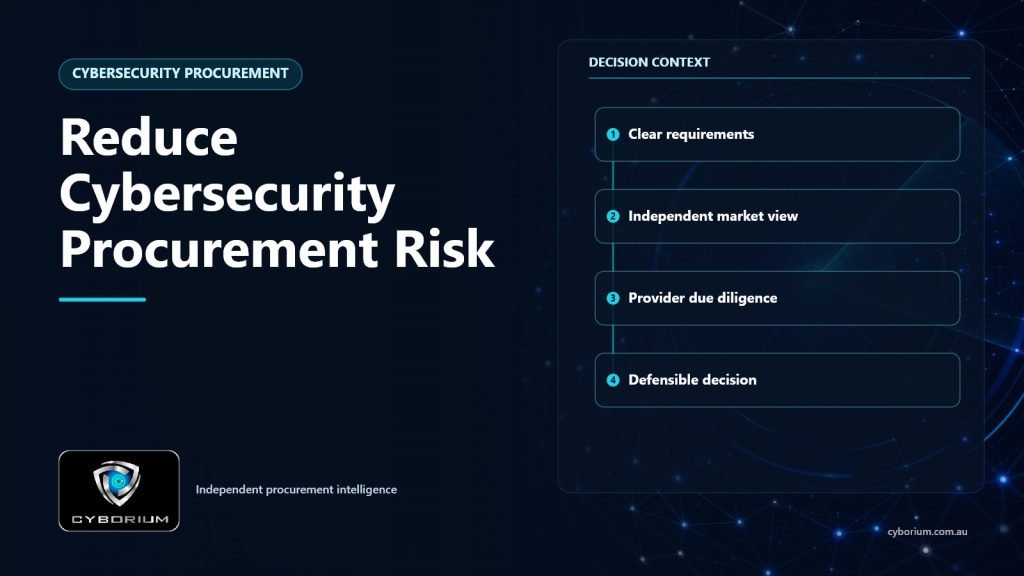
- A Practical Step-by-Step Guide to Reducing Cybersecurity Procurement Risk
- Seven Common Mistakes and How to Avoid Them
- What Good Looks Like
- FAQ
- Checklist: Cybersecurity Procurement Due Diligence
- Next Steps
The Real Problem with Cybersecurity Procurement in 2026
Australian enterprise decision owners face a procurement environment that has become genuinely difficult to navigate. The cybersecurity market alone contains hundreds of vendors, many of whom use similar language, similar claims, and similar slide decks. Distinguishing between a mature, enterprise-grade provider and a well-marketed but under-resourced one is not straightforward, especially when internal teams are already stretched.
The pressure to move quickly compounds the problem. Boards and executives want assurance that cyber risk is being managed. Procurement teams are asked to shortlist and select within weeks. Legal and compliance teams want audit trails. And all of this happens while vendors are actively competing for attention, sometimes with incentives that do not align with the decision owner’s best interests.
The result is a pattern that repeats across sectors: rushed decisions, incomplete requirements, shortlists built on familiarity rather than fit, and contracts that create problems at renewal. The risk goes beyond the financial. A poor cybersecurity procurement decision can leave genuine gaps in an organisation’s security posture, and those gaps may not become visible until something goes wrong.
There is a better way. It starts with structured requirements, independent market evaluation, and a clear understanding of what the organisation actually needs before any vendor conversation begins.
What CYBORIUM Is, in Plain Language
CYBORIUM is an independent, vendor-neutral procurement advisory and relationship management service. It operates like a high-touch decision owner’s agent for technology and cybersecurity procurement. CYBORIUM helps enterprise decision owners define their requirements clearly, evaluate the market objectively, and make introductions to providers who are genuinely suited to their needs.
Importantly, CYBORIUM does not invoice the end-client directly. The selected provider contracts and invoices the end-client directly. CYBORIUM’s role is to support the decision owner through the process, not to sit between the decision owner and the provider commercially. This means decision owners remain in full control of their contracts, their relationships, and their decisions. Learn more about CYBORIUM.
The Business Model, Explained Clearly
What CYBORIUM Does
- Helps decision owners define and prioritise requirements using structured methods such as MoSCoW prioritisation
- Conducts independent market evaluation to identify providers who match the decision owner’s needs
- Facilitates introductions between decision owners and shortlisted providers
- Supports the evaluation process with commercial and risk intelligence
- Assists with ongoing vendor relationship management after selection
What CYBORIUM Does Not Do
- Does not deliver the technology or cybersecurity services itself
- Does not invoice the end-client for services delivered by the provider
- Does not represent any vendor’s interests
- Does not receive commissions or referral fees that compromise independence
How Engagement Works at a High Level
An engagement typically begins with a requirements definition session. CYBORIUM works with the decision owner to clarify what is needed, what is preferred, and what is non-negotiable. This structured approach ensures the market evaluation is grounded in real organisational needs rather than assumptions or vendor-led narratives.
Once requirements are clear, CYBORIUM evaluates the market and produces a shortlist of providers who meet the criteria. Introductions are made, and the decision owner conducts their own due diligence and negotiations. The contract is signed directly between the decision owner and the chosen provider.
Why the Model Is Built for Governance and Defensible Decision-Making
Because CYBORIUM is vendor-neutral and does not benefit commercially from which provider is selected, the evaluation process is genuinely independent. This independence is valuable for the audit trail as well as for the quality of the outcome. Procurement decisions made through a structured, documented process are far easier to defend to boards, auditors, and regulators than decisions made informally or under vendor influence. See our procurement methodology.
CYBORIUM Versus Other Procurement Models
| Model | Decision owner Control | Bias Risk | Market Visibility | Speed to Shortlist | Audit Defensibility | Ongoing Vendor Management | Suitability for Cybersecurity |
|---|---|---|---|---|---|---|---|
| In-house procurement only | High | Low | Limited | Slow | Moderate | Variable | Moderate |
| Traditional consulting | Moderate | Moderate | Good | Moderate | Good | Limited | Good |
| Vendor-led buying (direct) | Low | High | Narrow | Fast | Low | Vendor-driven | Low |
| Broker or marketplace model | Moderate | Moderate to High | Moderate | Fast | Low to Moderate | Minimal | Low to Moderate |
| CYBORIUM model | High | Very Low | Broad and structured | Fast with structure | High | Supported | High |
The Procurement Intelligence Layer That Makes the Difference
What separates a structured procurement process from an ad hoc one is the quality of intelligence applied at each stage. CYBORIUM brings five layers of intelligence to every engagement.
Requirements Intelligence
Clear priorities and decision criteria before any vendor conversation begins. Using structured methods such as MoSCoW, decision owners can distinguish between what is essential, what is desirable, and what is out of scope. This prevents scope creep, reduces vendor confusion, and makes evaluation far more objective.
Market Intelligence
An independent view of what exists in the market, what is mature, and what carries risk. Not every vendor who claims enterprise capability can actually deliver at enterprise scale. Market intelligence helps decision owners avoid providers who are not yet ready for the complexity of their environment.
Commercial Intelligence
An understanding of pricing models, renewal structures, and negotiation angles. Many enterprise technology contracts contain terms that favour the vendor at renewal. Commercial intelligence helps decision owners enter negotiations with a clearer picture of what is reasonable and where flexibility typically exists.
Risk Intelligence
Supplier transparency, shared responsibility models, and jurisdictional risk are all relevant in cybersecurity procurement. Understanding where data is held, who is responsible for what in a breach scenario, and whether a provider’s security posture meets the decision owner’s standards is essential due diligence.
Delivery Intelligence
Knowing which providers can genuinely deliver at enterprise scale, and invoice directly, is not always obvious from marketing materials. Delivery intelligence ensures shortlisted providers have the capability, capacity, and commercial structure to serve the decision owner properly. Explore our services.
A Practical Step-by-Step Guide to Reducing Cybersecurity Procurement Risk
Step 1: Define Requirements Before Talking to Vendors
The single most effective way to reduce procurement risk is to define what is needed before any vendor conversation begins. Use a structured method such as MoSCoW to categorise requirements as Must Have, Should Have, Could Have, or Won’t Have. This gives the evaluation a clear foundation and prevents vendors from shaping the requirements to suit their own offerings.
Step 2: Map the Market Independently
Identify the range of providers who could meet the requirements. This should be done independently of vendor outreach. The goal is to understand what the market offers, not to respond to whoever reaches out first. Consider provider maturity, enterprise references, jurisdictional considerations, and financial stability.
Step 3: Apply a Consistent Evaluation Framework
Score each shortlisted provider against the same criteria. Weight the criteria according to the MoSCoW prioritisation. This produces a defensible, documented evaluation that can be shared with governance bodies and auditors.
Step 4: Assess Third-Party Risk
For cybersecurity providers specifically, assess the provider’s own security posture. A cybersecurity vendor with poor internal practices is a risk in itself. Ask for evidence of certifications, incident response procedures, and subcontractor arrangements.
Step 5: Clarify Shared Responsibility
Understand exactly what the provider is responsible for and what remains with the decision owner’s organisation. Shared responsibility models vary significantly between providers and service types. Ambiguity here is a governance risk.
Step 6: Review Commercial Terms Carefully
Pay particular attention to renewal clauses, price escalation mechanisms, exit provisions, and data handling obligations. These terms often receive less scrutiny than technical requirements but carry significant long-term risk.
Step 7: Document the Decision
Record the evaluation process, the criteria used, the scores applied, and the rationale for the final selection. This documentation is the audit trail that protects the organisation if the decision is ever questioned.
Seven Common Mistakes and How to Avoid Them
1. Starting with a Vendor Conversation Instead of a Requirements Document
When decision owners engage vendors before defining requirements, the vendor’s framing tends to shape the evaluation. Define requirements first, independently, before any vendor contact.
2. Shortlisting Based on Brand Recognition Alone
A well-known brand does not guarantee fit for a specific organisation’s needs. Evaluate on criteria, not familiarity. Some of the most capable providers in the Australian market are not the loudest.
3. Ignoring Jurisdictional Risk
For Australian enterprise decision owners, particularly in regulated sectors, where data is held and processed matters. Confirm data residency, sovereignty obligations, and the provider’s compliance with Australian regulatory requirements before shortlisting.
4. Underestimating Renewal Risk
Many technology contracts are straightforward to enter and difficult to exit. Review renewal terms, notice periods, and price escalation clauses at the point of selection, not at renewal time.
5. Treating Procurement as a One-Off Event
Vendor relationships require ongoing management. Performance, pricing, and fit all change over time. Build vendor relationship management into the operating model from the start.
6. Failing to Document the Evaluation
An undocumented procurement decision is difficult to defend. Even if the outcome is good, the absence of a clear process creates audit and governance risk. Document every stage.
7. Allowing Vendor Pressure to Accelerate the Timeline
Vendors often create urgency around pricing or availability. Genuine urgency should come from the decision owner’s operational needs, not from a vendor’s sales cycle. Maintain control of the timeline.
What Good Looks Like
A well-executed cybersecurity procurement process in 2026 looks like this: requirements are defined clearly and prioritised before any vendor engagement. The market is evaluated independently, with a structured shortlist based on documented criteria. Third-party risk is assessed, commercial terms are reviewed carefully, and the final decision is documented in a way that can be presented to a board or auditor with confidence.
The selected provider contracts and invoices the decision owner directly. The relationship is managed actively over time, with performance reviewed against the original requirements. And if the provider is not meeting expectations, the decision owner has the documentation and the commercial terms to act.
This is not an aspirational standard. It is achievable with the right structure and the right support. Reducing cybersecurity procurement risk is not about adding complexity. It is about applying the right intelligence at the right stage of the process. Talk to CYBORIUM.
FAQ
What is cybersecurity procurement risk?
Cybersecurity procurement risk refers to the financial, operational, and reputational risks that arise from making poor decisions when selecting cybersecurity providers or services. This includes choosing a provider who cannot deliver at enterprise scale, signing contracts with unfavourable terms, or failing to assess third-party risk adequately.
How does vendor-neutral procurement reduce risk?
Vendor-neutral procurement removes the commercial bias that exists when decision owners rely on vendor-led information. An independent evaluation based on structured requirements and objective market intelligence produces a shortlist that reflects the decision owner’s actual needs, not the vendor’s sales priorities.
What is MoSCoW prioritisation and why does it matter in procurement?
MoSCoW is a requirements prioritisation method that categorises needs as Must Have, Should Have, Could Have, or Won’t Have. In procurement, it ensures that evaluation criteria are weighted correctly and that the most important requirements drive the selection decision.
Does CYBORIUM invoice the end-client?
No. CYBORIUM does not invoice the end-client directly. The selected provider contracts and invoices the end-client directly. CYBORIUM’s role is advisory and facilitative, not commercial in the delivery sense.
What sectors does CYBORIUM work with?
CYBORIUM works with Australian enterprise decision owners across a range of sectors, including financial services, superannuation, healthcare, government-adjacent organisations, and other regulated industries where procurement governance and audit defensibility are important.
How long does a structured cybersecurity procurement process take?
The timeline depends on the complexity of the requirements and the number of providers being evaluated. A structured process with clear requirements can produce a defensible shortlist significantly faster than an unstructured one, because the evaluation criteria are agreed upfront and applied consistently.
What is third-party risk in cybersecurity procurement?
Third-party risk refers to the risks introduced by engaging an external provider. This includes the provider’s own security posture, their subcontractor arrangements, data handling practices, jurisdictional considerations, and their ability to respond effectively in the event of an incident.
What is a shared responsibility model?
A shared responsibility model defines which security obligations belong to the provider and which remain with the decision owner’s organisation. Understanding this clearly before signing a contract is essential to avoid gaps in security coverage and governance accountability.
Why is audit defensibility important in procurement?
Regulated organisations and those subject to board oversight need to demonstrate that procurement decisions were made through a fair, documented, and objective process. Audit defensibility means the decision can be explained and justified to auditors, regulators, or board members if required.
What is the difference between a broker model and CYBORIUM’s model?
A broker typically earns a commission from the provider they recommend, which creates a potential conflict of interest. CYBORIUM operates as a vendor-neutral advisory service. The end-client contracts directly with the chosen provider, and CYBORIUM’s independence is maintained throughout the process.
Can CYBORIUM help with ongoing vendor management after selection?
Yes. CYBORIUM supports ongoing vendor relationship management, which includes monitoring performance, managing renewals, and ensuring the provider continues to meet the decision owner’s requirements over time.
Is CYBORIUM suitable for small procurement exercises?
CYBORIUM is designed for enterprise decision owners with complex technology and cybersecurity procurement needs. The structured approach is most valuable where the stakes are high, the market is complex, and governance requirements are significant.
Cybersecurity Procurement Due Diligence Checklist
Requirements Definition
- Requirements documented before any vendor engagement
- MoSCoW prioritisation applied to all requirements
- Decision criteria agreed by relevant stakeholders
- Out-of-scope items clearly defined
Market Evaluation
- Market mapped independently of vendor outreach
- Shortlist based on documented criteria rather than familiarity
- Provider maturity and enterprise references assessed
- Australian market presence and regulatory compliance confirmed
Third-Party Risk
- Provider’s own security posture reviewed
- Subcontractor arrangements identified and assessed
- Data residency and jurisdictional risk confirmed
- Incident response procedures reviewed
- Relevant certifications verified (e.g. ISO 27001, SOC 2)
Shared Responsibility
- Shared responsibility model documented and agreed
- Security obligations clearly allocated between decision owner and provider
- Escalation and incident notification procedures confirmed
Commercial Terms
- Renewal clauses reviewed and understood
- Price escalation mechanisms identified
- Exit provisions assessed
- Data handling and return obligations confirmed
Decision Documentation
- Evaluation process documented
- Scoring and rationale recorded
- Final selection decision documented with supporting evidence
- Documentation stored and accessible for audit purposes
Next Steps
Soft CTA: Start with a Sanity-Check Conversation
If there is an upcoming cybersecurity or technology procurement decision, and the requirements are not yet fully defined, a short introductory call can help clarify the approach. No commitment is required. The goal is simply to confirm whether a structured, vendor-neutral process would add value in the specific context. Book a sanity-check call.
Direct CTA: Ready for a Provider Introduction?
If requirements are already clear and the next step is market evaluation and provider shortlisting, CYBORIUM can move quickly. Once requirements are confirmed, introductions to enterprise-grade, Australian-market providers can be facilitated. The end-client contracts directly. There is no invoice from CYBORIUM. Start with a provider introduction.
Standards and further reading
Cybersecurity procurement risk is reduced by testing claims, and these three define what a tested claim looks like in Australia.
- ASD Essential Eight Maturity Model. The maturity level your organisation is assessed against, and therefore the bar a proposed control has to clear.
- APRA CPS 234. Information security obligations for regulated entities, including those that follow data into a third party.
- ASD Annual Cyber Threat Report. Reported incident volumes and costs, useful for sizing a control against real frequency rather than a vendor scenario.