Data has become the most strategically valuable, and the most aggressively targeted, asset in the modern Australian enterprise. Every day, organisations generate, process, and store vast quantities of sensitive data: customer personal information, financial records, intellectual property, health data, and commercially sensitive business intelligence. Protecting this data, governing its use, and demonstrating compliance with an expanding portfolio of Australian and international data protection obligations has become one of the most complex and consequential challenges facing enterprise technology and risk leaders in 2026.
A Data Security and Management Platform (DSMP) is the technology foundation that enables Australian enterprises to meet this challenge, providing centralised visibility, automated governance, and comprehensive protection for sensitive data across on-premises, cloud, and hybrid environments.
Australian Data Protection in 2026
Australian enterprises in 2026 are navigating one of the most demanding data protection regulatory environments in the country’s history. Key obligations shaping data security investment and strategy include:
- The Privacy Act 1988 (as amended): The Privacy Act governs the collection, use, disclosure, and storage of personal information by Australian organisations. Recent amendments have significantly strengthened individual privacy rights, increased penalties for serious or repeated breaches, and expanded the definition of personal information to encompass a broader range of data types.
- The Notifiable Data Breaches (NDB) Scheme: Requires organisations to notify affected individuals and the Office of the Australian Information Commissioner (OAIC) when a data breach is likely to result in serious harm. The NDB scheme has driven significant investment in data breach detection, response, and notification capabilities.
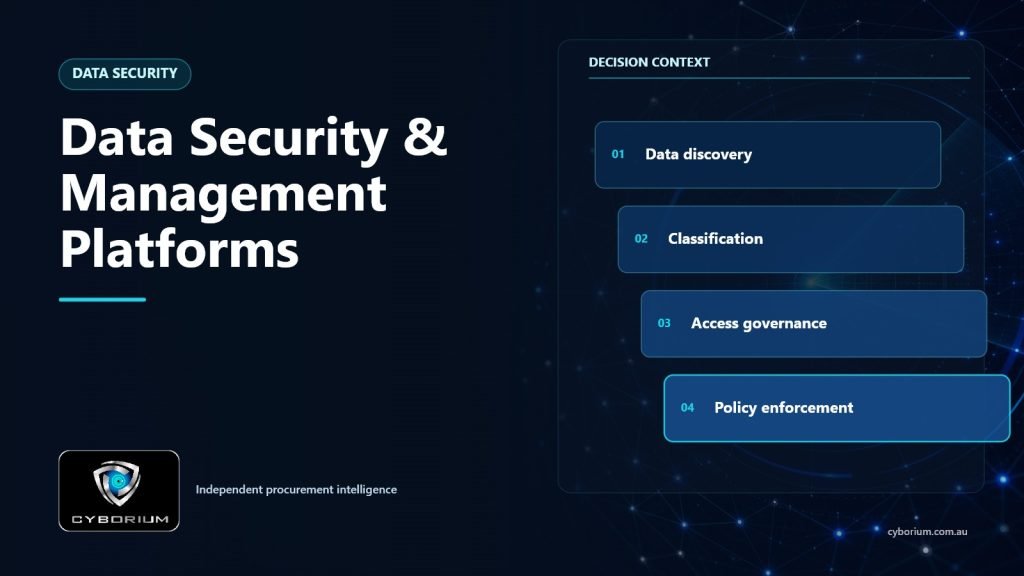
- APRA CPS 234 (Information Security): Requires APRA-regulated entities to classify their information assets by criticality and sensitivity, and to implement controls commensurate with the classification of each asset. A DSMP provides the data discovery, classification, and access governance capabilities needed to meet these requirements.
- The Australian Government’s Data Availability and Transparency Act: Governs the sharing of public sector data, with implications for organisations that work with government data or provide services to government agencies.
- Sector-specific data governance requirements: Healthcare organisations must comply with the My Health Records Act and the Australian Privacy Principles as they apply to health information. Financial services organisations face additional data governance obligations under ASIC and AUSTRAC requirements.
- International data transfer obligations: Australian organisations that transfer personal information to overseas recipients must comply with Australian Privacy Principle 8, which requires them to take reasonable steps to ensure that overseas recipients handle the information in accordance with the Australian Privacy Principles.
What Is a Data Security and Management Platform (DSMP)?
A Data Security and Management Platform (DSMP) is an integrated technology solution that provides organisations with comprehensive visibility, control, and governance over their data assets across the entire data lifecycle, from creation and storage through to use, sharing, archiving, and deletion. Unlike point solutions that address individual data security challenges in isolation, a DSMP delivers a unified, integrated approach to data risk management that spans on-premises systems, cloud environments, SaaS applications, and endpoints.
The most effective DSMPs in 2026 combine advanced data discovery and classification capabilities with strong access governance, data loss prevention, compliance automation, and AI-driven analytics, providing organisations with both the visibility to understand their data risk exposure and the controls to manage it effectively.
Core Capabilities of a Modern DSMP
Data Discovery and Inventory
You cannot protect data you don’t know you have. Automated data discovery is the foundation of effective data security, enabling organisations to identify and catalogue sensitive data across all data stores, including structured databases, unstructured file systems, cloud storage, SaaS applications, and endpoints. Modern DSMPs use AI and machine learning to accelerate discovery and improve accuracy, identifying sensitive data patterns that rule-based approaches would miss.
Intelligent Data Classification
Once discovered, data must be classified by sensitivity, regulatory category, and business value to enable risk-proportionate protection. Effective classification systems combine automated classification, using content inspection, context analysis, and machine learning, with user-driven classification that empowers employees to classify data at the point of creation. Classification labels drive downstream protection controls, ensuring that the most sensitive data receives the most rigorous protection.
Access Governance and Entitlement Management
Excessive and inappropriate access to sensitive data is one of the most common and consequential data security risks facing Australian enterprises. Access governance capabilities provide visibility into who has access to sensitive data, how that access was granted, whether it is still required, and whether it is being used appropriately. Effective access governance enforces least-privilege principles, detects anomalous access behaviour, and provides audit trails that support compliance with APRA CPS 234 and the Privacy Act.
Data Loss Prevention (DLP)
Data Loss Prevention controls prevent the unauthorised exfiltration or sharing of sensitive data across email, cloud applications, web browsers, removable media, and endpoints. Modern DLP solutions use content inspection, user behaviour analytics, and machine learning to identify and block data exfiltration attempts in real time, while minimising false positives that disrupt legitimate business activity. For Australian enterprises subject to the NDB scheme, effective DLP is a critical control for preventing the data breaches that trigger notification obligations.
Compliance Workflow Automation
Manual compliance processes are slow, error-prone, and difficult to scale. DSMP compliance automation capabilities simplify data mapping, privacy impact assessment, subject access request management, breach notification, and audit evidence collection, reducing the time and cost of compliance while improving accuracy and consistency. For Australian enterprises managing obligations under the Privacy Act, APRA CPS 234, and sector-specific frameworks, compliance automation delivers significant operational efficiency gains.
Cloud Data Security and CASB Integration
As Australian enterprises accelerate their adoption of cloud infrastructure and SaaS applications, maintaining consistent data security and governance across multi-cloud and hybrid environments has become a critical challenge. Modern DSMPs provide consistent data discovery, classification, and protection across cloud environments, including integration with Cloud Access Security Broker (CASB) capabilities to govern data movement between cloud applications and enforce data handling policies in SaaS environments.
AI-Driven Data Risk Analytics
The most advanced DSMPs in 2026 leverage AI and machine learning to provide predictive data risk analytics, identifying emerging data risk patterns, predicting potential breach scenarios, and recommending targeted remediation actions before incidents occur. These capabilities transform data security from a reactive, compliance-driven function into a proactive, risk-informed discipline.
How CYBORIUM Evaluates DSMP Vendors for Australian Enterprises
Australian enterprises trust CYBORIUM for their experience in strategic sourcing and procurement as a service, and our DSMP vendor evaluation capability reflects the same rigour and independence we bring to all technology assessments. CYBORIUM evaluates DSMP vendors against a comprehensive framework designed to ensure our clients select solutions that deliver genuine, measurable value in the Australian context:
- Australian regulatory alignment: Native support for Australian-specific compliance frameworks including the Privacy Act, the NDB scheme, APRA CPS 234, and sector-specific data governance requirements, without relying on international frameworks that need significant customisation.
- Data discovery breadth and accuracy: The ability to discover sensitive data across all relevant data stores, including legacy on-premises systems, modern cloud environments, and SaaS applications, with high accuracy and minimal false positives.
- Classification intelligence: The sophistication and accuracy of automated classification capabilities, including support for Australian-specific data types such as Tax File Numbers, Medicare numbers, and Australian Business Numbers.
- Scalability and performance: The ability to handle the data volumes and growth trajectories of Australian enterprise environments without performance degradation or operational disruption.
- Integration capability: Integration with existing security, IT, and business systems, including SIEM, identity management, cloud platforms, and endpoint protection solutions.
- Australian data sovereignty: Data storage and processing options that support Australian data residency requirements, a critical consideration for regulated industries and government-adjacent organisations.
- Ease of deployment and time-to-value: Rapid deployment with minimal disruption and intuitive management interfaces that reduce the burden on internal teams.
The Business Case for DSMP Investment in Australian Enterprises
The return on investment from DSMP implementation is compelling and multi-dimensional. Australian organisations that implement effective data security and management platforms consistently report:
- Significant reduction in the time and cost of privacy compliance activities through automation
- Faster and more confident response to data breach incidents, reducing regulatory penalty exposure
- Improved audit outcomes and reduced audit preparation time
- Reduced risk of costly data breaches through improved access governance and DLP controls
- Stronger board and executive confidence in the organisation’s data governance posture
- Competitive advantage in enterprise sales processes where data security due diligence is a requirement
Protect Your Most Critical Asset with CYBORIUM
CYBORIUM’s zero-fee procurement model means we can help your organisation identify, evaluate, and select the right DSMP solution at no cost. Our structured evaluation process, informed by deep knowledge of Australian regulation and a broad view of the DSMP market, helps you choose a platform that genuinely safeguards your critical data assets and supports your compliance obligations.
Contact CYBORIUM today to discuss your data security and governance requirements and take the first step toward stronger, more confident data protection in 2026.
Standards and further reading
Data platform decisions are privacy decisions, and in Australia the obligations attach to the organisation holding the data rather than the platform vendor.
- OAIC guidance on APP 11. The security obligation for personal information, which does not transfer to a provider along with the data.
- ISO/IEC 27001:2022. The control set a provider is most likely to certify against. Ask for the certificate scope as well as the certificate.
- OAIC Notifiable Data Breaches. What a breach involving this platform would require you to do, and how quickly, which is worth knowing before choosing where data lives.