Enterprise AI pricing guide. Last reviewed:
Enterprise AI pricing is the part of an AI purchase that most often goes wrong after signing. A seat price is easy to forecast. A bill that depends on tokens, actions or conversations is not, because it grows with how much your people and systems use the product. This guide explains the pricing models in use, what actually drives an AI bill, how to forecast it, which contract terms cap it, and how to negotiate. It uses published price lists and public announcements for its examples, all in US dollars and correct at the time of writing, so check current prices before you rely on any figure.
How is enterprise AI priced?
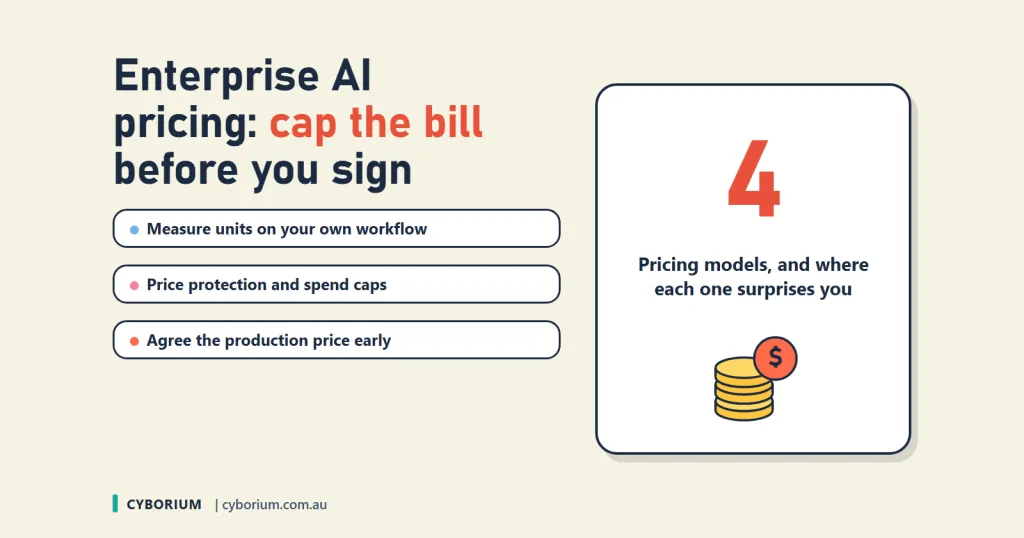
Suppliers sell AI in four main ways, and many mix them. The table sets out how each one scales and what to watch.
| Model | How you pay | How the bill scales | What to watch |
|---|---|---|---|
| Per seat | A fixed fee per named user per month. | With headcount, not use. | Fair-use limits inside the fee, and what happens when you pass them. |
| Consumption | By model use, usually tokens. | With volume, prompt length and model choice. | Output tokens, long prompts, retries and the model tier you are routed to. |
| Per action or credit | A pool of credits spent per action the AI takes. | With the number of actions per task. | What counts as an action, and whether credits expire. |
| Per conversation or outcome | A set fee per conversation, case or result. | With volume of completed units. | A clear definition of “resolved”, and who decides. |
A public example shows the spread. In May 2025 Salesforce announced Flex Credits for its Agentforce product at US$500 per 100,000 credits, with each action costing 20 credits, which is US$0.10 per action. It described its earlier conversational pricing as US$2 per conversation, and announced per-user licences with unmetered employee-facing agent use. One vendor, three ways to pay, and each gives a different bill for the same work.
Why are suppliers moving away from per-seat pricing?
Gartner expects at least 40 per cent of enterprise software-as-a-service spending to shift toward usage-, agent- or outcome-based pricing by 2030, with the seat-based share of vendor revenue falling from 21 per cent to 15 per cent, as reported by CIO.com. The reason is structural: an AI agent does not occupy a named-user licence the way a person does, and the cost to the supplier rises with use.
For the customer, the consequence is that more of the price risk moves to you. A seat price protects you from heavy use. A consumption price does not. That is why the same article advises treating tokens like cloud spend a decade ago: meter it, govern it and tie it to outcomes.
What drives an AI bill?
For token-priced products, one provider’s public price list shows the mechanics that apply in some form across the market.
- Input and output are priced separately. On that list, output tokens cost five times as much as input tokens on its flagship models. A task that produces long answers costs more than one that reads long documents.
- Repeated context can be cheaper. Reusing a cached prompt costs a small fraction of the base input price, but writing to the cache costs more than a normal input (1.25 times for a five-minute cache). Design matters.
- Batch work is discounted. The same provider offers a 50 per cent discount on both input and output for asynchronous batch processing. Work that does not need an instant answer should not pay instant prices.
- Location can add a premium. Choosing to keep processing in a specific region can carry a multiplier. On that list, restricting inference to the United States applies a 1.1 times multiplier. If you need Australian data residency, ask what it costs.
- Model tier is the largest lever. A premium model for every task is costly when a smaller one would do. Ask whether the supplier routes work by difficulty, and whether you can control it.
- Agents multiply calls. One task can involve many model calls, tool calls and retries. Our guide to AI agent procurement covers this and how to cap it.
Prices on that list are in US dollars. If you pay in AUD, you carry the exchange-rate risk on every consumption bill, so ask whether the supplier will invoice in AUD or fix a rate for the term.
How do you forecast an AI bill?
Forecast in units, not dollars. Start from what the product charges for, and build up.
- Define the unit. Seat, token, action, conversation or outcome.
- Measure units per task on a real workflow in a pilot, not from a demo.
- Count tasks. How many a user, team or system will do each month.
- Multiply by the unit price, then add retries and background runs.
- Run three scenarios: low, expected and high adoption. Adoption is usually the biggest unknown.
- Add the costs around the AI: integration, data preparation, monitoring, security review, training and governance. Our five-year total cost of ownership model shows how to carry them across years.
A worked example using the published Flex Credits price. The volumes are hypothetical. Suppose an agent handles 10,000 service cases a month and takes five actions per case. That is 50,000 actions, or 1,000,000 credits at 20 credits each, which is ten packs of 100,000 and US$5,000 a month. If the agent takes eight actions per case instead of five, the bill is US$8,000. A three-action change per case moves the bill by 60 per cent, which is why you measure actions per task in a pilot before you sign a commitment. Your own workflow, price list and volumes will differ.
Which contract terms cap an AI bill?
Price is only one part of the commercial terms. These clauses decide whether the price you were quoted is the price you pay.
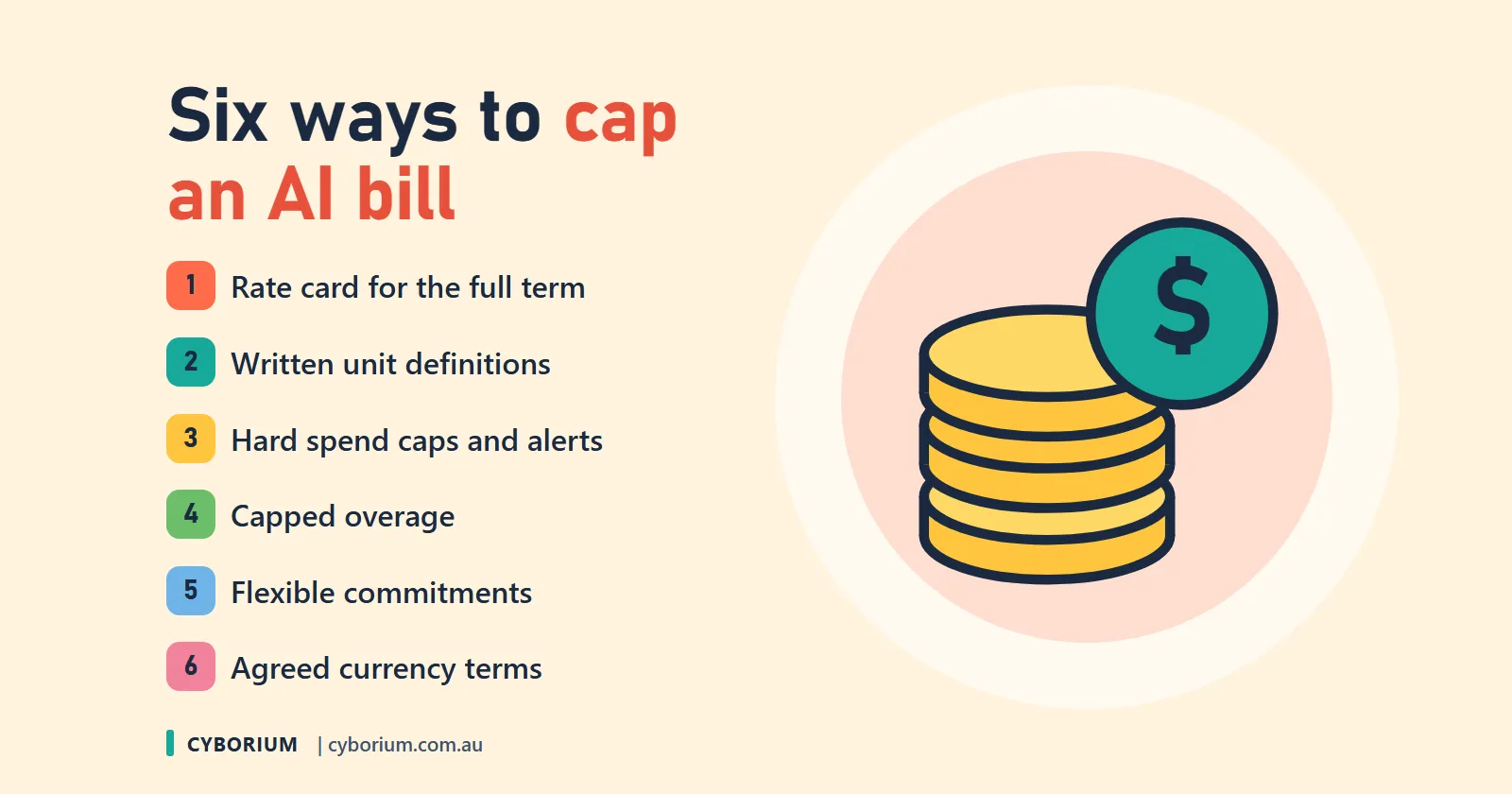
- A rate card for the full term, with price protection against increases, and no repricing without your agreement.
- Unit definitions. What exactly counts as an action, credit, conversation or outcome, written into the contract.
- A hard spend cap and alerts per team or workflow, so a fault cannot run up a bill overnight.
- Overage at the contracted rate, with a cap, not at list price.
- Flexible commitments. Ramp-up in the first year, the right to move unused commitment to other products, and a true-down at renewal.
- Credit terms. Whether prepaid credits expire, are refundable on exit, or can be transferred.
- Model change protection. If the supplier retires or reprices a model, price and performance protection for you.
- Usage reporting you can read yourself, in a format you can audit against invoices.
- Currency terms. Invoicing in AUD or a fixed rate for the term.
- Pilot to production pricing. The production price agreed before the pilot starts, so a free pilot does not end at list price.
The general AI terms in our guide to AI contract clauses in Australia sit alongside these. Our guide to software licence renewals covers the uplift, true-up and audit terms that also apply when AI is added to an existing agreement.
How do you negotiate AI pricing?
- Negotiate while suppliers still compete. Price protection and caps are far easier to win before one supplier is selected.
- Ask for a cost model on your workflow, not the supplier’s example, and test it in the pilot.
- Trade commitment for flexibility. A larger commitment should buy lower unit prices and the right to reallocate it, not only a discount.
- Separate the AI price from the bundle. An AI add-on folded into a renewal is hard to compare. Ask for it as its own line.
- Put the exit in the contract. Our guide to pricing the exit before you sign applies to credits and committed spend too.
How do you keep AI costs under control after signing?
Treat AI spend like cloud spend. Tag usage by team and workflow so cost can be allocated. Set budgets and alerts. Review unit cost, such as cost per case or per task, each month, because a rising unit cost is the earliest warning. Name an owner who can switch off or throttle a workload. Revisit the forecast against actuals every quarter and use the result in the next negotiation.
What are the red flags in an AI pricing proposal?
- A price quoted per month with no definition of the unit it assumes.
- A “free” pilot with no agreed production price.
- No spend cap, or caps that the supplier can raise.
- Overage charged at list price.
- Usage reporting that only the supplier can access.
- Credits that expire before you can plausibly use them.
- Pricing that can change when the underlying model changes.
- A cost example that uses far fewer steps than your real workflow.
What is CYBORIUM’s role?
CYBORIUM helps Australian organisations compare AI providers on a like-for-like cost basis and prepare the commercial terms before signature. The selected provider pays CYBORIUM a capped fee at an agreed percentage, providers that are shortlisted but not selected pay nothing, and you contract directly with the provider. The decision is always yours. See our AI vendor evaluation page for how an evaluation runs.
Enterprise AI pricing in short
Know which of four models you are buying, forecast in units measured on your own workflow, and run three adoption scenarios. Cap the bill with price protection, unit definitions, spend caps, overage terms and flexible commitments, and agree the production price before the pilot. Meter and review usage monthly after you sign.
Comparing AI quotes? Get the Procurement Readiness Brief or tell us about your project. The client pays CYBORIUM nothing and chooses the provider.
Frequently asked questions
How is enterprise AI priced?
Mainly per seat, by consumption such as tokens, per action or credit, or per conversation or outcome. Many suppliers combine them, with a base fee and a variable part.
Why do AI bills exceed forecasts?
Usage grows with adoption, long prompts and long outputs cost more, agents make many calls per task, and retries and background runs add volume. Forecasts built from a demo understate real use.
How do I forecast an AI bill?
Define the unit, measure units per task in a pilot, count tasks per month, multiply by the unit price, add retries, and run low, expected and high adoption scenarios. Add the costs around the AI such as integration, governance and training.
What contract terms limit AI costs?
Price protection for the term, written unit definitions, hard spend caps with alerts, capped overage, flexible commitments, clear credit terms, protection when models change, usage reporting you can read, and agreed currency terms.
Should I pay for AI per seat or by usage?
Per seat gives predictable cost when use per person is similar. Usage-based pricing fits variable or automated work but needs spend caps and monitoring. A hybrid with a cap often balances both.
Related guidance: AI agent procurement, AI contract clauses in Australia, the TCO calculator.
Sources
- Anthropic, Claude API pricing: separate input and output token prices, prompt caching multipliers, 50 per cent batch discount and the 1.1 times multiplier for US-only inference. Prices in US dollars, read 21 October 2026.
- Salesforce, Agentforce flexible pricing announcement, 15 May 2025: Flex Credits at US$500 per 100,000 credits and 20 credits (US$0.10) per action, and earlier pricing at US$2 per conversation.
- CIO.com, IT hurtles toward the great enterprise pricing reset: Gartner’s forecast on usage-, agent- and outcome-based pricing by 2030 and advice on metering tokens.