
The price in a technology proposal is usually less than half of what the purchase will cost over its term. Staff time, annual uplifts, user growth, implementation and the cost of leaving make up the rest, and most of it is negotiable only before signature. This guide shows how to build a total cost of ownership (TCO) that holds up at renewal, with a worked five-year example.
What total cost of ownership should include
The clearest Australian definition sits in the Commonwealth Procurement Rules 2025. Paragraph 4.5 says price is not the sole factor in value for money and lists whole-of-life costs among the things an official must consider. Paragraph 4.6 then sets out what whole-of-life costs could include:
- the initial purchase price
- maintenance and operating costs
- transition out costs
- licensing costs
- the cost of additional features bought after the initial procurement
- consumables
- decommissioning, remediation and disposal
The rules bind Commonwealth entities, but the list works for any organisation. Two items on it are routinely missing from private sector business cases: transition out costs, and features added after the first purchase.
The seven cost lines, and what to ask for
| Cost line | What to ask the vendor for |
|---|---|
| Subscription or licence | Price per unit, the unit definition, and every tier boundary |
| Price uplift | The annual increase mechanism and any cap, in writing for the full term |
| Growth and true-ups | How extra users, devices or consumption are counted and billed |
| Implementation | A fixed price or capped estimate, with named deliverables |
| Integration and migration | Who builds each integration, and what the data migration includes |
| Internal effort | The vendor’s own estimate of customer effort, which you then test |
| Exit and transition-out | Data export format, transition assistance rates and notice periods |
A worked five-year example
Take a software platform quoted at A$200,000 a year. The proposal shows A$1 million over five years. Now add realistic assumptions:
- a 7% annual price uplift at each renewal
- 5% more users each year as adoption grows
- A$150,000 implementation and A$60,000 integration and migration in year one
- half a full-time staff member to run it, at A$160,000 a year fully loaded
- A$30,000 of training in year one, then A$10,000 a year
- A$120,000 to exit at the end of the term

The five-year cost comes to about A$2.08 million, roughly double the number in the proposal. The licence at its year-one price is 48% of the total. Internal staff time is the second largest line, and it never appears in a vendor’s pricing.
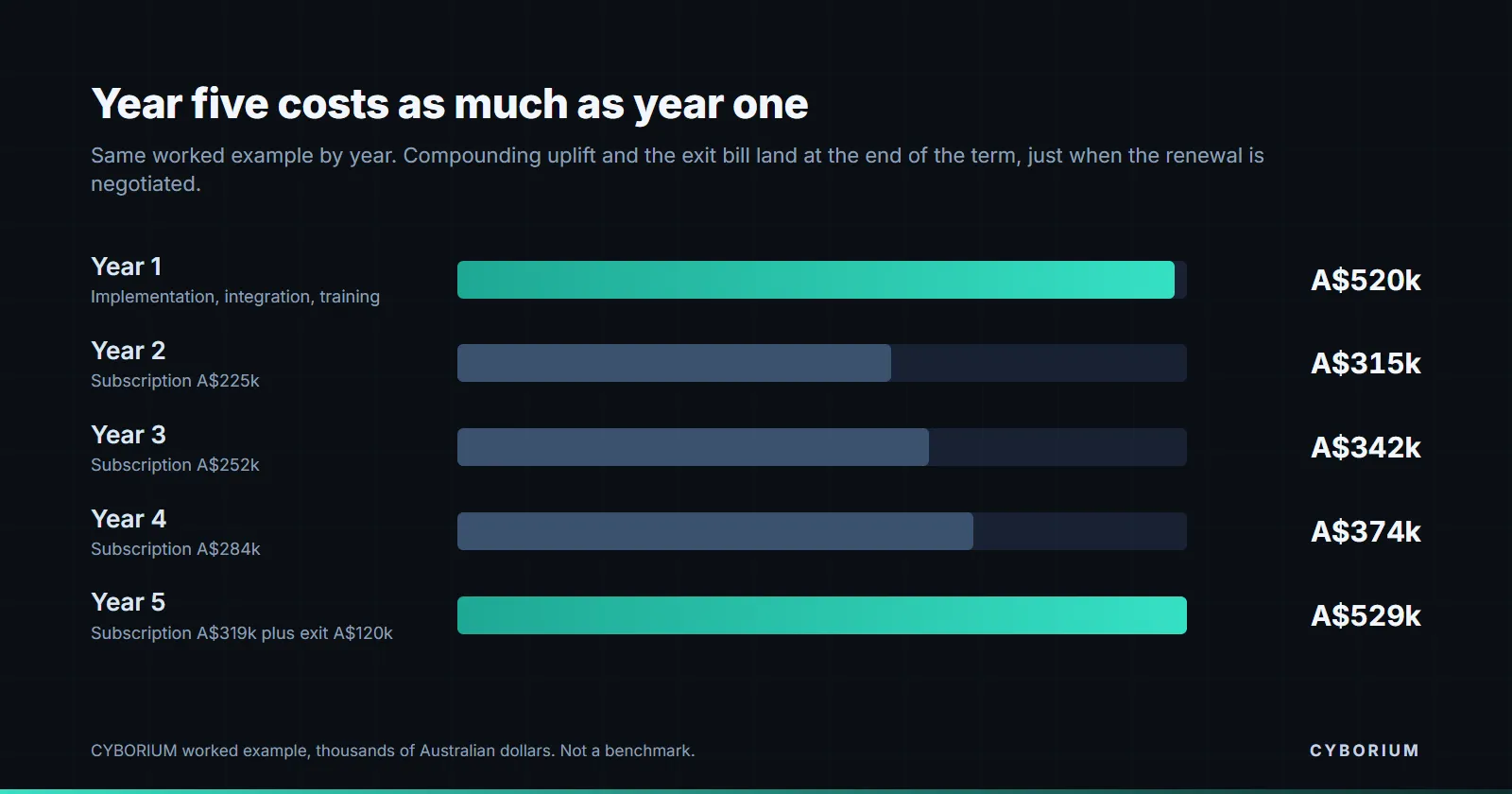
The shape matters as much as the total. Year one carries the implementation, which everyone budgets for. Year five carries the compounded uplift plus the cost of leaving, and it arrives exactly when the renewal is being negotiated. If the exit has not been priced, the renewal will look cheap by comparison, whatever the vendor asks. These figures are an illustration built from stated assumptions. Run the same model with your own numbers in our free TCO calculator. The terms that move the total most are the ones technology contract negotiation support works on before signature.
The terms that move TCO most
Uplift caps
In the example, the uplift and growth together add A$279,000. A cap on the annual increase, written into the contract for the full term, is often the most valuable commercial term in a multi-year deal. A cap that applies only to the first renewal protects one year out of five.
How growth is counted
Check whether extra users are billed at the discounted contract rate or at list price, whether true-ups are counted at a peak or an average, and whether inactive accounts can be removed. Our guide to software licence renewals covers true-ups and audit clauses in more depth.
Exit terms
Export formats, transition assistance at fixed rates and a defined handover period all shrink the year-five bill. They cost almost nothing to agree at signature and a great deal to buy later. See what it costs to leave a supplier, and how to price it.
Honest internal effort
Vendors understate the customer effort their product needs, because it is not their cost. Ask existing customers of similar size how many people run the platform day to day, and use that figure rather than the vendor’s.
How to compare vendors on TCO
- Use one horizon for everyone. Three or five years, matching how long you expect to keep the service, including the exit at the end.
- Use one set of growth assumptions. Apply the same user growth to every proposal, then each vendor’s own pricing rules to that growth.
- Fill gaps with your own estimates. If a vendor will not quote transition assistance, put in a conservative figure rather than zero.
- Test the sensitivity. Rerun the model with growth doubled. A proposal that is cheapest at 5% growth and most expensive at 10% tells you where the vendor expects to make its margin.
- Keep TCO next to the quality score. The cheapest total is not automatically the best value. The Procurement Rules list quality, fitness for purpose and supplier performance alongside cost for that reason.
Common traps
- Comparing year-one prices, which hides every uplift and the exit.
- Multi-year discounts that auto-renew at list price once the term ends.
- “Unlimited” tiers with fair-use clauses that define the real limit.
- Bundles where one component is cheap only while you keep the others.
- Professional services at day rates that were never tendered or capped.
- Treating the internal team as free because it is already on the payroll.
For a security-specific view of the same problem, see the hidden costs of choosing the wrong cybersecurity vendor.
Frequently asked questions
What is total cost of ownership in technology procurement?
It is the full cost of a technology purchase over the period you will use it: licences or subscriptions, price increases, growth, implementation, integration, internal staff effort, training, and the cost of exiting at the end. The Commonwealth Procurement Rules call this whole-of-life cost.
Over how many years should TCO be calculated?
Over the period you expect to keep the service, typically three to five years for software and managed services, and always including the exit at the end of that period.
Why is TCO often double the quoted price?
Because the quote covers only what the vendor charges at today’s price. Annual uplifts, growth, internal staff time, implementation and exit costs sit outside it. In our worked example those lines take a A$1 million quote to about A$2.08 million over five years.
Which contract terms reduce TCO most?
A cap on annual price increases for the full term, growth billed at the contract rate, fixed-rate transition assistance and defined data export formats. All four are cheapest to agree before signature.
Official sources and update status
- Commonwealth Procurement Rules 2025, Department of Finance, paragraphs 4.4 to 4.6
- Value for money, Department of Finance
Information status: Commonwealth Procurement Rules paragraphs checked against the 17 November 2025 edition on 27 September 2026. The worked example uses illustrative assumptions and is not a price benchmark.
Try your own figures in the technology TCO calculator, or comparing multi-year proposals and want them modelled on the same basis? Talk to CYBORIUM.
Last updated: