Table of Contents
- The Real Problem in 2026: Pressure, Noise, and Rising Risk
- What Changed in 2026 and Why It Matters
- What “Good Procurement” Actually Looks Like in 2026
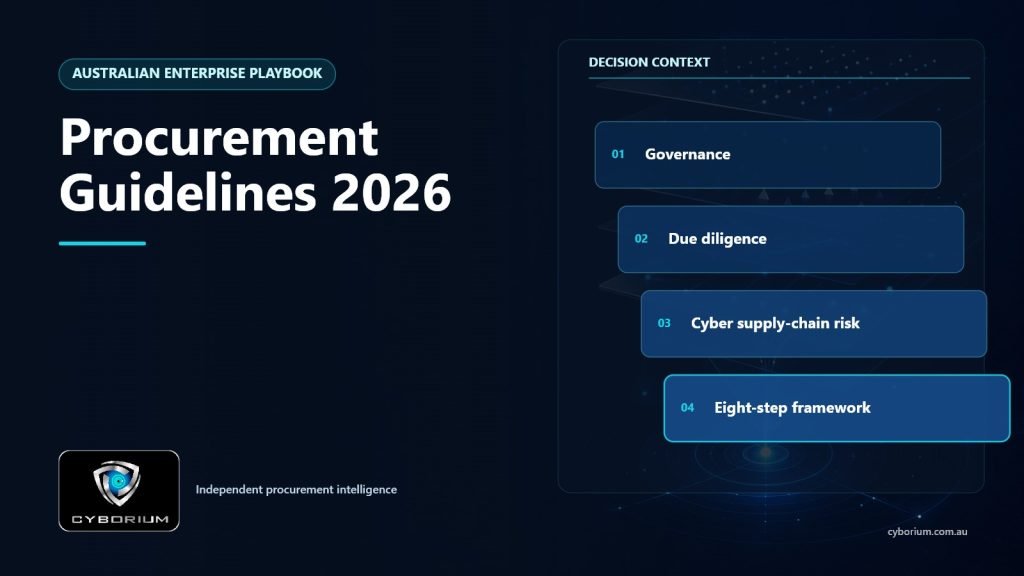
- The 2026 Procurement Guidelines Framework: 8 Steps
- Procurement Models Compared: Where CYBORIUM Fits
- The Additional Layer of Intelligence That Changes Outcomes
- Practical Assets: Templates, Scorecards, and Checklists
- Vendor Questions That Reveal the Truth
- Procurement Checklist for 2026 (Copy-Ready)
- FAQ: People Also Ask
- Next Steps and CTAs
- Glossary
1. The Real Problem in 2026: Pressure, Noise, and Rising Risk
Procurement decisions in 2026 are being made faster, under more pressure, and with higher consequences than ever before. Budgets are tighter. Audit scrutiny is sharper. Vendor noise is louder. And the cost of a poor technology or cybersecurity purchase, whether financial, operational, or reputational, is no longer something a board will quietly absorb.
Shadow buying is still happening. Stakeholders are still going direct to vendors before requirements are defined. Contracts are still being signed without proper exit clauses. And procurement teams are still being handed a shortlist that was quietly assembled by the vendor’s sales team.
This guide exists to change that. It is a practical, defensible procurement playbook built for Australian CIOs, CISOs, Heads of Procurement, and Risk leaders who need to make better decisions in 2026, and be able to prove it.
The procurement guidelines 2026 framework in this guide is grounded in what actually works: clear requirements, structured evaluation, independent market visibility, and governance that holds up under scrutiny.
Related reading: CYBORIUM’s procurement methodology.
2. What Changed in 2026 and Why It Matters
Governance and Compliance Expectations Have Raised the Bar
For Australian Government entities, the Commonwealth Procurement Rules (CPR) were updated with effect from 17 November 2025. These updates reinforce value for money, transparency, and supplier accountability. Procurement Connected Policies continue to apply, and agencies are expected to demonstrate compliance at every stage of the procurement lifecycle, before and after contract execution.
For enterprise and regulated-sector organisations, the direction is the same: stronger vendor oversight, clearer documentation, and more defensible decision-making. Boards and audit committees are asking harder questions. Internal audit teams are reviewing procurement files more closely. The expectation is that every significant vendor decision can be explained, evidenced, and defended.
Cyber Supply Chain Risk Is Now an Early-Stage Procurement Issue
Cybersecurity risk used to be something assessed after a vendor was selected. In 2026, that approach is no longer acceptable. Jurisdictional risk, data residency, privacy obligations under the Australian Privacy Act, and the shared responsibility model for cloud and managed services must all be assessed before a shortlist is formed, not after a contract is signed.
Supply chain compromise, third-party access to sensitive systems, and vendor concentration risk are now standard items on the risk register of any well-governed organisation. The cybersecurity procurement checklist and vendor due diligence checklist in this guide address each of these directly.
AI Is Reshaping Procurement, But Speed Without Controls Is Dangerous
AI tools are accelerating parts of the procurement process: market scanning, RFP drafting, vendor scoring, and contract review. That is genuinely useful. But faster buying without stronger controls creates new risks. AI-generated shortlists can embed bias. Automated scoring can miss context. And procurement teams that rely on AI outputs without human review are creating audit exposure, not reducing it.
The right response is not to avoid AI in procurement. It is to use it with clear governance: human sign-off on requirements, transparent evaluation criteria, and documented decision rationale that does not simply say “the system recommended it.”
3. What “Good Procurement” Actually Looks Like in 2026
Good procurement is not about following a process for its own sake. It is about making decisions that are transparent, repeatable, auditable, tied to business outcomes, and measurable after the fact.
Here is what that looks like in practice, with measurable outcomes:
- Reduced cycle time. Requirements are defined clearly upfront, which means fewer rounds of clarification, fewer vendor re-engagements, and faster time to contract.
- Fewer surprises post-signature. Risks, responsibilities, and exit conditions are documented before signing, not discovered during delivery.
- Clearer ownership. Every procurement decision has a named owner, a documented rationale, and a clear escalation path.
- Fewer exceptions and workarounds. When the process is practical and well-designed, people follow it. Shadow buying decreases.
- Better vendor performance. Vendors who are selected through a rigorous process understand what is expected of them. Performance metrics are agreed at the start, not negotiated after problems arise.
- Audit-ready documentation. Every stage of the process produces a record that can be reviewed, explained, and defended without reconstruction.
- Measurable return on investment. Procurement outcomes are tracked against the original business case, so the organisation knows whether the decision delivered value.
This is the standard that the procurement compliance framework in the next section is designed to achieve.
4. The 2026 Procurement Guidelines Framework: 8 Steps
This framework applies to technology and cybersecurity procurement at mid-to-large Australian organisations. Each step is designed to be practical.
Step 1: Intake and Problem Definition
Purpose: Establish what the organisation actually needs before any vendor conversation begins.
What to do:
- Define the business outcome being sought, not the product or vendor.
- Identify all stakeholders: technical, commercial, legal, risk, and end-user.
- Document constraints: budget range, timeline, integration dependencies, regulatory obligations.
- Confirm whether this is a new capability, a replacement, or an extension of an existing contract.
- Assign a named procurement owner with decision authority.
Common failure modes:
- Starting with a vendor name instead of a problem statement.
- Excluding risk or legal stakeholders until late in the process.
- Treating budget as a fixed number before understanding market pricing.
- No named owner, so decisions drift or get made informally.
What good looks like:
- A one-page intake brief that any stakeholder can read and understand.
- Clear agreement on what success looks like before the market is approached.
- Risk and legal engaged from day one.
Step 2: Requirements Gathering
Purpose: Translate the business problem into structured, prioritised requirements that vendors can respond to.
What to do:
- Use MoSCoW prioritisation: Must have (non-negotiable), Should have (important but not critical), Could have (desirable), Won’t have (explicitly out of scope). This keeps requirements honest and prevents scope creep.
- Separate functional requirements (what it must do) from non-functional requirements (how it must perform: security, availability, scalability).
- Include data residency, privacy, and security requirements as first-class items rather than appendices.
- Validate requirements with end-users before going to market.
Common failure modes:
- Requirements written around a specific vendor’s product features.
- Security and privacy requirements added as an afterthought.
- No prioritisation, so every requirement is treated as equally critical.
What good looks like:
- A requirements register with MoSCoW ratings, owners, and acceptance criteria.
- Security and privacy requirements reviewed by the CISO or security team before market approach.
Step 3: Market Scan
Purpose: Understand what the market actually offers before forming a shortlist.
What to do:
- Conduct a structured scan of the relevant vendor market, including established players, emerging solutions, and niche specialists.
- Assess market maturity: is this a proven category or an emerging one with delivery risk?
- Identify vendors with Australian presence, local support, and relevant certifications (ISO 27001, SOC 2, IRAP where applicable).
- Document the scan methodology so it can be evidenced in an audit.
Common failure modes:
- Shortlisting based on brand recognition or existing relationships rather than fit.
- Missing specialist vendors who are better suited but less visible.
- No documentation of why certain vendors were excluded.
What good looks like:
- A long-list of at least six to eight vendors with a documented rationale for inclusion.
- A clear, evidence-based process for narrowing to a shortlist of three to five.
Step 4: Due Diligence and Third-Party Risk
Purpose: Assess vendor risk before commercial engagement begins.
What to do:
- Review security posture: certifications, penetration testing history, incident response capability.
- Assess data residency and jurisdictional risk: where is data stored, processed, and backed up? Which laws apply?
- Review privacy practices against Australian Privacy Principles (APPs).
- Assess financial stability and business continuity planning.
- Understand the vendor’s own supply chain: who are their critical sub-processors and third parties?
- Confirm the shared responsibility model in writing: what does the vendor own, and what does the client own?
Common failure modes:
- Accepting a vendor’s security questionnaire response without verification.
- Overlooking jurisdictional risk for cloud services with offshore data processing.
- No assessment of the vendor’s sub-processors or fourth-party risk.
What good looks like:
- A completed vendor due diligence checklist for every shortlisted vendor.
- Jurisdictional and privacy risk documented and signed off by legal and risk teams.
- Shared responsibility model agreed in writing before contract execution.
Related reading: CYBORIUM’s procurement methodology.
Step 5: Commercial and Contracting
Purpose: Protect the organisation’s interests before, during, and after the contract term.
What to do:
- Negotiate risk allocation clauses: liability caps, indemnities, data breach notification obligations.
- Define responsibilities clearly in the contract itself rather than relying on the vendor’s standard terms.
- Include exit provisions: data portability, transition assistance, notice periods, and termination for convenience.
- Identify renewal traps: auto-renewal clauses, price escalation mechanisms, and lock-in provisions.
- Ensure SLAs are measurable, enforceable, and tied to meaningful remedies.
Common failure modes:
- Accepting vendor standard terms without negotiation.
- Missing auto-renewal clauses that lock the organisation in for another term.
- Exit provisions that make it practically impossible to leave without significant cost.
What good looks like:
- Legal review of all non-standard terms before execution.
- A contract summary document that non-legal stakeholders can read and understand.
- Renewal dates and key obligations tracked in a contract register.
Step 6: Evaluation Method
Purpose: Make the selection decision in a way that is transparent, consistent, and defensible.
What to do:
- Build a weighted scorecard before any vendor is assessed.
- Define evaluation categories: functional fit, security and compliance, commercial value, vendor capability, and risk profile.
- Use structured demonstrations with pre-defined scenarios, not vendor-led presentations.
- Require proof points: reference customers, case studies, certifications, and financial statements.
- Document scores and rationale for every evaluator.
Common failure modes:
- Adjusting weights after scoring to favour a preferred vendor.
- Allowing vendor demonstrations to set the evaluation agenda.
- No documentation of individual evaluator scores or rationale.
What good looks like:
- A completed RFP evaluation matrix with individual and aggregate scores.
- A documented rationale for the recommended vendor that references the scorecard.
Step 7: Decision Governance
Purpose: Ensure the right people make the decision, and that it is documented in a way that holds up under scrutiny.
What to do:
- Define the decision authority: who can approve at each spend threshold?
- Produce a decision paper that summarises the evaluation, the recommended vendor, and the rationale.
- Document dissenting views if they exist.
- Obtain sign-off from all required approvers before contract execution.
- Retain all evaluation records, including those for unsuccessful vendors.
Common failure modes:
- Verbal approvals with no written record.
- Decision papers written after the contract is signed.
- Evaluation records for unsuccessful vendors discarded or not retained.
What good looks like:
- A signed decision paper on file before contract execution.
- A complete procurement file that can be reviewed by internal audit or an external regulator without reconstruction.
Step 8: Implementation Oversight and Ongoing Vendor Management
Purpose: Ensure the value promised at procurement is actually delivered, and that vendor risk is managed throughout the contract term.
What to do:
- Assign a named vendor relationship owner post-contract.
- Establish a regular cadence of performance reviews against agreed SLAs and KPIs.
- Monitor for changes in the vendor’s risk profile: ownership changes, security incidents, financial distress.
- Track contract milestones, renewal dates, and exit windows in a contract register.
- Conduct a formal post-implementation review at six and twelve months.
Common failure modes:
- No named owner after contract execution, so performance issues go unaddressed.
- SLAs that are never actually measured or enforced.
- Renewal dates missed, resulting in automatic lock-in for another term.
What good looks like:
- A vendor management framework that is active from day one of the contract.
- Performance reviews documented and shared with the vendor in writing.
- A contract register with automated renewal alerts.
5. Procurement Models Compared: Where CYBORIUM Fits
Not all procurement models are equal. The table below compares the most common approaches used by Australian enterprises when buying technology and cybersecurity solutions.
| Criteria | In-House Only | Traditional Consulting | Vendor-Led (Direct) | Marketplace / Broker | CYBORIUM Model |
|---|---|---|---|---|---|
| Cost to end-client | Internal resource cost | High consulting fees | Zero direct cost, but bias risk | Commission or referral fee | Zero fee to end-client |
| Bias risk | Low, but limited market view | Medium (panel relationships) | High (vendor’s interest first) | High (commission-driven) | Low (vendor-neutral, independent) |
| Market visibility | Limited to known vendors | Moderate (panel-dependent) | Single vendor only | Limited to marketplace members | Broad, independent market scan |
| Speed | Slow (resource-constrained) | Moderate | Fast, but skips due diligence | Fast, but shallow | Fast with rigour built in |
| Audit defensibility | Variable | Good if documented | Poor (no independent process) | Poor (no documented rationale) | Strong (structured, documented) |
| Vendor management support | Internal only | Limited post-engagement | None (vendor manages itself) | None | Supported through to delivery |
| Fit for cybersecurity and complex tech | Depends on internal expertise | Depends on consultant | Poor | Poor | Strong (specialist domain focus) |
CYBORIUM operates as an independent, vendor-neutral procurement partner. It acts as a high-touch decision owner’s agent: never invoicing the client directly, taking no margin on what the client buys, and always acting in the client’s interest. The end-client contracts directly with the chosen provider. CYBORIUM supports requirements definition, market evaluation, and introductions, then steps back once the right match is made.
This is what Procurement as a Service and zero-fee procurement Australia actually means in practice: independent expertise, at no cost to the client and with a capped provider fee.
Related: CYBORIUM’s Procurement as a Service model.
6. The Additional Layer of Intelligence That Changes Outcomes
The difference between a good procurement decision and a poor one is rarely about effort. It is about the quality of intelligence available at each stage of the process. There are five types of intelligence that consistently separate strong procurement outcomes from weak ones.
Requirements Intelligence
Clear MoSCoW prioritisation and well-defined decision criteria mean vendors are assessed against what the organisation actually needs, not what they happen to offer. Without this, evaluation becomes subjective and difficult to defend.
Questions to ask internally: “If we could only have three things from this vendor, what would they be?” and “What would make us walk away from a contract mid-term?”
Market Intelligence
Understanding what exists, what is maturing, and what carries delivery risk prevents organisations from buying yesterday’s solution or betting on an unproven one. This requires an active, independent scan, not a vendor briefing.
Questions to ask vendors: “Who are your three largest Australian customers in our sector, and can we speak with them?” and “What percentage of your revenue comes from Australia, and what is your local support model?”
Commercial Intelligence
Pricing models in technology and cybersecurity are complex. Subscription tiers, usage-based pricing, professional services add-ons, and renewal escalation clauses can significantly change the total cost of ownership over a three-to-five year term. Knowing the market rate and the negotiation points before entering commercial discussions is a significant advantage.
Questions to ask vendors: “What does the total cost look like at year three, including all modules and support tiers we are likely to need?” and “What are the conditions under which pricing can change during the contract term?”
Risk Intelligence
Supplier transparency, shared responsibility models, and jurisdictional risk are not always visible on a vendor’s website. Risk intelligence means knowing which questions to ask, and knowing when an answer is incomplete.
Questions to ask vendors: “Where is our data stored, processed, and backed up, and under which legal jurisdiction?” and “What is your incident response process, and what are your notification obligations to us under Australian law?”
Delivery Intelligence
A vendor can win an evaluation on paper and then struggle to deliver. Delivery intelligence means understanding who can actually deliver at enterprise scale in Australia, who has the local resources, and who has a track record of successful implementations in comparable organisations.
Questions to ask vendors: “Who will be the named delivery lead on our account, and what is their availability?” and “What does your implementation methodology look like, and what does the client need to provide?”
7. Practical Assets: Templates, Scorecards, and Checklists
One-Page Procurement Policy Excerpt Template for 2026
Policy title: Technology and Cybersecurity Procurement Policy
Effective date: [Insert date]
Owner: [Head of Procurement / CIO / CFO]
Review cycle: Annual
Purpose: To ensure all technology and cybersecurity procurement decisions are transparent, repeatable, auditable, and aligned to business outcomes.
Scope: All technology and cybersecurity purchases above [insert threshold], including software, hardware, managed services, and professional services.
Mandatory steps:
- Intake brief completed and approved by named owner.
- Requirements register completed with MoSCoW prioritisation.
- Market scan documented with long-list rationale.
- Due diligence checklist completed for all shortlisted vendors.
- Weighted evaluation scorecard completed before vendor assessment.
- Decision paper signed by required approvers before contract execution.
- Contract registered with renewal date and named relationship owner.
Exceptions: Any exception to this policy requires written approval from [insert authority] and must be documented in the procurement file.
Vendor Evaluation Scorecard Outline
| Category | Sample Weight | Sub-criteria examples |
|---|---|---|
| Functional fit | 30% | Must-have requirements met, Should-have requirements met, integration capability |
| Security and compliance | 25% | Certifications (ISO 27001, SOC 2, IRAP), data residency, privacy practices, incident response |
| Commercial value | 20% | Total cost of ownership (3 years), pricing transparency, contract flexibility |
| Vendor capability | 15% | Australian presence, reference customers, implementation track record, financial stability |
| Risk profile | 10% | Jurisdictional risk, sub-processor transparency, business continuity, exit provisions |
Note: Weights should be set before evaluation begins and approved by the procurement owner. Adjust weights to reflect the specific risk profile of the procurement.
Vendor Due Diligence Checklist
Security
- ISO 27001 or equivalent certification current and verified?
- SOC 2 Type II report available and reviewed?
- IRAP assessment completed (for government or sensitive data contexts)?
- Penetration testing conducted annually by an independent third party?
- Vulnerability disclosure and patch management process documented?
- Incident response plan available and tested?
Privacy
- Privacy policy reviewed against Australian Privacy Principles (APPs)?
- Data processing agreement (DPA) available and reviewed by legal?
- Sub-processors identified and assessed?
- Data breach notification obligations confirmed in writing?
Resilience
- Business continuity plan (BCP) and disaster recovery plan (DRP) available?
- Recovery time objective (RTO) and recovery point objective (RPO) confirmed?
- Uptime SLA defined, measurable, and tied to remedies?
Legal
- Governing law and jurisdiction confirmed?
- Data residency confirmed in writing?
- Exit provisions reviewed: data portability, transition assistance, notice period?
- Auto-renewal and price escalation clauses identified?
Financial
- Financial statements reviewed (or credit check completed for significant contracts)?
- Ownership structure and any recent changes confirmed?
- Insurance coverage confirmed (professional indemnity, cyber liability)?
8. Vendor Questions That Reveal the Truth (15 for 2026)
These questions are designed to surface what vendor presentations and marketing materials do not tell you.
- “Where exactly is our data stored, processed, and backed up, and under which legal jurisdiction?”
- “Who are your sub-processors, and how do you manage their security and compliance?”
- “What is your incident response process, and what are your contractual notification obligations to us?”
- “Can you provide your most recent independent penetration test report or executive summary?”
- “What does the total cost of ownership look like at year three, including all modules, support tiers, and likely usage growth?”
- “What are the conditions under which you can change pricing during the contract term?”
- “What does your exit process look like, and how long does data portability take?”
- “Who will be the named delivery lead on our account, and what is their current workload?”
- “Can you provide three reference customers in Australia in a comparable sector, and can we speak with them directly?”
- “What percentage of your revenue comes from Australia, and what is your local support model?”
- “What is your shared responsibility model, and where does your obligation end and ours begin?”
- “What changes to your product roadmap are planned in the next 12 months that could affect our implementation?”
- “Have you had any material security incidents in the past 24 months? If so, what happened and what changed?”
- “What is your financial stability position, and have there been any ownership or investment changes in the past 12 months?”
- “If we needed to exit the contract in 12 months, what would that process look like and what would it cost?”
9. Procurement Checklist for 2026 (Copy-Ready for Policy Use)
Stage 1: Intake and Definition
- Business outcome defined (not product or vendor)
- Stakeholders identified and engaged (technical, commercial, legal, risk)
- Constraints documented (budget, timeline, integrations, regulatory)
- Named procurement owner assigned
Stage 2: Requirements
- Requirements register completed with MoSCoW prioritisation
- Security and privacy requirements included as first-class items
- Requirements validated with end-users
- CISO or security team sign-off obtained
Stage 3: Market Scan
- Long-list of six to eight vendors documented with rationale
- Market maturity assessed
- Australian presence and certifications verified
- Shortlist of three to five vendors formed with documented exclusion rationale
Stage 4: Due Diligence
- Security due diligence completed for all shortlisted vendors
- Privacy and data residency assessed against APPs
- Jurisdictional risk documented and signed off
- Financial stability assessed
- Shared responsibility model confirmed in writing
Stage 5: Commercial and Contracting
- Total cost of ownership modelled over contract term
- Risk allocation clauses reviewed by legal
- Exit provisions confirmed
- Auto-renewal and escalation clauses identified and addressed
- SLAs defined, measurable, and tied to remedies
Stage 6: Evaluation
- Weighted scorecard completed before assessment begins
- Structured demonstrations conducted with pre-defined scenarios
- Proof points obtained (references, certifications, financials)
- Individual evaluator scores documented
Stage 7: Decision Governance
- Decision paper completed with evaluation summary and rationale
- Required approvals obtained in writing before contract execution
- All evaluation records retained (including unsuccessful vendors)
Stage 8: Implementation and Vendor Management
- Named vendor relationship owner assigned
- Performance review cadence established
- Contract registered with renewal date and key milestones
- Post-implementation review scheduled at six and twelve months
10. FAQ: People Also Ask
What are the procurement guidelines for 2026 in Australia?
In 2026, Australian procurement guidelines emphasise transparency, vendor oversight, cyber supply chain risk management, and audit-ready documentation. For government entities, the Commonwealth Procurement Rules (CPR) updated on 17 November 2025 set the compliance baseline. For enterprise organisations, best practice means an 8-step process covering intake, requirements, market scan, due diligence, commercial review, evaluation, decision governance, and ongoing vendor management.
What is a vendor due diligence checklist?
A vendor due diligence checklist is a structured set of questions and verification steps used to assess a vendor’s security posture, privacy practices, financial stability, legal compliance, and resilience before a contract is signed. In 2026, it should include data residency, jurisdictional risk, sub-processor transparency, and shared responsibility model confirmation.
What is the technology procurement process?
The technology procurement process is the structured sequence of steps an organisation follows to identify, evaluate, select, and contract a technology vendor. A sound process includes problem definition, requirements gathering, market scanning, due diligence, commercial review, evaluation, decision governance, and post-contract vendor management.
What is a cybersecurity procurement checklist?
A cybersecurity procurement checklist is a set of security-specific requirements and verification steps applied during vendor evaluation. It typically covers certifications (ISO 27001, SOC 2, IRAP), penetration testing, incident response capability, data residency, privacy compliance, and the shared responsibility model.
What is third-party risk in procurement?
Third-party risk in procurement refers to the risks introduced by vendors and their sub-processors: security vulnerabilities, data breaches, jurisdictional exposure, financial instability, and service disruption. In 2026, managing third-party risk means assessing it before shortlisting, not after contract signature.
What is a procurement compliance framework?
A procurement compliance framework is the set of policies, processes, and controls that ensure procurement decisions are made consistently, transparently, and in accordance with legal and regulatory obligations. It defines who can approve what, what documentation is required, and how decisions are recorded and retained.
What is an RFP evaluation matrix?
An RFP evaluation matrix is a weighted scorecard used to assess vendor responses to a Request for Proposal. It defines evaluation categories (such as functional fit, security, commercial value, and vendor capability), assigns weights to each, and provides a consistent basis for comparing vendors. It must be completed before evaluation begins to be defensible.
What is Procurement as a Service?
Procurement as a Service is a model where an external specialist manages some or all of the procurement process on behalf of an organisation. In CYBORIUM’s model, this is delivered at zero fee to the end-client: the organisation contracts directly with the chosen vendor, and CYBORIUM supports requirements definition, market evaluation, and introductions without invoicing the client.
What is vendor-neutral procurement?
Vendor-neutral procurement means the advisor has nothing to sell you and no margin in what you buy. Advisors are still paid, and the questions that matter are who pays, whether the fee is capped, and whether shortlisted-but-unselected providers pay anything. It is the opposite of a reseller model, where the advisor’s income depends on which vendor is selected.
What is zero-fee procurement in Australia?
Zero-fee procurement in Australia refers to a model where the end-client pays nothing for procurement support. CYBORIUM’s model operates this way: the organisation receives independent procurement expertise, market evaluation, and vendor introductions at no direct cost, because CYBORIUM’s commercial model does not rely on client invoicing.
What is the shared responsibility model in cybersecurity procurement?
The shared responsibility model defines which security obligations belong to the vendor and which belong to the client. In cloud and managed services, vendors typically own infrastructure security, while clients own data classification, access management, and configuration. This must be confirmed in writing before contract execution.
How has AI changed procurement in 2026?
AI is accelerating parts of the procurement process: market scanning, RFP drafting, vendor scoring, and contract review. However, faster buying without stronger controls creates new risks. AI-generated outputs require human review, transparent evaluation criteria, and documented decision rationale. The governance framework must keep pace with the speed AI enables.
11. Next Steps and CTAs
Four Next Best Actions
- Download or copy the 2026 Procurement Checklist from this page and share it with your procurement or risk team.
- Review your current vendor due diligence process against the checklist in Step 4 of this framework.
- Identify your next significant technology or cybersecurity procurement and map it against the 8-step framework.
- Book a short call with CYBORIUM to sanity-check your requirements and evaluation approach before going to market.
Soft CTA: Sanity-Check Your Approach
Before going to market on your next technology or cybersecurity procurement, it is worth a short conversation to pressure-test your requirements and evaluation approach. CYBORIUM offers a no-obligation call to help clarify what good looks like for your specific context, at no cost and with no agenda other than helping you make a better decision.
Book a short requirements call with CYBORIUM
Direct CTA: Get a Vendor Introduction
Once requirements are clear, CYBORIUM can conduct an independent market evaluation and introduce the right providers for your specific needs. The end-client contracts directly with the chosen vendor. There is no fee to the client. The selected provider pays a capped fee, providers that are not selected pay nothing, and the applicable rate is disclosed on request.
Start a vendor evaluation with CYBORIUM
Conclusion
Meeting procurement guidelines 2026 in Australia is more demanding than it has ever been. Governance expectations are higher, cyber supply chain risk is a board-level issue, AI is accelerating the pace of buying, and audit scrutiny is sharper. The organisations that navigate this well are not the ones with the biggest procurement teams. They are the ones with the clearest requirements, the most structured evaluation processes, and the most defensible decision records.
This guide has provided a practical, audit-ready framework for doing exactly that: from intake to vendor management, with the templates, checklists, and questions needed to make it real. The next step is applying it to the next procurement decision on the table.
CYBORIUM exists to make that easier: independent, vendor-neutral, and at zero fee to the end-client. Talk to CYBORIUM.
Glossary
- APPs (Australian Privacy Principles): The 13 principles under the Privacy Act 1988 (Cth) that govern how organisations handle personal information.
- CPR (Commonwealth Procurement Rules): The rules that govern procurement by Australian Government entities, updated 17 November 2025.
- IRAP (Information Security Registered Assessors Program): An Australian Signals Directorate (ASD) program that assesses the security of systems handling Australian Government data.
- ISO 27001: An international standard for information security management systems.
- MoSCoW: A prioritisation method: Must have, Should have, Could have, Won’t have. Used to rank requirements by importance.
- RFP (Request for Proposal): A formal document issued to vendors inviting them to propose a solution to a defined problem.
- RTO / RPO: Recovery Time Objective (how quickly a system must be restored after an outage) and Recovery Point Objective (how much data loss is acceptable).
- Shared responsibility model: A framework that defines which security obligations belong to the vendor and which belong to the client, particularly relevant in cloud and managed services.
- SOC 2 Type II: An independent audit report that assesses a vendor’s controls for security, availability, processing integrity, confidentiality, and privacy over a defined period.
- Third-party risk: The risk introduced to an organisation by its vendors, suppliers, and their sub-processors.
- Vendor-neutral: An advisor that sells, resells and operates nothing, takes no margin on what the client buys, and is paid a capped fee by the provider the client selects.
Standards and further reading
A playbook is only as good as the standards it can point at when someone asks why a decision was made.
- Commonwealth Procurement Rules. The obligations Commonwealth entities buy under, and the clearest published statement of what value for money requires.
- ISO 31000:2018. Risk management vocabulary that lets a procurement decision be expressed in terms a board already accepts.
- ANAO procurement and contract management insights. Where audited procurements actually go wrong, which is a better guide to controls than a theoretical framework.
Related from CYBORIUM
Also relevant: strategic sourcing for procurement leaders.