Vendor consolidation is the most common procurement project in Melbourne organisations right now, and the most commonly misjudged. Cutting the supplier list reduces admin, licence duplication and the number of relationships nobody owns. It also concentrates risk and hands the surviving vendors more power at renewal. Whether consolidation pays depends on how the selection is run, not on how many suppliers are removed.
CYBORIUM helps Australian organisations run consolidation and technology sourcing through a structured vendor-neutral process. The selected provider pays CYBORIUM a capped fee. The client contracts directly with that provider, and CYBORIUM does not sell, deliver, operate or invoice the technology.
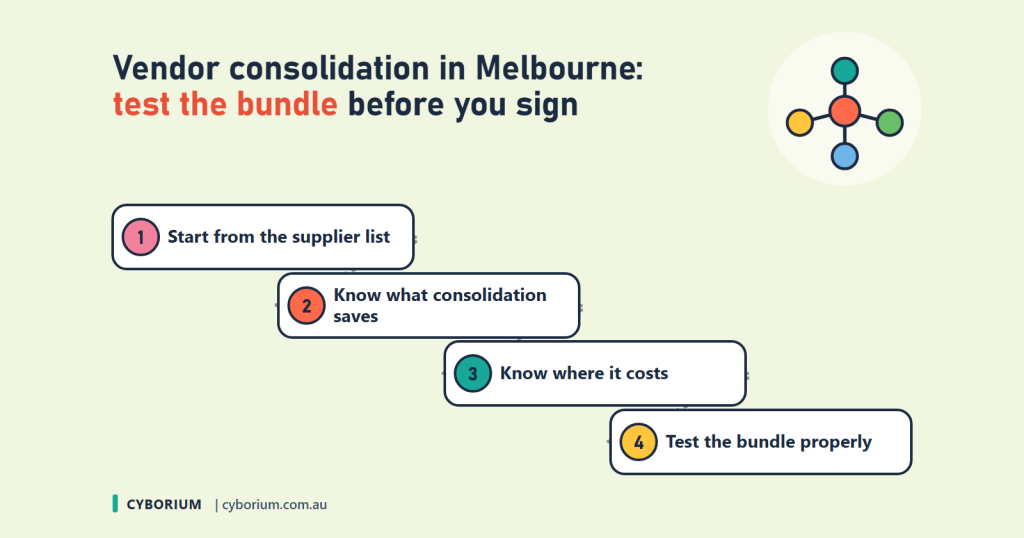
Start from the supplier list, not the platform pitch
Consolidation usually begins when a large vendor offers to replace several smaller ones at an attractive bundled price. Before testing that offer, build the list it would replace: each supplier, annual cost, renewal date, notice period, what it does and who depends on it.
Two things become visible immediately. Part of the duplication is real and cheap to remove, such as three overlapping SaaS tools bought by different teams. Some of it is not duplication at all, and the bundle covers the function only in name.
What consolidation actually saves
- Licence overlap, where two products do the same job and both are paid for.
- Integration and administration effort, since fewer products means fewer connections and fewer consoles.
- Supplier management time: fewer reviews, fewer assessments, fewer renewals to track.
Those savings are real and can be estimated from the register before any vendor is approached. Estimate them first, so the bundle is judged against a number you calculated rather than one the vendor supplies.
What it costs, and where it is easy to miss
- Concentration risk. When one provider carries several critical functions, an outage or a security incident at that provider affects all of them. APRA-regulated entities are expected to understand these dependencies under CPS 230, and the logic applies to everyone else too.
- Weaker position at renewal. Once alternatives are removed, the next negotiation happens without a credible option to leave.
- Weaker components. Platform bundles are rarely best in every module. A weak component in a bundle still has to do a job someone depends on.
- Migration effort, which usually lands on internal teams and is rarely priced in the business case.
Test the bundle properly
Price each component of the bundle separately as well as together, and ask which would win its own evaluation. Give the incumbent suppliers the same opportunity to respond to the same requirements, because their renewal pricing often changes once a credible alternative exists.
Then settle exit terms before signing: data return in a usable format, transition assistance, and the right to remove a component at renewal without repricing the rest. Those clauses are what keep a consolidated estate from becoming a permanent one.
Why local context matters
Melbourne organisations buying technology work under the same Australian obligations as everyone else: Privacy Act duties for personal information, the Notifiable Data Breaches scheme, CPS 230 and CPS 234 for regulated entities, and SOCI obligations for critical infrastructure. Those requirements should appear in the approach to market, not in a legal review after a preferred vendor is chosen. Local presence matters mostly for support hours, data location and the availability of people who can attend a site when something fails.
How CYBORIUM helps
CYBORIUM can build the supplier register, calculate the duplication that can actually be removed, run the market approach so incumbents and alternatives answer the same questions, and support negotiation. The organisation keeps the decision and contracts directly with the provider it selects. Related reading: software licence renewals and vendor and supplier risk management.
Updated 16 September 2026. This article is general information about procurement practice. It does not provide legal or regulatory advice.
Standards and further reading
Local market conditions change who you can buy from. They do not change what a defensible process has to produce.
- Gartner forecast for Australian IT spending. Sets the scale of the market a Melbourne decision owner is negotiating inside, and which categories are absorbing the growth.
- Commonwealth Procurement Rules. Value for money is the core rule, and it requires a comparison rather than a preference. Private decision owners borrow this test because it survives scrutiny.
- ANAO procurement and contract management insights. Audit findings on where procurement processes fail in practice, which is more useful than a list of what should happen.
Related from CYBORIUM
- Procurement as a Service
- Strategic Sourcing
- Australian Technology Procurement Trends: What Has Changed for Enterprise Decision owners
- Top 5 Vendor Management Challenges Facing Sydney Enterprises, And How to Solve Them in 2026
- Procurement Guidelines in Australia: Commonwealth Rules and Enterprise Technology Practice
- Technology Procurement Consultants in Sydney
Related: Learn how CYBORIUM delivers procurement as a service across Australia, at no fee to the buying organisation.
How do you test a vendor bundle before signing?
Price each component on its own, then compare the total with the bundle. If the discount disappears once each part is priced, the bundle is a convenience, not a saving.
When is consolidating vendors a bad idea?
When it creates a single point of failure or removes the competition that kept prices honest. Check exit terms and what happens if the provider fails.
Planning this in the next year? Contact CYBORIUM or request a free market briefing.
Last updated: