Vendor management gets harder with every supplier added, and Sydney organisations tend to carry a lot of them: a managed service provider, several security vendors, cloud platforms, SaaS applications bought by individual teams, and the contractors who connect them. The problems below are the ones that show up most often in a review, and each has a practical fix that does not require new software.
CYBORIUM helps Australian organisations run vendor selection and vendor reviews through a structured vendor-neutral process. The selected provider pays CYBORIUM a capped fee. The client contracts directly with that provider, and CYBORIUM does not sell, deliver, operate or invoice the technology.
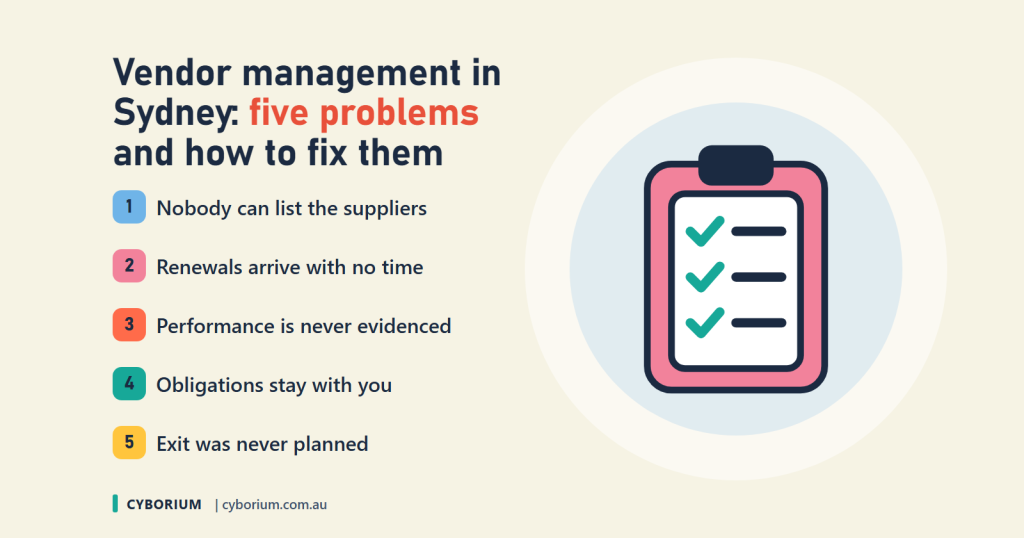
1. Nobody can list the suppliers or what they cost
Contracts sit with different teams, renewals arrive by email to whoever signed last time, and there is no single view of spend or expiry dates.
The fix is a supplier register recording the contract owner, annual value, renewal date, notice period and what each supplier can access. Start with the twenty largest by spend and every supplier that touches customer data. A register of this kind is also what APRA CPS 230 expects of regulated entities for material service providers, and it is the input to every other fix here.
2. Renewals arrive with no time to act
An auto-renewal clause passes, the notice window closes, and the only option left is to accept the increase. Bargaining power exists only while there is time to run an alternative.
Work back from each renewal date: twelve months out for a major platform, six for a mid-sized service. Our guide to software licence renewals sets out that runway in detail.
3. Performance is discussed but never evidenced
Service reviews rely on the provider’s own slides. Nobody compares those numbers with the contract, and service credits are rarely claimed.
Agree the measures that matter before the next review, require the raw data behind them, and record where the service missed. That record is what makes a renewal negotiation or an exit defensible.
4. Security and privacy obligations stay with you
A supplier failure becomes your incident and your notification. Under the Notifiable Data Breaches scheme the assessment obligation stays with the organisation holding the personal information, and APRA-regulated entities must notify APRA within 72 hours of becoming aware of a material information security incident.
Require prompt notification, evidence access and subcontractor disclosure in the contract, and check what security assurance the supplier holds and what its scope actually covers. The vendor and supplier risk management guide covers tiering suppliers by risk so this effort lands where it matters.
5. Exit was never planned, so lock-in decides the next contract
Data in proprietary formats, agents deployed everywhere and no migration plan mean the incumbent knows you cannot leave. That knowledge shapes every price increase.
Negotiate exit assistance, data return in a usable format and transition support at the start, while more than one provider is still in contention. Test the export once during the term rather than discovering the gaps at the end.
Where an independent party helps
These fixes are process, not product. The parts organisations most often hand out are the ones that need market context or time they do not have: benchmarking a renewal against real alternatives, running a comparable evaluation when replacing a supplier, and preparing the evidence a board or regulator will ask for.
CYBORIUM can build the register, run the market approach, evaluate providers against the same criteria and support negotiation. The organisation keeps the decision and contracts directly with the provider it selects.
Updated 16 September 2026. This article is general information about vendor management practice. It does not provide legal or regulatory advice.
Standards and further reading
Vendor management problems in a concentrated market are usually contract problems that surfaced late.
- APRA CPS 230. Operational risk and material service provider obligations that bind many Sydney enterprises directly, and their suppliers indirectly.
- ASD Annual Cyber Threat Report. The incident picture your third parties are operating in, useful for judging whether a vendor risk rating reflects reality.
- ANAO procurement and contract management insights. Recurring contract management failures, most of which begin with obligations that were never written down.
Related guidance: technology procurement consultants in Sydney, at no cost to your organisation.
Related from CYBORIUM
Also relevant: the Sydney Executive Circle.
What is the first vendor management problem to fix?
Usually the renewal calendar. Without a single list of contracts, end dates and owners, notice periods pass and auto-renewals roll over before anyone compares the market.
Who should own vendor management in a mid-sized organisation?
One named person who holds the contract list, the renewal calendar and the review schedule. Without a single owner the calendar slips.
Want a second opinion before you commit? Contact CYBORIUM or request a free market briefing.
Last updated: