Procurement as a service contract guide. Last reviewed:
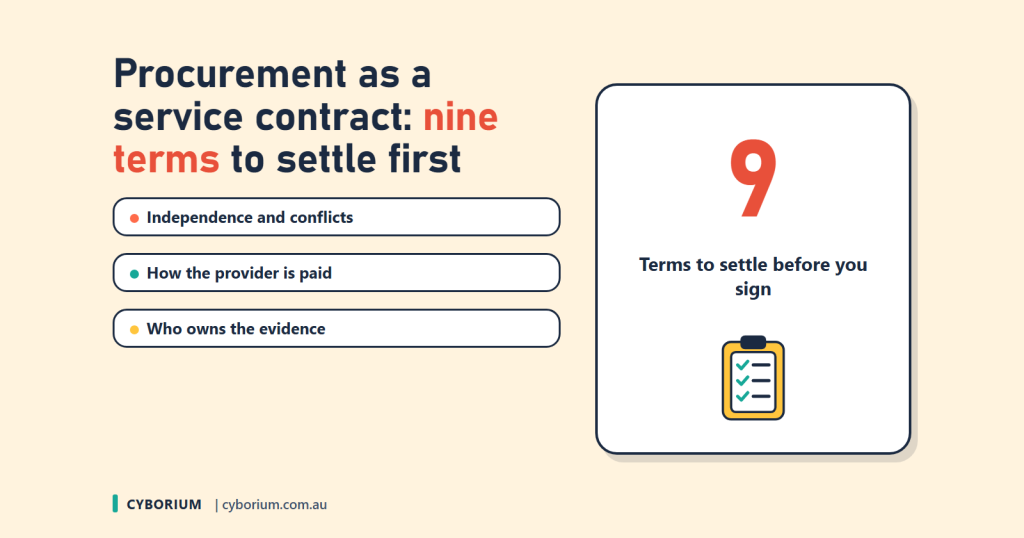
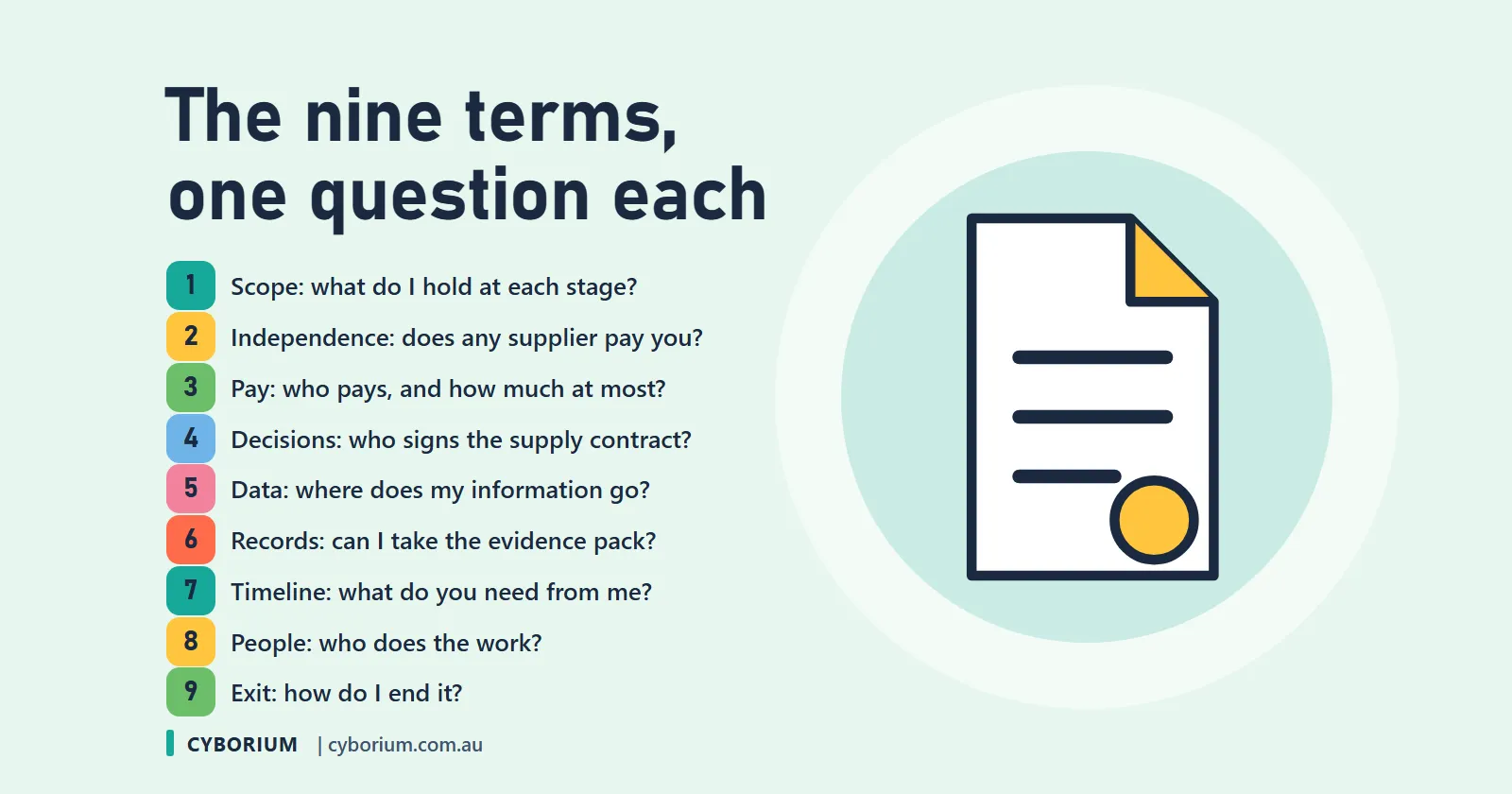
A procurement as a service contract decides who does the work, who the provider answers to and who profits from your decision. Most organisations read the rate card and skip the rest. The terms that matter sit elsewhere: scope, independence, how the provider is paid, who owns the evaluation record, and what happens when you want out. This guide lists the nine terms to settle before you sign, with the question to ask for each.
What should a procurement as a service contract cover?
Procurement as a service means a provider runs part of your sourcing work on demand: defining requirements, scanning the market, evaluating providers and supporting negotiation. The contract has to say which of those you are buying, what you receive at the end of each, and how the provider stays independent of the suppliers it compares. Our guide to what procurement as a service is covers the model itself. This page covers the paper.
1. Scope and deliverables
List the stages you are buying and the document that closes each one. A stage with no deliverable is an invitation to argue later. For a technology purchase that usually means an approved requirements set, a longlist and shortlist with the reasons, a scored evaluation, and a recommendation with the commercial comparison. Say what is out of scope too, such as implementation, legal drafting or running the final contract.
Ask: what do I hold in my hands at the end of each stage, and in what format?
2. Independence and conflicts of interest
Independence is the main thing you are paying for, so it needs a clause. Require the provider to disclose any commercial relationship with a supplier it may put on a shortlist: resale margins, referral payments, partner programs, shared ownership or paid placement. Require a declaration before each engagement and a duty to update it. The Australian National Audit Office makes the same point for government procurement: a declaration is the start, and the conflict then has to be managed actively. Our guide to testing for conflicts of interest in vendor selection has the questions.
Ask: does any supplier on this shortlist pay you, in any form, and will you tell me in writing?
3. How the provider is paid
The payment model shapes behaviour, so the contract should state it plainly. There are four common shapes, and each has a different thing to check.
| Model | Who pays the provider | What to check |
|---|---|---|
| Fixed project fee | You | What the fee covers and what triggers a variation. |
| Retainer or day rate | You | A cap on hours, and a deliverable for each block of time. |
| Success-based fee from the selected provider | The supplier you choose | That the fee is capped, that it is disclosed to you, and that suppliers who are not selected pay nothing. |
| Hybrid | Both | That you are not paying twice for the same work. |
None of these is wrong. A success-based fee paid by the supplier can work well when it is capped and disclosed. It becomes a problem when the rate is hidden or when the provider is paid more for recommending a more expensive option. Our guide to how procurement consultants actually get paid goes through each model.
Ask: who pays you, how much can that be at most, and will you disclose the rate to me?
4. Decision rights
The provider recommends and you decide. Write that down. Also write down that the supply contract is between you and the selected supplier, not the provider. This keeps the provider out of the delivery relationship and keeps your negotiating position clear.
Ask: will the provider sign the supply contract or take any part in delivery?
5. Confidentiality and supplier data
You will share requirements, architecture notes and budgets. Suppliers will share pricing. Cover both directions: the provider must not use your information for another client, must not pass one supplier’s pricing to another, and must tell you where data is stored. If the provider uses AI tools in its work, ask whether your material is entered into them and under what terms.
Ask: where does my information go, and who can see supplier pricing?
6. Records and ownership of the evaluation
The scoring sheets, evidence and comparison are the defensible part of the decision. They should be yours. Ask for the full evaluation record at handover, in a format you can open without the provider. That record is what your board, auditor or regulator will ask for later.
Ask: can I take the full evidence pack with me if we part ways?
7. Timeline and service levels
Agree milestones, response times and what you must supply to keep the work moving. Delay usually comes from missing inputs on your side, so a clause that names them protects both parties.
8. Liability, insurance and subcontracting
Ask who does the work and whether named people stay on the engagement. Require notice before the provider subcontracts any part of it. Check professional indemnity cover is in place and in proportion to the value of the purchase being advised on. If a subcontractor is used, the provider should stay responsible for their work.
9. Term, change and exit
You should be able to end the engagement without penalty between stages, with a defined handover. Avoid minimum terms and auto-renewal for a service you buy per project. Our guide to pricing exit before you sign applies to the advisory contract as much as to the technology you are buying.
What changes if your organisation is APRA-regulated?
APRA-regulated entities should check whether the provider counts as a material service provider under CPS 230. The standard requires due diligence before entering the arrangement and a formal agreement covering service levels, audit access, subcontracting notice, liability and termination. A provider that advises on sourcing but does not run a critical operation will often fall outside the material test, but that is a judgement to record, not assume. See our CPS 230 due diligence guide.
What are the red flags in a procurement as a service proposal?
- A fee that is not stated, or that depends on which supplier you pick without being disclosed.
- No statement on commercial relationships with suppliers.
- A minimum term for an engagement you are buying per project.
- The provider keeps the evaluation record or charges to release it.
- The provider asks to sign or manage the supply contract.
- A shortlist that appears before your requirements are agreed.
What is CYBORIUM’s role?
CYBORIUM runs procurement as a service for Australian organisations: we prepare requirements, run the evaluation and support negotiation. The selected provider pays CYBORIUM a capped fee at an agreed percentage, providers that are shortlisted but not selected pay nothing, and you contract directly with the provider. The decision is always yours. See procurement as a service for how an engagement runs.
Procurement as a service contract terms in short
A good procurement as a service contract settles nine things: scope, independence, how the provider is paid, decision rights, confidentiality, ownership of the evaluation record, timeline, liability and subcontracting, and exit. Ask the question for each, get the answer in writing, and walk away from any provider that will not give it.
Want these terms checked on a live engagement? Get the Procurement Readiness Brief or tell us about your project. The client pays CYBORIUM nothing and chooses the provider.
Frequently asked questions
What should a procurement as a service contract include?
Scope with a deliverable for each stage, a conflict-of-interest declaration, how the provider is paid and the most it can be, decision rights, confidentiality, ownership of the evaluation record, a timeline, liability and subcontracting terms, and an exit with handover.
Should the provider be paid by me or by the supplier?
Either can work. What matters is that the arrangement is stated, capped and disclosed. If the supplier pays, ask whether suppliers who are not selected pay anything and whether the rate is shown to you.
Who owns the evaluation work?
You should. Ask for the scoring sheets, evidence and comparison at handover, in a format you can use without the provider.
Do I need a minimum term?
Not for a service bought per project. Prefer stage-based work that you can stop between stages with a defined handover.
Does CPS 230 apply to a procurement provider?
It applies to APRA-regulated entities. Whether the provider is a material service provider depends on whether you rely on it for a critical operation or whether it exposes you to material operational risk. Record the judgement either way.
Related guidance: what zero-fee procurement means and who pays, how to compare independent IT procurement advisers, how to engage an independent procurement service.
Sources
- Australian National Audit Office, management of conflicts of interest in procurement activity and grants programs: audit insights on declaring and actively managing conflicts.
- APRA, Prudential Standard CPS 230 Operational Risk Management: service provider due diligence and agreement requirements for regulated entities.
- Department of Finance, Commonwealth Procurement Rules: value for money, probity and ethical conduct principles that private organisations often borrow.