Outsourcing procurement risks guide. Last reviewed:
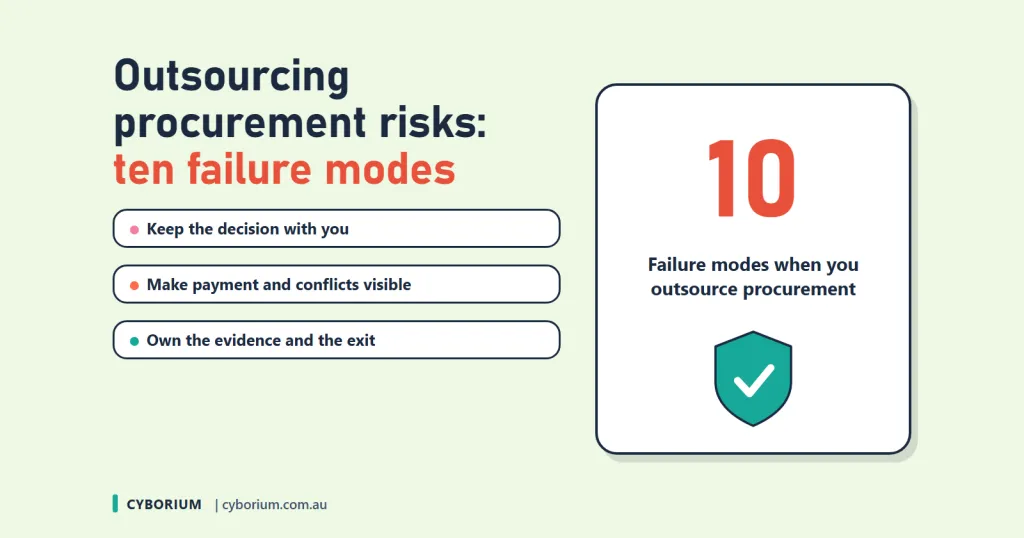
The main outsourcing procurement risks are not about cost. They are about what you lose when someone else runs your sourcing: knowledge, control of conflicts, ownership of evidence and a clean way out. This guide lists ten failure modes, the control that prevents each, and what to check if your organisation is regulated. It assumes you have already decided to outsource, or are close to it. If you have not, start with in-house versus outsourced procurement.
What are the main outsourcing procurement risks?
Outsourcing procurement moves work, and with it some risk, to a provider. The risks below come up repeatedly when organisations hand over sourcing for technology. Each has a control you can write into the contract or the way you run the engagement.
| Risk | What goes wrong | Control |
|---|---|---|
| 1. Lost knowledge | Your team stops understanding why suppliers were chosen. | Keep an internal owner for every decision and require a written rationale. |
| 2. Hidden conflicts | The provider earns from suppliers it recommends. | Require written disclosure of every supplier relationship, updated per engagement. |
| 3. Blurred decision rights | The provider drifts from advising to deciding. | State that you decide and that you sign the supply contract. |
| 4. Evidence you cannot take | The provider holds the scoring and records. | Make the evaluation record yours, handed over in an open format. |
| 5. Exposed supplier data | Your requirements and supplier pricing leak or are reused. | Set confidentiality, storage location and AI tool terms in writing. |
| 6. Unmanaged third-party risk | A regulated entity treats the provider as an ordinary vendor. | Assess it against CPS 230 and record the material service provider decision. |
| 7. Silent subcontracting | Work moves to a party you never assessed. | Require notice and keep the provider responsible for subcontractors. |
| 8. Uneven quality | Senior staff pitch, junior staff deliver. | Name the people and require notice of change. |
| 9. Misaligned incentives | The provider gains when you spend more. | Cap any success fee and disclose the rate. |
| 10. No way out | Exit is slow, costly or blocked by missing records. | Agree handover, term and exit before you sign. |
How do you keep control when you outsource?
Keep three things in house: the requirements, the decision and the contract with the supplier. Requirements are your business problem in writing, and nobody else can own them. The decision is yours because you carry the consequences. The supply contract should name you and the selected supplier, with the provider outside the delivery relationship. Everything else can be outsourced with controls.
How do you manage conflicts of interest in an outsourced arrangement?
Ask early and in writing. Which suppliers does the provider resell, partner with or take payment from? Do those suppliers appear on your shortlist? The Australian National Audit Office’s work on procurement conflicts stresses an active approach: declarations are the start, and management follows. For an outsourced provider that means a declaration for each engagement, a record of what was disclosed, and a right to end the work if a conflict appears. Our guide to testing for conflicts of interest has the questions.
What does a security-minded outsourcing arrangement need?
An outsourced procurement provider sees your architecture, your gaps and your budgets. Treat that as sensitive. The Australian Government’s Information Security Manual guidelines for procurement and outsourcing frame this as cyber supply chain risk management: consider security when you choose suppliers, prefer those that show commitment to security and transparency, and assess the integrity of what you buy. Apply the same thinking to the provider that runs your sourcing. Ask how it stores your material, who can access it and whether AI tools are used on it. Our guide to information security in procurement sets requirements by stage.
What if you are an APRA-regulated entity?
CPS 230 applies to APRA-regulated entities and sets out how to manage service providers. Entities maintain a register of material service providers, carry out due diligence including an appropriate selection process, and use formal agreements covering service levels, audit access, subcontracting notice, liability and termination. Whether an outsourced procurement provider is material depends on whether you rely on it for a critical operation or whether it exposes you to material operational risk. A provider that advises on sourcing may not meet that test, but one that runs the function end to end more plausibly could. Record your reasoning. See our CPS 230 due diligence guide.
How do you test the arrangement before you rely on it?
- Start with one purchase rather than the whole function, and review the evidence pack against your own standard.
- Check the record. Could a new person understand the decision from the pack alone?
- Test the exit. Ask for a handover plan in the first month, not the last.
- Review each stage. Keep the right to pause between stages.
What is CYBORIUM’s role?
CYBORIUM runs defined sourcing engagements for Australian organisations buying cybersecurity, AI and enterprise IT. We prepare requirements, run the evaluation and support negotiation. The selected provider pays CYBORIUM a capped fee at an agreed percentage, providers that are shortlisted but not selected pay nothing, and you contract directly with the provider. The decision is always yours. See outsourcing IT procurement for how to choose a model.
Outsourcing procurement risks in short
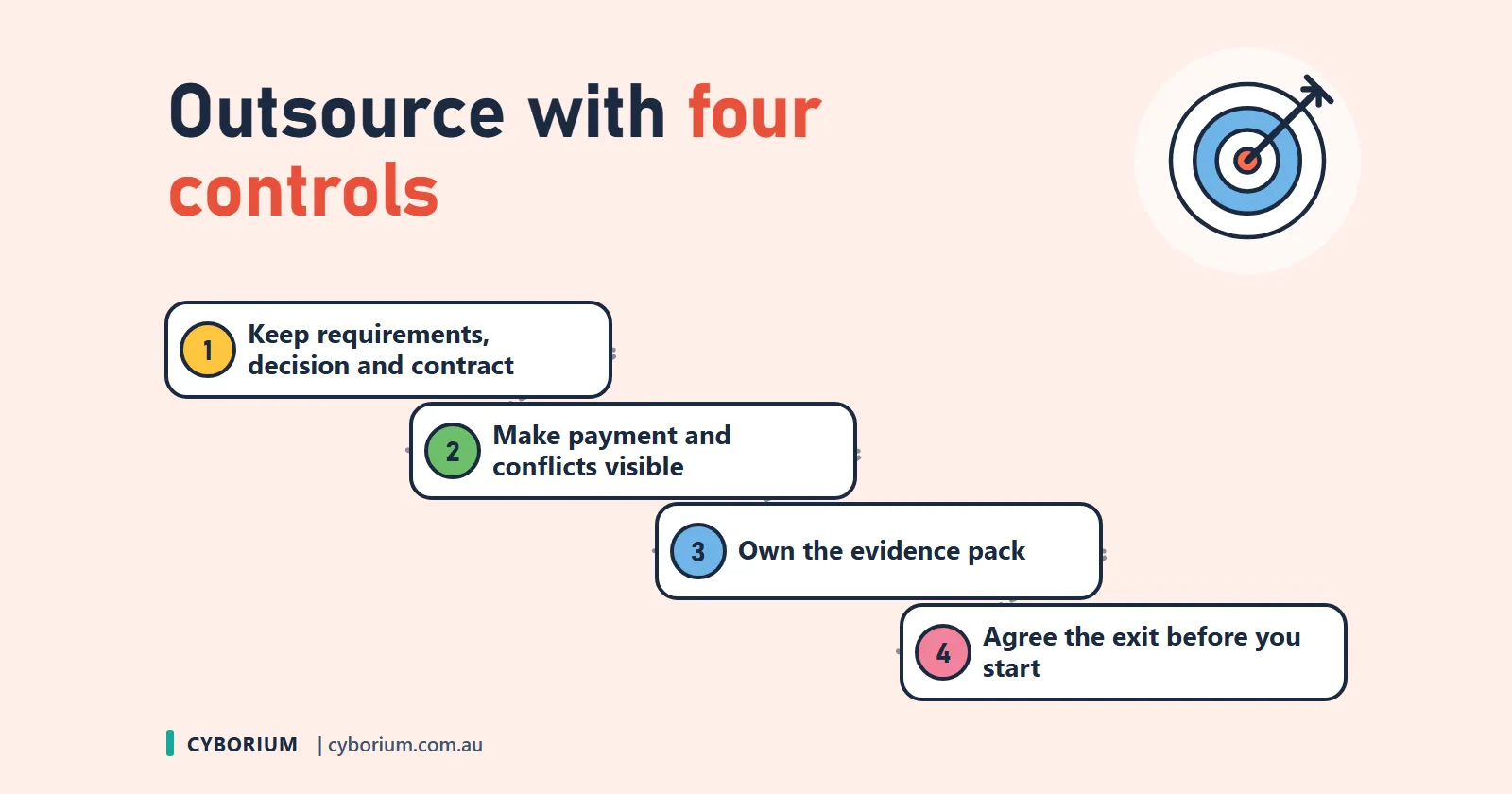
The ten outsourcing procurement risks come down to four habits: keep the requirements, the decision and the supply contract with you, make conflicts and payment visible, own the evidence, and agree the exit before you start. Pilot on one purchase, then widen.
Want the risks checked on a live decision? Get the Procurement Readiness Brief or tell us about your project. The client pays CYBORIUM nothing and chooses the provider.
Frequently asked questions
What are the risks of outsourcing procurement?
Lost internal knowledge, undisclosed conflicts of interest, blurred decision rights, evidence you cannot take with you, exposed supplier data, unmanaged third-party risk, silent subcontracting, uneven quality, misaligned incentives and no clean exit.
Can I outsource procurement and keep the decision?
Yes. Keep the requirements, the decision and the supply contract with you, and let the provider advise, evaluate and support negotiation.
Is an outsourced procurement provider a material service provider under CPS 230?
Not automatically. It depends on whether you rely on the provider for a critical operation or whether it exposes you to material operational risk. Record the judgement either way.
How do I check a provider is independent?
Ask for written disclosure of any relationship with suppliers it may recommend, including resale, referral and partner payments, and ask who pays the provider and the most that can be.
What should I do first?
Pilot the arrangement on one purchase, review the evidence pack and agree a handover plan early, before you widen the scope.
Related guidance: procurement as a service contract terms, what third-party risk management is, exit and transition-out.
Sources
- APRA, Prudential Standard CPS 230 Operational Risk Management: service provider register, due diligence and agreement requirements.
- Australian Signals Directorate, ISM guidelines for procurement and outsourcing: cyber supply chain risk management in procurement.
- Australian National Audit Office, management of conflicts of interest in procurement activity and grants programs: audit insights on active conflict management.