Types of procurement services guide. Last reviewed:
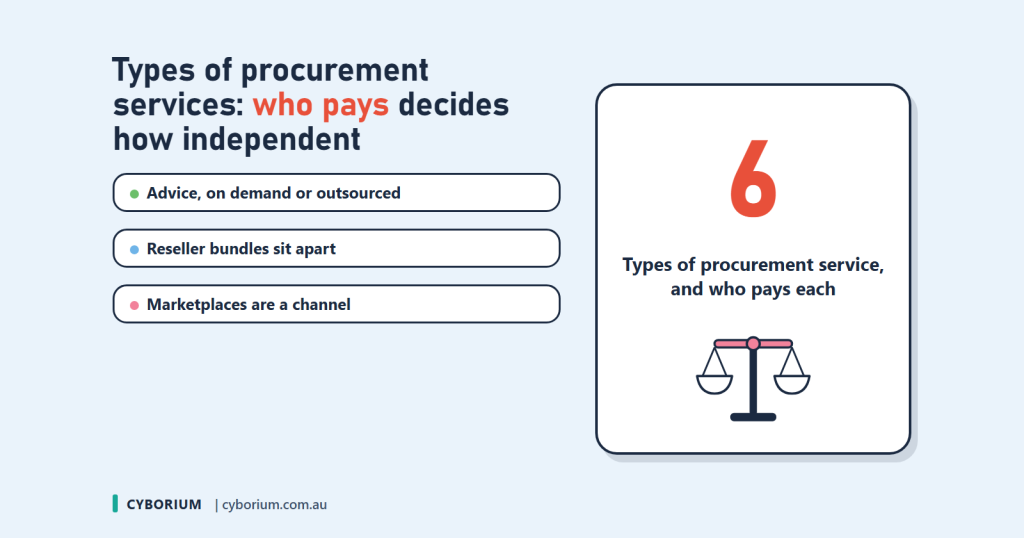
The types of procurement services on offer in Australia look alike on a website and behave very differently once you sign. A consultancy sells advice, an outsourced provider runs the work, a reseller sells a product with buying help attached, and a government marketplace is a different channel again. This guide sets out six types, who pays for each, how independent each can be and when each fits, so you can match the type to the job before you compare names.
What are the main types of procurement services?
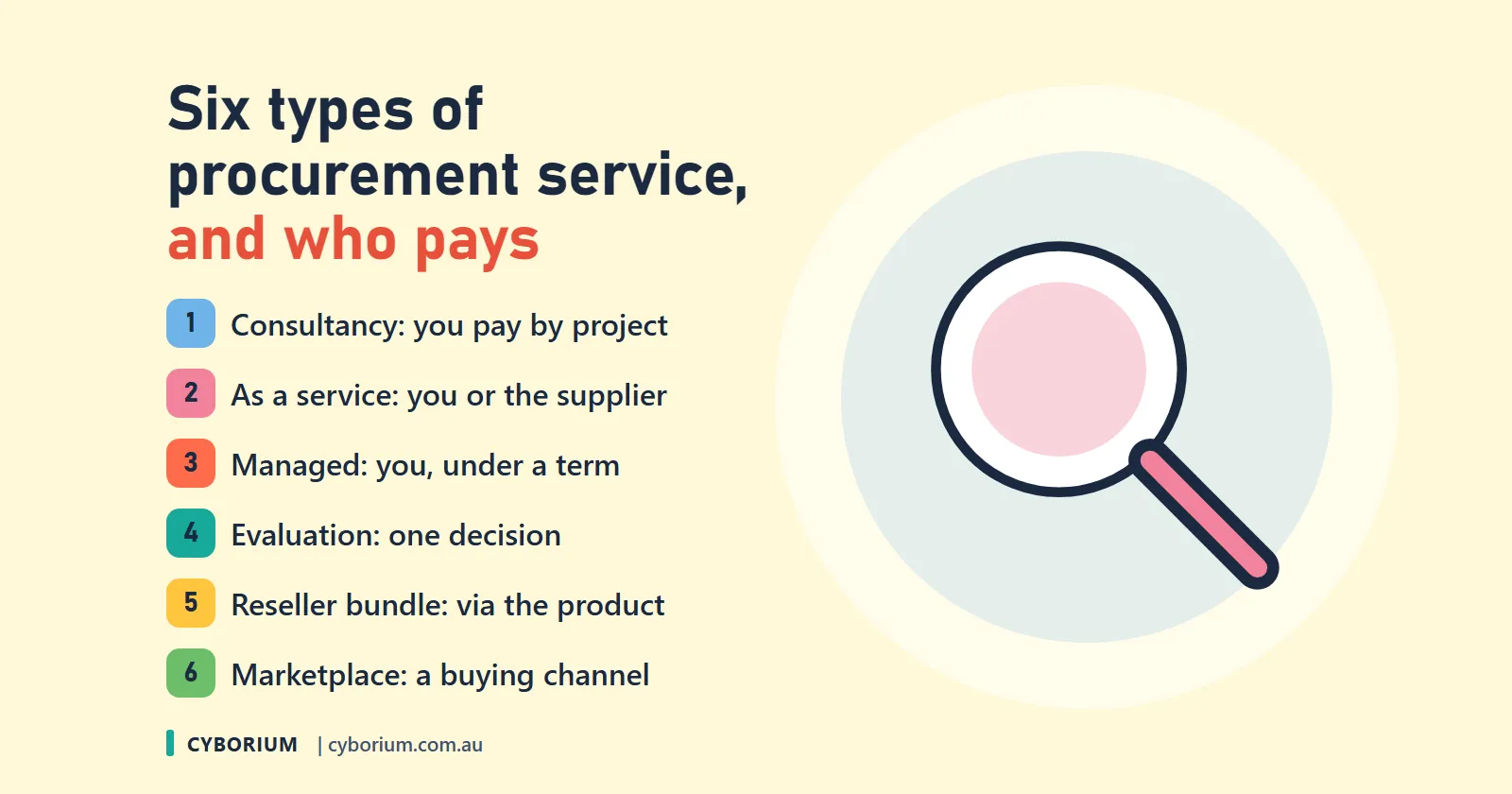
The label “procurement services” covers at least six distinct offers. The table sets them side by side. Read the “who pays” and “independence” columns first, because they predict how the provider behaves when two options are close.
| Type | What you get | Who pays | Independence | Fits when |
|---|---|---|---|---|
| Strategy and category consultancy | Analysis, a sourcing strategy, sometimes a market view | You, by project | High, if it sells no products | You need a plan and will run the buying yourself. |
| Procurement as a service | A sourcing function on demand: requirements, market scan, evaluation, negotiation support | You, or the selected supplier, depending on the model | High when payment is disclosed and capped | You buy technology in bursts and lack a standing team. |
| Managed or outsourced procurement | A provider runs your procurement function end to end | You, usually under a multi-year agreement | Medium to high | You want to hand over the whole function. |
| Independent evaluation advisory | A scored comparison of providers for one decision | You, or the selected supplier | High if conflicts are disclosed | One large decision needs an evidence pack. |
| Reseller or managed service bundle | Buying help bundled with the product it sells | You, through the product price | Low, by design | You have already chosen the product. |
| Government panels and marketplaces | A pre-approved supplier list and buying channel | Suppliers, through panel terms | Not an advisory service | You are a government agency with a set process. |
How do the types differ in practice?
Strategy and category consultancy. This is advice. It suits an organisation that wants a sourcing strategy or category plan and has people to carry it out. The work often ends at a report, so check who runs the market approach afterwards.
Procurement as a service. The provider does the sourcing work for a specific purchase and then steps back. It fits technology purchases that arrive in bursts. The questions that matter are how the provider is paid and who owns the evaluation record. Our guide to procurement as a service contract terms covers both, and our page on procurement as a service explains how an engagement runs.
Managed or outsourced procurement. Here a provider takes over the function itself, often for several years. It can lower internal headcount, and it also creates dependence and a third-party risk to govern. The risks and the controls for each are in our guide to outsourcing procurement risks, and the decision itself is covered in in-house versus outsourced procurement.
Independent evaluation advisory. A narrow service for one decision: scoring providers against agreed requirements and producing a recommendation. It is the shortest route to a defensible answer when the question is “which one?”. See how independent IT vendor evaluation works.
Reseller or managed service bundle. A reseller helps you buy, and earns from what you buy. That is useful once you have chosen, and a poor basis for choosing. Our guide to a vendor-neutral advisor versus a reseller sets out the difference.
Government panels and marketplaces. For government agencies, a panel or marketplace such as the Digital Transformation Agency’s BuyICT is a buying channel with its own rules. It tells you who may sell to government. It does not evaluate which supplier fits your requirements.
How do you choose between them?
- Decide what you are short of. A plan, people, an evidence pack or a product. The answer points to a type.
- Check whether the decision is made. If the product is already chosen, a reseller or bundle is fine. If not, you need someone with no product to sell.
- Ask who pays the provider and whether the arrangement is capped and disclosed. This is the most reliable test of independence.
- Match the term to the need. A single purchase suits a project or on-demand service. A standing function suits a longer agreement, with exit terms agreed up front.
- Check regulation. If you are APRA-regulated, CPS 230 may make a provider that runs a critical function a material service provider with specific contract terms.
Which questions expose the differences?
- Do you sell, resell or earn from any product you might recommend?
- Who pays you, and how much can that be at most?
- Who owns the evaluation record at the end?
- Who does the work, and will the same people stay on it?
- How do I end the arrangement, and what do I get on the way out?
What is CYBORIUM’s role?
CYBORIUM provides procurement as a service and independent evaluation for Australian organisations buying cybersecurity, AI and enterprise IT. We do not sell or resell technology. The selected provider pays CYBORIUM a capped fee at an agreed percentage, providers that are shortlisted but not selected pay nothing, and you contract directly with the provider. The decision is always yours. For the full range, see technology procurement services in Australia.
Types of procurement services in short
Match the type to the gap. Choose advice when you need a plan, an on-demand service when you need the sourcing work done for one purchase, a managed service when you want to hand over the function, and a reseller only once the product is chosen. Whatever the type, ask who pays and what you own at the end.
Not sure which type fits? Get the Procurement Readiness Brief or tell us about your project. The client pays CYBORIUM nothing and chooses the provider.
Frequently asked questions
What are the types of procurement services?
The common types are strategy and category consultancy, procurement as a service, managed or outsourced procurement, independent evaluation advisory, reseller or managed service bundles, and government panels and marketplaces.
What is the difference between procurement as a service and outsourced procurement?
Procurement as a service handles specific purchases on demand and then steps back. Outsourced procurement hands the whole function to a provider, usually under a longer agreement.
Which type of procurement service is the most independent?
Independence depends less on the label than on who pays the provider and whether it sells or resells any product. Consultancies and evaluation advisers that sell nothing and disclose payment are the most independent.
Do I need a procurement service for a single technology purchase?
Often not for a small, low-risk purchase. For a large or regulated one, an independent evaluation or on-demand service gives you a defensible record without hiring a standing team.
Is a government marketplace a procurement service?
It is a buying channel. It lists approved suppliers and sets terms, but it does not compare them against your requirements.
Related guidance: procurement as a service versus staff augmentation, how procurement consultants actually get paid, how to compare independent IT procurement advisers.
Sources
- Digital Transformation Agency, BuyICT: the Australian Government’s ICT procurement marketplace.
- Department of Finance, Commonwealth Procurement Rules: the rules and principles government agencies follow.
- APRA, Prudential Standard CPS 230 Operational Risk Management: service provider requirements for regulated entities.